

Unpacking Network Cable Tester Technologies: A Technical Deep Dive
Core Network Cable Testing Functionalities
At the heart of any network cable tester are its fundamental diagnostic capabilities, crucial for establishing and maintaining robust network infrastructure. These functions provide the initial layer of insight into cable health and connectivity.
Continuity and Wiremap Testing
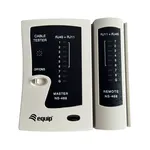
Continuity testing is the most basic function, verifying that a continuous electrical path exists from one end of a cable to the other. It detects opens (broken wires) and shorts (wires touching each other or ground). More advanced, wiremap testing provides a visual representation of how each individual wire pair is connected across the cable run. This allows technicians to identify common wiring faults such as crossed pairs (where send and receive pairs are swapped), reversed pairs (wires within a pair are swapped), split pairs (wires from different pairs are inadvertently connected as a single pair), and miswires. Proper wiremapping is critical for Gigabit Ethernet and faster networks, as incorrect pairing can lead to significant signal degradation and performance issues, even if basic continuity appears present. Testers often display these faults graphically, indicating which specific conductors are affected.
Cable Length Measurement and Time Domain Reflectometry (TDR)
Accurate cable length measurement is vital for ensuring compliance with cabling standards (e.g., Ethernet's 100-meter segment limit for twisted-pair copper) and for efficient cable management. Modern network cable testers achieve this primarily through Time Domain Reflectometry (TDR). TDR works by sending a signal down the cable and measuring the time it takes for reflections to return. These reflections occur at impedance changes, such as opens, shorts, or splices. By knowing the signal's propagation velocity (Velocity of Propagation, or NVP, which is cable-type dependent), the tester can precisely calculate the distance to the fault. This capability is invaluable for pinpointing the exact location of a break or short within a wall, conduit, or ceiling, drastically reducing troubleshooting time and material waste during repairs.
Power over Ethernet (PoE) Verification
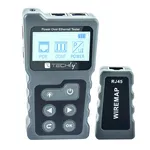
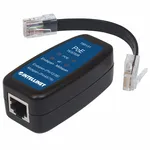
With the widespread adoption of PoE devices (IP cameras, VoIP phones, wireless access points), verifying PoE capability is a critical function for many network cable testers. A PoE-enabled tester can identify if power is present on the cable, what type of Power Sourcing Equipment (PSE) is detected (e.g., 802.3af, 802.3at/PoE+, 802.3bt/PoE++), and often measure the voltage and even the available power. Some advanced testers can also determine the PoE class of the connected device. This ensures that a connected powered device (PD) will receive adequate power, helping to diagnose issues where a device fails to power on due to insufficient PoE provision or incorrect wiring configuration.
Advanced Diagnostic Capabilities
Beyond the core functions, high-end network cable testers offer advanced features that streamline troubleshooting and enhance network deployment.
Link Speed and Network Connectivity Testing
Advanced testers can connect to an active network and provide insights into network connectivity. This includes identifying the advertised link speed (e.g., 10/100/1000 Mbps) and duplex status (half/full-duplex) of the switch port to which the cable is connected. Some can even ping network devices to verify basic IP connectivity, detect DHCP server presence, and identify VLAN IDs. This capability is extremely useful for verifying end-to-end connectivity and diagnosing issues related to speed negotiation mismatches or basic network layer problems, distinguishing between a cable fault and a network configuration error.
Tone Generation and Port Identification
For cable tracing in congested wiring closets or identifying specific ports on a switch, a tone generator is indispensable. The tester injects an audible tone onto a selected wire pair, which can then be picked up by an inductive probe. This allows technicians to quickly and accurately locate a specific cable amongst a bundle or identify which port on a patch panel or switch corresponds to a wall jack. Many testers also feature a "port blink" function, which causes the link light on the connected switch port to flash, providing another visual cue for identification without requiring an external tone probe.
Reporting and Documentation
Professional network installations often require detailed documentation of cabling tests. Many sophisticated cable testers include internal memory to store test results and software to generate comprehensive reports. These reports typically include wiremap diagrams, length measurements, fault locations, PoE status, and even certification against industry standards. The ability to export data to a PC for analysis, archiving, and client presentation adds significant value, ensuring compliance, facilitating future troubleshooting, and demonstrating the quality of the installation. This feature is particularly valuable for larger projects where accountability and historical data are paramount.