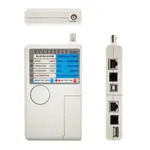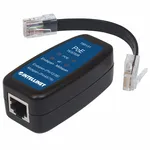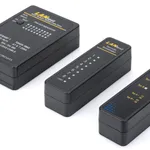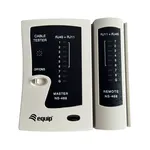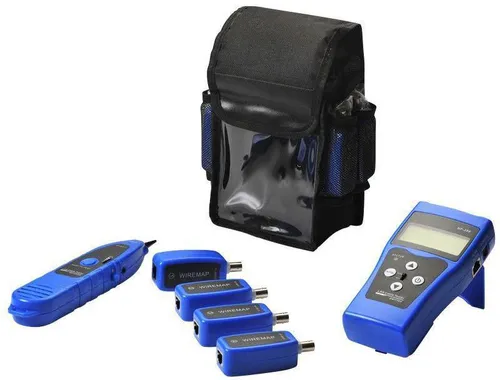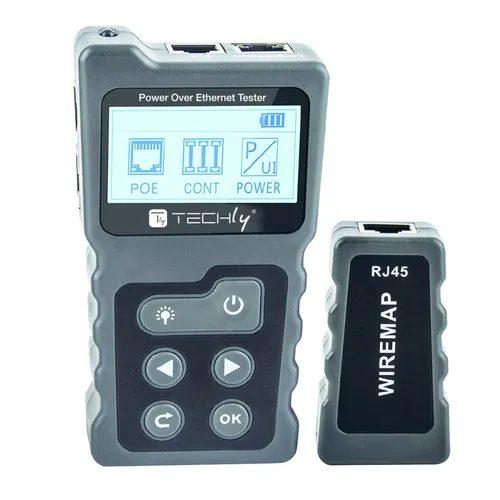


Techly I-CT PRO-POECK Network Cable Tester
Specifications
Features
Features
| Product type |
PoE tester
|
|---|---|
| Test type |
PoE testing
|
| Maximum cable length |
300
m
24% better than others
|
| Supported connectors |
RJ-45
|
| Built-in display |
Yes
63% have it
|
| Display type |
LCD
|
| Backlight display |
Yes
79% have it
|
| Display size (HxV) |
128 x 64 mm
|
| Product colour |
Black, Grey
|
| RJ-45 ports quantity |
4
|
| Cable type |
Cat5, Cat6, UTP, STP
|
| Networking standards |
IEEE 802.3af, IEEE 802.3at
|
Power
Power
| Battery type |
AAA
|
|---|---|
| Battery technology |
Alkaline
|
| Number of batteries supported |
3
|
| Battery voltage |
1.5
V
15% better than others
|
| DC-in jack |
Yes
76% have it
|
| DC-out jack |
Yes
60% have it
|
| Current test interval |
0 - 3 A
|
| Power test range |
0 - 180 W
|
| Maximum operating current |
80 mA
|
Weight & dimensions
Weight & dimensions
| Width |
125
mm
34% better than others
|
|---|---|
| Depth |
28
mm
35% better than others
|
| Height |
70
mm
94% better than others
|
| Weight |
302
g
75% better than others
|
| Remote control dimensions (W x H x D) |
65 x 37 x 23 mm
|
Packaging content
Packaging content
| Storage pouch |
Yes
79% have it
|
|---|---|
| Manual |
Yes
84% have it
|
| Batteries included |
No
21% do not have it
|
| Remote control included |
Yes
74% have it
|
| Test line crocodile clip cable included |
Yes
89% have it
|
Disclaimer: Information on this page may need review. If you notice any discrepancies, please report them

In the intricate world of network infrastructure, the reliability and integrity of cabling are paramount. The Techly I-CT PRO-POECK emerges as a specialized tool designed to address the critical need for accurate cable testing. This device is positioned within the professional segment, targeting network technicians, IT administrators, and anyone responsible for deploying or maintaining Ethernet networks where performance and stability are non-negotiable. Its purpose is to systematically verify the continuity, order, and potential faults within network cables, providing clear diagnostic feedback to ensure optimal connectivity.
The I-CT PRO-POECK distinguishes itself through its focused functionality, aiming to streamline the often-tedious process of cable verification. By offering a robust set of features tailored for network cabling, it seeks to reduce troubleshooting time and prevent connectivity issues before they impact end-users. Understanding its capabilities requires a closer look at its specifications, which dictate its performance in real-world networking environments. This review will dissect these specifications to evaluate its practical utility and its standing in the competitive landscape of network testing equipment.
Pros & Cons
Pros
What we love about this product
- Comprehensive Pin-to-Pin Testing: Accurately verifies all 8 conductors and shielding for continuity and correct pairing, ensuring no open circuits or shorts.
- Remote Unit Capability: Includes a detachable remote unit that allows for testing installed cabling runs from both ends simultaneously, significantly improving efficiency.
- Clear Visual Feedback: Features an intuitive display that clearly indicates the wire map and any faults, making diagnostics straightforward.
- Durable Build Quality: Designed for professional use, suggesting a robust construction capable of withstanding the rigors of field deployment.
Cons
Points to consider before buying
- Limited Cable Type Support: Primarily focused on standard network cables (e.g., Cat5e, Cat6), may not support specialized or advanced cabling types without adapters.
- Basic Fault Detection: While it identifies shorts and opens, it may not offer advanced diagnostics like cable length measurement or detailed crosstalk analysis found in higher-end testers.
- No PoE Testing: Lacks integrated Power over Ethernet (PoE) testing capabilities, which is a growing requirement in modern network deployments.