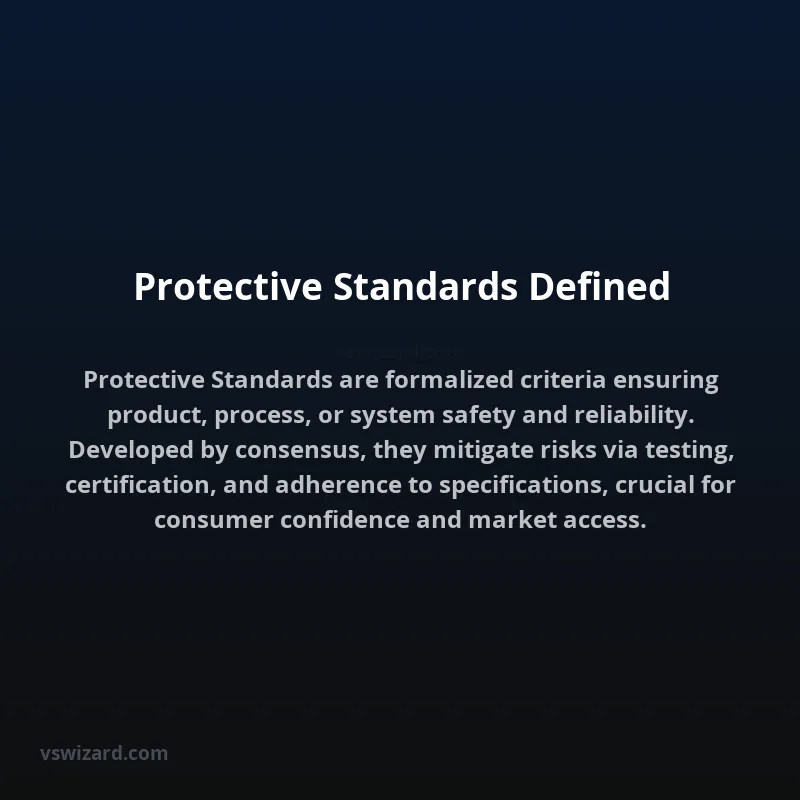
Protective Standards represent a formalized set of criteria, guidelines, and specifications designed to ensure the safety, reliability, and efficacy of products, processes, or systems, particularly in contexts where potential hazards to human health, property, or the environment exist. These standards are typically developed through consensus among stakeholders, including manufacturers, regulatory bodies, industry experts, and end-users, and often form the basis for national and international regulations. Their implementation necessitates rigorous testing, certification, and adherence to prescribed methodologies, aiming to mitigate risks by establishing baseline performance requirements and acceptable operational parameters.
The establishment and enforcement of Protective Standards are crucial for fostering consumer confidence, facilitating market access, and promoting responsible technological development. They often encompass a broad spectrum of considerations, ranging from material properties and design principles to manufacturing tolerances, operational procedures, and end-of-life management. Compliance with these standards can be voluntary or mandatory, depending on the criticality of the application and the regulatory landscape. They serve as a technical language for communicating safety expectations and performance benchmarks across diverse industrial sectors, thereby enabling interoperability and safeguarding against substandard or hazardous implementations.
History and Evolution
The genesis of protective standards can be traced to early industrialization, where rudimentary safety concerns, driven by catastrophic failures and worker injuries, prompted the first attempts at codifying acceptable practices. Early standards were often empirical, derived from accumulated experience rather than deep scientific understanding. The 20th century witnessed a significant formalization and professionalization of standards development, spurred by technological advancements, increased product complexity, and a growing awareness of public health and environmental impacts. Organizations such as the International Organization for Standardization (ISO), the International Electrotechnical Commission (IEC), and national bodies like the American National Standards Institute (ANSI) emerged, providing frameworks for creating globally recognized and harmonized standards. This evolution reflects a shift from reactive safety measures to proactive risk management, integrating scientific principles and advanced engineering analysis into the standards-setting process.
Key Milestones in Standards Development
- Early 20th Century: Formation of national standards bodies and initial codification of industrial safety practices.
- Mid-20th Century: Rise of international standards organizations (ISO, IEC) to facilitate global trade and technological exchange.
- Late 20th Century: Increased focus on environmental protection and consumer safety, leading to new classes of protective standards (e.g., emissions, material safety).
- 21st Century: Integration of digital technologies, cybersecurity, and sustainability principles into protective standards frameworks.
Mechanism of Action and Design Principles
Protective Standards operate by defining specific technical requirements that, when met, are presumed to provide a predefined level of protection. This can involve:
- Material Specifications: Stipulating the chemical composition, physical properties (e.g., tensile strength, flammability rating), and durability requirements of materials used in a product.
- Design Constraints: Imposing limits on dimensions, structural integrity, electrical insulation, or operational ranges to prevent failure modes or hazardous conditions.
- Performance Benchmarks: Setting minimum thresholds for functionality, endurance, resistance to environmental factors (e.g., temperature, humidity, shock), or security robustness.
- Testing Protocols: Detailing standardized methods for evaluating compliance with specified requirements, including sampling procedures, test equipment, and pass/fail criteria.
- Labeling and Documentation: Requiring clear identification of compliance, hazard warnings, and usage instructions to inform users and facilitate proper application.
Industry Standards and Certifications
Protective Standards are codified in a vast array of industry-specific documents. These are often maintained and updated by standards development organizations (SDOs) and professional bodies. Compliance is frequently verified through certification processes conducted by accredited third-party laboratories or inspection bodies. These certifications serve as an objective attestation that a product, process, or system meets the stipulated protective criteria.
Examples of Standards Categories
- Safety Standards: Electrical safety (IEC 60335, UL 94), mechanical safety (ISO 13849), fire safety (NFPA standards).
- Environmental Standards: Emissions control (Euro standards), material restrictions (RoHS, REACH), waste management (ISO 14001).
- Performance Standards: Durability, reliability, operational efficiency (e.g., energy star ratings).
- Cybersecurity Standards: Data protection, network security, system resilience (e.g., ISO 27001, NIST frameworks).
- Health and Hygiene Standards: Food safety (HACCP), medical device safety (ISO 13485).
A comparative overview of key protective standard parameters across different domains illustrates their scope:
| Domain | Key Standard Example | Primary Focus | Typical Metric |
|---|---|---|---|
| Electrical Appliances | IEC 60335 | Electrical, thermal, mechanical hazards | Ingress Protection (IP) rating, Dielectric strength (kV) |
| Material Flammability | UL 94 | Burning behavior of plastics | V-0, V-1, V-2 rating (Vertical burn tests) |
| Environmental Management | ISO 14001 | Environmental performance and impact | Compliance with regulations, pollution prevention |
| Food Safety | HACCP | Identification and control of biological, chemical, and physical hazards | Critical Control Points (CCPs), temperature thresholds (°C) |
| Cybersecurity | ISO 27001 | Information security management system | Risk assessment results, security control implementation |
Applications and Implementation
Protective Standards find application across virtually every industrial sector, from consumer electronics and automotive manufacturing to aerospace, healthcare, and construction. Their implementation involves integrating the standard's requirements into the entire lifecycle of a product or system, including research and development, design, procurement, manufacturing, quality control, deployment, and maintenance. For manufacturers, adherence to standards often simplifies regulatory compliance and enhances marketability. For consumers and end-users, these standards offer assurance of safety and quality.
Challenges in Implementation
- Cost: Achieving compliance can involve significant investment in specialized materials, testing equipment, and process modifications.
- Complexity: Interpreting and applying complex, often evolving, standards requires specialized expertise.
- Global Harmonization: Divergent national or regional standards can create barriers to international trade and product interoperability.
- Dynamic Nature: Keeping pace with rapidly advancing technologies and emerging risks necessitates continuous updating of standards.
Performance Metrics and Validation
The effectiveness of Protective Standards is measured through various performance metrics and validation processes. These include:
- Failure Rate Analysis: Monitoring the incidence of product failures or hazardous events in the field relative to the number of units deployed.
- Compliance Audit Results: Outcomes of internal and external audits assessing adherence to standards.
- Certification Status: Maintaining valid certifications issued by accredited bodies.
- Post-Market Surveillance: Ongoing monitoring for safety issues or performance degradation after a product is in use.
- Benchmarking: Comparing product performance against specified criteria and competitor offerings.
Validation often involves a combination of laboratory testing under simulated conditions and real-world performance monitoring. The feedback loop from performance data and post-market surveillance is critical for the ongoing refinement and improvement of protective standards themselves.
Future Outlook
The future of Protective Standards will likely be shaped by the increasing integration of artificial intelligence, the Internet of Things (IoT), and advanced materials. Emerging challenges such as cybersecurity threats to critical infrastructure, the environmental impact of new technologies, and the need for adaptable safety protocols in complex, interconnected systems will drive the evolution of these standards. Greater emphasis will be placed on lifecycle assessment, predictive maintenance, and proactive risk identification, moving towards adaptive and intelligent standard frameworks that can respond dynamically to changing conditions and unforeseen threats.