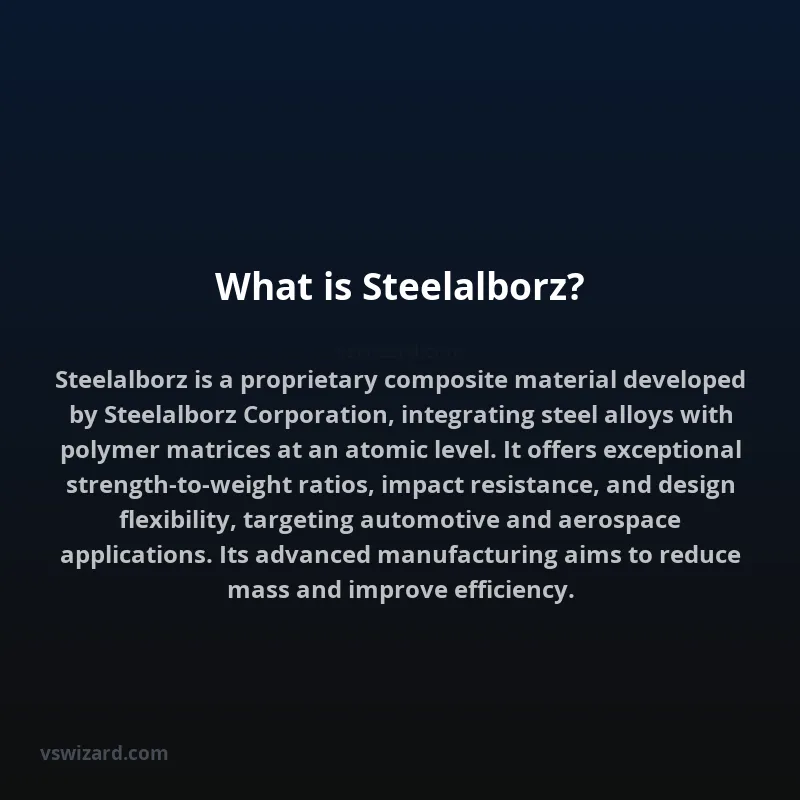
Steelalborz designates a proprietary manufacturing process and resultant material composite developed and patented by the Steelalborz Corporation. This innovative approach focuses on the creation of high-strength, lightweight structural components primarily for automotive chassis and aerospace applications. The core technology involves the controlled atomic-level integration of specific steel alloys with advanced polymer matrices, often utilizing a vacuum-assisted infusion or additive manufacturing (3D printing) technique. This fusion yields a material characterized by exceptional tensile strength-to-weight ratio, superior impact resistance, and enhanced corrosion passivation compared to traditional metallic or composite materials. The specific composition and manufacturing parameters are trade secrets, but industry analysis suggests the use of advanced high-strength steels (AHSS) or maraging steels as a base, reinforced with carbon nanotubes or graphene within a tailored thermosetting polymer.
The engineering philosophy behind Steelalborz is to overcome the inherent compromises between strength, weight, and cost that have historically constrained material selection in performance-critical industries. By precisely controlling the interfacial adhesion between the metallic reinforcement and the polymer binder at a nanoscale, the material exhibits synergistic properties. This allows for the design of optimized structural elements that can withstand extreme mechanical loads while significantly reducing overall vehicle or aircraft mass. The process aims to streamline manufacturing by potentially enabling the direct printing of complex, integrated sub-assemblies, thereby reducing part count, assembly time, and the need for secondary joining operations like welding or riveting. This approach aligns with emerging trends in sustainable engineering, focusing on lifecycle efficiency through reduced material consumption and improved fuel economy or battery range due to weight reduction.
History and Development
The genesis of Steelalborz can be traced to research initiated by the Steelalborz Corporation in the early 2010s, driven by a mandate to develop next-generation automotive structural materials. Early-stage research focused on hybrid metallic-composite structures, with initial prototypes exploring bonded or riveted combinations of steel and carbon fiber reinforced polymers (CFRP). The breakthrough came with the development of a proprietary bonding agent and a novel multi-stage manufacturing process that facilitated true metallurgical integration and matrix infusion at the atomic level. Significant investment in additive manufacturing R&D allowed for the refinement of techniques to precisely deposit and fuse the metallic and polymeric phases, leading to the first patent filings in 2015. Pilot production lines were established in 2018, with initial applications targeting niche high-performance automotive sectors and select aerospace sub-components. Continuous refinement of the alloy compositions and polymer formulations, alongside process optimization for scalability, has characterized its subsequent development.
Material Composition and Microstructure
The precise elemental composition of Steelalborz is proprietary. However, technical analyses suggest a sophisticated multi-component system. The metallic phase typically comprises high-performance steel alloys, potentially including elements like nickel, cobalt, and molybdenum to achieve properties characteristic of maraging steels, known for their extreme strength and toughness after heat treatment. These alloys are often processed into micro-reinforcements, such as finely powdered particles or nano-fibers. The polymeric phase is a carefully engineered thermosetting resin, likely epoxy or polyimide-based, selected for its high glass transition temperature (Tg), low coefficient of thermal expansion (CTE), and excellent adhesion properties. The crucial aspect is the interfacial layer where the steel and polymer meet. This zone is engineered to achieve strong covalent or chemical bonds, preventing delamination and ensuring load transfer across the material matrix. Techniques like surface functionalization of the metallic reinforcements and the use of specific cross-linking agents in the polymer are theorized to be integral to achieving this robust interface. The resulting microstructure is a complex, heterogeneous composite with metallic reinforcements dispersed within a cross-linked polymer matrix, often exhibiting gradients in composition or reinforcement density tailored to specific stress requirements.
Microstructural Analysis Techniques
Characterization of Steelalborz microstructures relies on advanced analytical techniques. Scanning Electron Microscopy (SEM) combined with Energy-Dispersive X-ray Spectroscopy (EDS) is essential for visualizing the distribution of metallic and polymeric phases and analyzing elemental composition at specific locations. Transmission Electron Microscopy (TEM) provides higher resolution imaging to examine the atomic-level bonding at the interface and identify nano-reinforcements. X-ray Diffraction (XRD) is used to determine the crystalline phases present in the steel component and to assess internal stresses. Raman spectroscopy can be employed to analyze the chemical bonding and structural integrity of the polymer matrix and any carbon-based reinforcements.
Manufacturing Process
The Steelalborz manufacturing process is a multi-stage operation designed to achieve intimate integration of metallic and polymeric constituents. While specific details are proprietary, the general methodology is understood to involve several key steps:
- Pre-treatment of Reinforcements: Steel alloys are processed into micro- or nano-scale particles, fibers, or lattices. These reinforcements undergo surface treatments to enhance chemical compatibility and adhesion with the polymer matrix.
- Matrix Preparation: A specialized thermosetting polymer resin is formulated with curing agents and potentially other additives to achieve desired rheological properties and final performance characteristics.
- Composite Formation: This is the core innovation. Methods may include:
- Vacuum-Assisted Infusion: Pre-formed metallic reinforcement structures are placed in a mold, and the polymer resin is infused under vacuum to ensure complete penetration and minimize voids.
- Additive Manufacturing (3D Printing): Advanced 3D printing techniques could build the composite layer by layer, depositing precise amounts of metallic powder or precursor and polymer simultaneously or sequentially, followed by in-situ curing or consolidation.
- Consolidation and Curing: The composite structure undergoes controlled thermal and pressure cycles to fully cure the polymer matrix and achieve optimal interfacial bonding. Post-curing heat treatments might be applied to further enhance the mechanical properties of the steel phase.
- Machining and Finishing: Final component dimensions are achieved through precision machining, with techniques adapted to handle the unique properties of the hybrid material.
The precision required in controlling temperature, pressure, infusion rates, and curing kinetics is critical for the structural integrity and performance of the final Steelalborz component.
Applications
Automotive Industry
The primary target sector for Steelalborz is the automotive industry, particularly in the manufacturing of structural components where weight reduction is paramount for performance and efficiency. Key applications include:
- Chassis and Frame Components: Subframes, A-pillars, B-pillars, and integral body structures benefit from the high strength-to-weight ratio, enhancing crash safety and handling dynamics.
- Suspension Components: Control arms, steering knuckles, and spring perches can be manufactured lighter and stronger, improving unsprung mass and responsiveness.
- Impact Absorption Structures: Front and rear crumple zones and side-impact beams can be optimized for energy absorption while maintaining structural integrity.
- Powertrain Mounts: Engine and transmission mounts can be designed for increased stiffness and vibration damping.
The material's potential to be molded or printed into complex shapes also facilitates design integration, reducing the number of parts required in assembly.
Aerospace Industry
In aerospace, weight savings directly translate to reduced fuel consumption and increased payload capacity. Steelalborz is being explored for:
- Airframe Structural Elements: Ribs, spars, and fuselage sections where high strength and fatigue resistance are critical.
- Interior Components: Seat frames and structural elements within the cabin, potentially offering improved fire resistance and strength.
- Landing Gear Components: Sub-assemblies requiring extreme durability and resistance to cyclic loading.
Other Potential Applications
Beyond automotive and aerospace, the unique properties of Steelalborz suggest potential uses in:
- High-Performance Sporting Goods: Bicycle frames, protective gear, and components for motorsports.
- Industrial Machinery: Robotic arms, high-speed machine frames, and components requiring stiffness and low inertia.
- Defense Applications: Lightweight armor components and structural elements for vehicles and equipment.
Performance Metrics and Specifications
Steelalborz exhibits a combination of properties that surpass many conventional materials. While exact figures are proprietary and vary based on specific formulation and manufacturing, general performance targets and achieved metrics place it at the forefront of advanced material engineering. Key performance indicators include:
| Property | Steelalborz (Typical Range) | Conventional Steel | Aluminum Alloy | CFRP |
|---|---|---|---|---|
| Density (g/cm³) | 3.5 - 5.5 | 7.85 | 2.7 | 1.5 - 1.8 |
| Tensile Strength (MPa) | 1500 - 2500+ | 400 - 1200 | 300 - 500 | 1500 - 2500+ |
| Specific Strength (MPa/(g/cm³)) | 270 - 710+ | 50 - 150 | 110 - 185 | 830 - 1380+ |
| Specific Modulus (GPa/(g/cm³)) | 15 - 30 | 20 - 26 | 25 - 30 | 50 - 70+ |
| Impact Toughness (kJ/m²) | > 100 | Highly Variable (e.g., 50-200) | 50 - 100 | Variable (can be brittle) |
| Fatigue Strength (MPa) | 800 - 1200+ | 300 - 600 | 150 - 250 | 500 - 1000+ |
| Corrosion Resistance | Excellent | Poor to Moderate | Good | Excellent |
Note: Specific strength and modulus values for Steelalborz are highly dependent on the volume fraction and type of reinforcement, as well as the base alloy and polymer matrix. CFRP values can vary significantly with fiber orientation and resin system.
Advantages and Disadvantages
Advantages
- Exceptional Strength-to-Weight Ratio: Significantly lighter than traditional steels while often exceeding their tensile strength, leading to improved fuel efficiency and performance.
- High Stiffness and Rigidity: Enables the design of precise and responsive structures.
- Enhanced Impact Resistance: The composite nature and tailored interfaces contribute to superior energy absorption compared to monolithic metals.
- Corrosion Resistance: The polymer matrix provides a protective barrier, greatly reducing susceptibility to galvanic corrosion and environmental degradation compared to bare steel.
- Design Flexibility: Potential for additive manufacturing allows for complex geometries, integrated functionalities, and reduced part count.
- Fatigue Life: Combination of strong metallic reinforcements and resilient polymer matrix can lead to extended fatigue life.
Disadvantages
- High Manufacturing Cost: The complex proprietary processes, specialized equipment, and raw material costs contribute to a significant premium over conventional materials.
- Limited Production Scale: Current manufacturing processes may not be as mature or scalable as those for steel or aluminum, limiting widespread adoption.
- Repair Challenges: Repairing or joining Steelalborz components may require specialized techniques and materials, potentially differing from standard automotive or aerospace repair methods.
- Thermal Performance Limitations: While the polymer matrix is chosen for high Tg, extreme operating temperatures could still affect the material's integrity, especially the polymer phase.
- Recyclability Concerns: The hybrid nature of the material, combining metals and polymers, presents challenges for efficient and cost-effective recycling compared to single-material solutions.
- Proprietary Nature: Limited availability of detailed material data and reliance on a single manufacturer can pose risks for supply chain and long-term product support.
Industry Standards and Certifications
As a proprietary material, Steelalborz itself is not governed by broad industry standards in the same way as commodity materials like AISI 4130 steel or T6 aluminum alloys. However, components manufactured using Steelalborz must adhere to stringent standards set by regulatory bodies and industry consortia within the automotive and aerospace sectors.
- Automotive: Components must meet standards like FMVSS (Federal Motor Vehicle Safety Standards) for crashworthiness and safety. Specific performance requirements for structural integrity, fatigue, and durability are often defined by original equipment manufacturers (OEMs) based on internal testing protocols and industry best practices.
- Aerospace: Applications in aerospace necessitate compliance with rigorous certifications from bodies such as the FAA (Federal Aviation Administration) or EASA (European Union Aviation Safety Agency). This involves extensive material qualification testing, including static and dynamic load testing, environmental resistance (temperature, humidity, UV), flame, smoke, and toxicity (FST) testing, and long-term durability assessments. Standards from organizations like ASTM International and SAE International (Society of Automotive Engineers) pertaining to composite materials and structural integrity are highly relevant.
Steelalborz Corporation would typically provide detailed material data sheets (MDS) and certifications for specific grades of their material, often validated through third-party testing laboratories, to meet the demanding requirements of these industries.
Alternatives and Competitive Materials
Steelalborz competes with a range of advanced materials, each offering different sets of advantages and disadvantages:
- Advanced High-Strength Steels (AHSS) and Ultra High-Strength Steels (UHSS): These materials, such as Dual Phase (DP), TRIP, and Martensitic steels, offer high strength with improving formability and weldability, often at a lower cost than Steelalborz.
- Aluminum Alloys: Widely used for weight reduction, particularly in automotive body structures and aerospace components. They offer good strength, corrosion resistance, and established manufacturing processes, though often with lower specific strength than Steelalborz.
- Carbon Fiber Reinforced Polymers (CFRP): Offer the highest specific strength and stiffness. They are extensively used in high-performance vehicles and aircraft. However, CFRP can be more susceptible to impact damage, and manufacturing costs can be very high, with complex repair procedures.
- Magnesium Alloys: Offer the lowest density among structural metals, providing significant weight savings. However, they can be more challenging to form, have lower corrosion resistance, and are more flammable than aluminum or steel.
- Titanium Alloys: Possess an excellent strength-to-weight ratio and superb corrosion resistance, but are significantly more expensive than steel or aluminum.
- Other Metal Matrix Composites (MMCs): Various combinations of metal matrices (e.g., aluminum, magnesium) reinforced with ceramics or carbon fibers. These offer tailored properties but can also present manufacturing complexities and high costs.
The choice among these materials depends heavily on the specific application requirements, cost targets, production volumes, and desired performance envelope.
Future Outlook and Research Directions
The future of Steelalborz is closely tied to advancements in materials science, manufacturing technology, and sustainability initiatives. Continued research is likely to focus on several key areas:
- Cost Reduction: Developing more efficient and scalable manufacturing processes, optimizing raw material sourcing, and improving recycling technologies are crucial for broader market penetration.
- Enhanced Properties: Further refinement of alloy compositions and polymer matrices, along with novel reinforcement structures (e.g., hierarchical designs), could yield even higher specific strength, stiffness, and toughness.
- Wider Application Range: Exploring applications in sectors beyond automotive and aerospace, such as renewable energy infrastructure or advanced robotics, where lightweight, high-strength components are beneficial.
- Joining and Repair Techniques: Development of standardized, cost-effective methods for joining Steelalborz to other materials and for repairing damaged components will be vital for long-term adoption.
- Sustainability and Circular Economy: Investigating closed-loop recycling processes and the use of bio-based or recycled polymers could improve the material's environmental footprint.
- Digital Integration: Leveraging AI and simulation tools for material design, process optimization, and in-service performance monitoring will become increasingly important.
As industries continue to prioritize lightweighting and performance enhancement, materials like Steelalborz, despite their current complexities, represent a significant avenue for innovation in structural engineering.