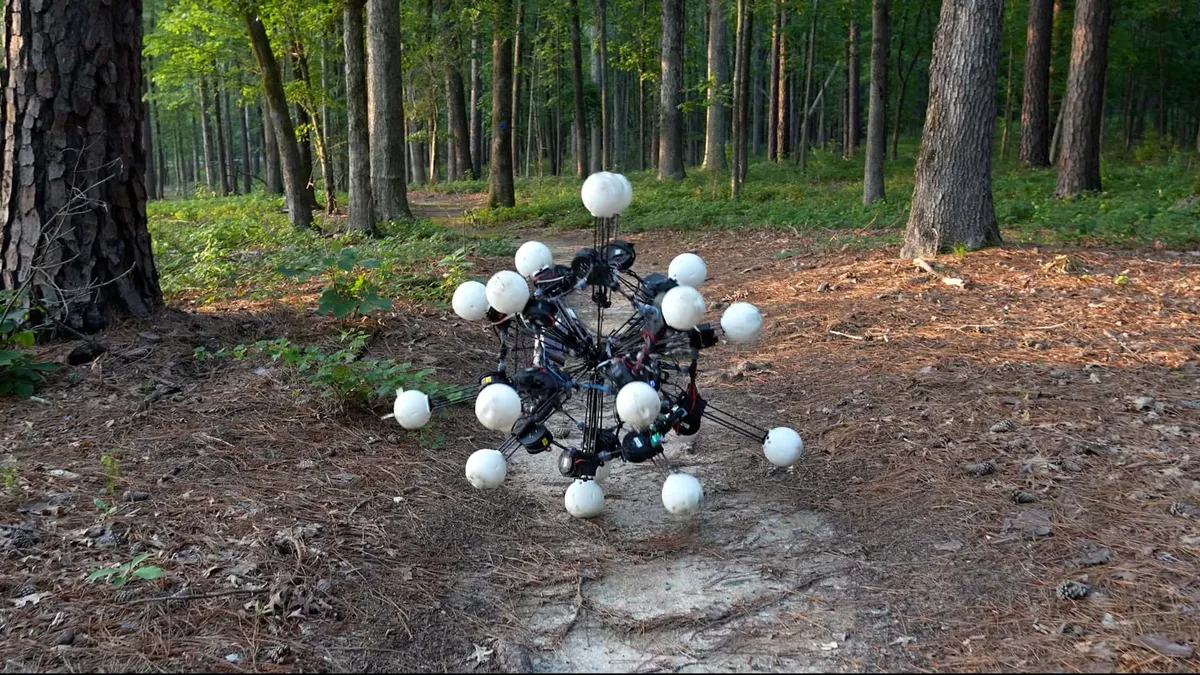
Researchers at Duke University have unveiled a novel robotic design, named Argus, that diverges significantly from traditional bio-mimicry in locomotion. Unlike robots designed to emulate human or animal movements, Argus is engineered around the principle of 'dynamic isotropy,' aiming for uniform force application and acceleration in all directions. This unique approach results in a spherical, leg-driven robot with no discernible front or back, capable of rolling and shuffling through complex terrains with remarkable stability and responsiveness.
The key innovation lies in Argus's ability to push, accelerate, and recover with equal efficacy regardless of its orientation. This 'all-directional' capability eliminates the need for the robot to orient itself conventionally, simplifying control and enhancing its adaptability to unpredictable environments. Each of its 20 telescoping legs is equipped with depth cameras, providing an expansive field of vision that allows it to navigate varied surfaces such as grass, sand, and uneven ground with exceptional agility.
The Principle of Dynamic Isotropy
Traditional robotics has largely drawn inspiration from biological forms, leading to humanoid robots mimicking human gait and quadrupedal robots emulating canine or equine movement. While this has yielded impressive results, it inherently introduces a bias based on the chosen biological model. The Duke University team challenged this paradigm by posing a different fundamental question: What if a robot's body plan prioritized an equal ability to act in every direction?
This concept, termed 'dynamic isotropy,' quantifies how uniformly a robot can accelerate its center of mass. A score closer to 1 indicates near-perfect omnidirectional performance. Advanced robots, including many current quadrupeds and humanoids, often score below 0.6. In contrast, Argus achieved an impressive score of 0.91, demonstrating a significant leap in omnidirectional mobility. The researchers explored designs with up to 40 legs to achieve even higher scores, but opted for a more practical 20-leg configuration to manage complexity and potential failure points.
Argus's Unique Design and Capabilities
The physical prototype of Argus was developed after simulating over 1,500 different designs. The resulting structure features 20 identical cable-driven linear legs radiating from a central frame based on a regular dodecahedron. This arrangement, reminiscent of a sea urchin's spines, allows each leg to function independently yet cooperatively. The robot's movement is characterized by a rolling and shuffling motion, propelled by the synchronized extension and retraction of its legs.
In practical tests, Argus demonstrated remarkable resilience and adaptability. It successfully navigated diverse surfaces including concrete, grass, bark, dense foliage, sand, and wet ground, overcoming obstacles up to five inches in height. Crucially, it maintained mobility even when one, two, or three legs were disabled. Its stability was further tested when it was pushed; instead of toppling, Argus extended its legs on the opposite side to brace itself, showcasing an intrinsic self-righting mechanism. It also performed well in simulated lunar-gravity wall-climbing scenarios.
Omnidirectional Vision and Manipulation
Beyond locomotion, Argus's design enhances its perceptual and manipulative capabilities. The depth cameras mounted on each leg provide a comprehensive 3D understanding of the environment, irrespective of the robot's orientation. This all-around vision is vital for its whole-body manipulation tasks, such as tracking and pushing a large cube while rolling—a feat difficult for robots with a fixed directional focus.
While the simulation results are promising, the researchers acknowledge real-world limitations. In outdoor tests, factors like camera overheating and desynchronization led to a drop in performance for tasks like object tracking. The inherent trade-offs of a multi-leg system—increased complexity, weight, and potential failure points—are recognized. However, the core principle of dynamic isotropy has been proven effective, suggesting a new direction for robotic design where mathematical and physical principles take precedence over biological imitation.
Impact Analysis
The Argus robot represents a significant departure from conventional robotic locomotion and design philosophy. By prioritizing dynamic isotropy, the Duke University team has introduced a robot that can operate effectively in environments where traditional robots might struggle. This breakthrough has profound implications for fields requiring robots to navigate unstructured and unpredictable terrains, such as disaster response, mining, agriculture, and space exploration. The ability to move and perceive without a fixed orientation could unlock new possibilities for robotic assistance in complex, dynamic settings, potentially leading to a future of more adaptable and resilient autonomous systems.