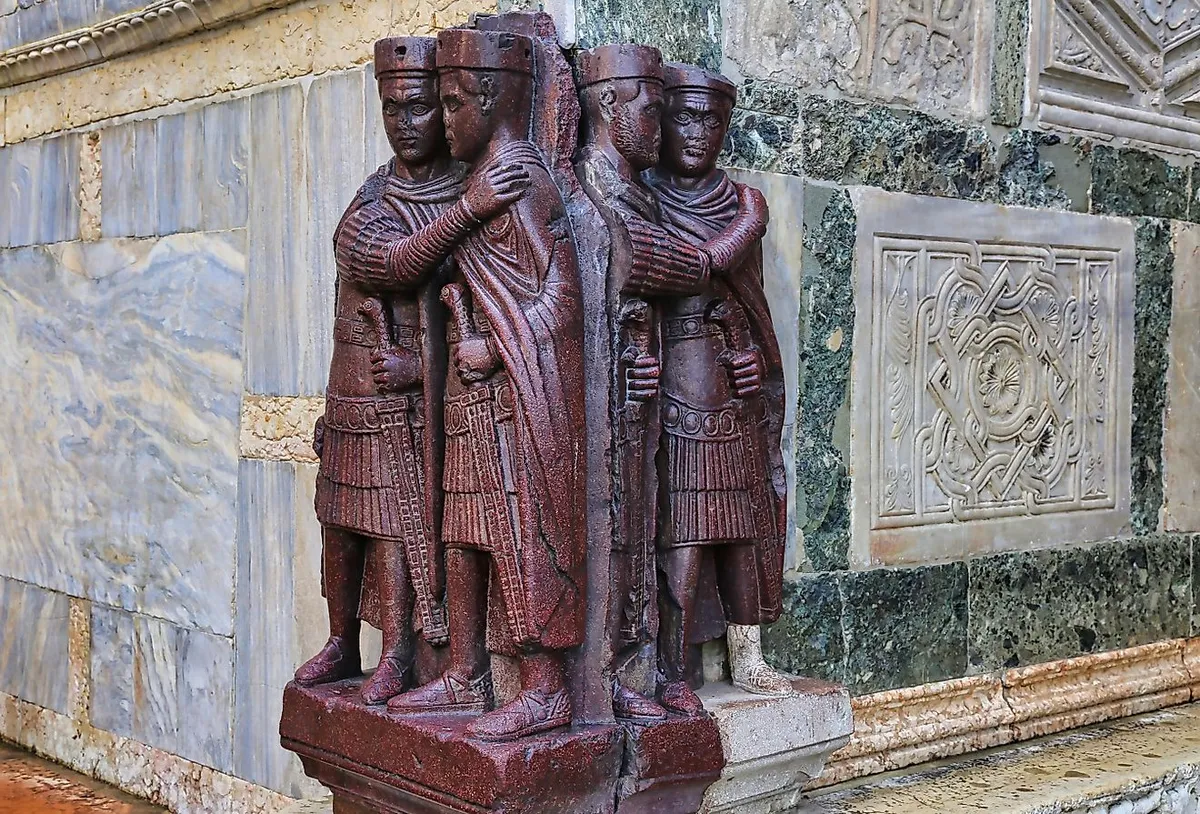
By the late third century CE, the Roman Empire had expanded to a scale that rendered unified governance increasingly untenable. Decades of internal strife, marked by rapid successions of emperors and civil wars, underscored the critical need for administrative reform. Emperor Diocletian's implementation of the Tetrarchy in 293 CE, a system dividing imperial authority among four rulers, was a direct acknowledgment of this challenge. Although the Tetrarchy itself eventually dissolved into conflict, it established a crucial precedent for shared rule and administrative decentralization. This period of instability, known as the Crisis of the Third Century (235-284 CE), witnessed over twenty emperors rise and fall, highlighting the profound governance and security issues plaguing the vast empire.
The inherent economic and cultural divergences between the western and eastern halves of the empire further exacerbated these challenges. These divisions, long simmering, were eventually formalized by Emperor Theodosius upon his death in 395 CE, when he bequeathed the empire to his two sons. This act solidified a separation that had been developing for over a century, setting the stage for the eventual divergence and ultimate fall of the Western Roman Empire while the East continued for another millennium.
Understanding the Empire's Unwieldy Size

The sheer geographical expanse of the Roman Empire presented an almost insurmountable administrative hurdle. Its territories stretched from Britannia in the northwest to Mesopotamia in the east, and from Hispania in the southwest to Aegyptus in the south. This immense scale made it exceedingly difficult for a centralized government to maintain effective control, understand the unique needs of its diverse populations, and respond swiftly to emerging threats. Foreign invasions, for instance, could go unnoticed or unaddressed for weeks as information slowly traversed the vast distances.
Furthermore, the empire's immense size diluted the emperor's authority. A lack of consistent imperial presence meant that local power structures could consolidate, leading to increased instances of ambitious generals challenging the throne and fostering a climate of perpetual succession disputes. This contributed significantly to the aforementioned Crisis of the Third Century, a period characterized by widespread civil conflict, external incursions, and crippling economic and political instability, ultimately demonstrating that the existing administrative framework was no longer adequate for the empire's scale.
Deepening Economic Disparities Between East and West

Significant economic disparities existed between the Western and Eastern Roman Empires, fundamentally weakening the former. The East encompassed highly prosperous regions such as Egypt, Anatolia, and Syria, which boasted robust agricultural output, dense urban populations, and thriving inter-regional trade networks. These areas generated substantial tax revenues for the imperial treasury.
In contrast, the West was comparatively more agrarian and less economically developed. The persistent threat of incursions from Germanic tribes along its northern frontiers necessitated a disproportionately high allocation of resources towards military defense. This diverted investment away from crucial sectors like agriculture and infrastructure development, resulting in lower tax yields and a more precarious economic foundation for the Western administration compared to its eastern counterpart.
Linguistic and Cultural Divergence

The cultural and linguistic landscape of the Roman Empire was markedly different between its western and eastern territories. In the West, Latin served as the predominant language, and the city of Rome itself remained a powerful symbol of cultural heritage and tradition, even as political power in the West later gravitated towards administrative centers like Ravenna.

Conversely, Greek was the lingua franca of the East. This linguistic preference was deeply rooted in the Hellenistic legacy established by Alexander the Great's conquests centuries earlier, which had fostered a fusion of Greek and local cultures across the eastern Mediterranean and Middle East. When Rome incorporated these territories, it largely allowed this existing cultural framework to persist. Consequently, while inhabitants of the Eastern Roman Empire continued to identify as "Roman," they increasingly felt a cultural and linguistic disconnect from their Latin-speaking counterparts in the West.
The Genesis of Imperial Division

Emperor Diocletian's reign (284-305 CE) marked a critical juncture in the empire's administrative evolution. Confronted with the escalating challenges of governance over such a vast territory, he instituted the Tetrarchy in 293 CE, dividing the empire's rule between two senior emperors (Augusti) and two junior emperors (Caesars). While this system ultimately failed to prevent internal conflict, it institutionalized the concept of divided imperial authority and administrative decentralization.
Another pivotal development occurred under Emperor Constantine (306-337 CE). In 330 CE, he established Constantinople as the empire's new capital. Strategically located on the Bosporus strait, it offered superior defensibility, control over vital trade routes between the Black Sea and the Mediterranean, and proximity to the empire's more prosperous eastern provinces. Although a politically astute decision, the relocation of the capital significantly shifted the center of power eastward, further entrenching the distinctions between the western and eastern spheres of the empire.
The Definitive Split

Although attempts were made to reunite the empire following Diocletian's reforms, the division became permanent in 395 CE. Upon Emperor Theodosius's death, the empire was formally divided between his sons: Arcadius inherited the East, and Honorius the West. From this point forward, the Western Roman Empire and the Eastern Roman Empire operated as distinct political entities. Despite a shared historical heritage and a mutual sense of Roman identity, their subsequent historical trajectories diverged significantly. The Western Roman Empire eventually collapsed in 476 CE with the deposition of Emperor Romulus Augustulus by the Germanic chieftain Odoacer. In stark contrast, the Eastern Roman Empire, later known as the Byzantine Empire, endured for nearly another millennium before its fall to the Ottoman Turks in 1453 CE.
Factors Cementing the Permanent Division

The Roman Empire's eventual permanent division was a consequence of several converging factors. The immense geographical scale of the empire rendered single-ruler governance practically unfeasible, necessitating administrative reforms. Deep-seated economic and cultural disparities between the eastern and western provinces created distinct identities and interests that further propelled the separation. Emperor Diocletian's attempts at administrative division through the Tetrarchy, while ultimately unsuccessful in its original form, established a critical precedent for shared governance that facilitated the empire's eventual permanent split in 395 CE.