XRP (CRYPTO: XRP) recently experienced a significant price decline, hitting $1.08 on Friday, marking its lowest point in 19 months. This level has not been seen since November 2024, when the cryptocurrency briefly dipped to $0.50. The current trading range appears to be stabilizing between $1.12 and $1.16. The potential for a sustained recovery for XRP hinges on several critical factors, including institutional investor activity, the legislative progress of the CLARITY Act, and the performance of Bitcoin. A convergence of positive developments in these areas could propel XRP higher, whereas unfavorable outcomes might lead to further declines, potentially testing the $1 support level.
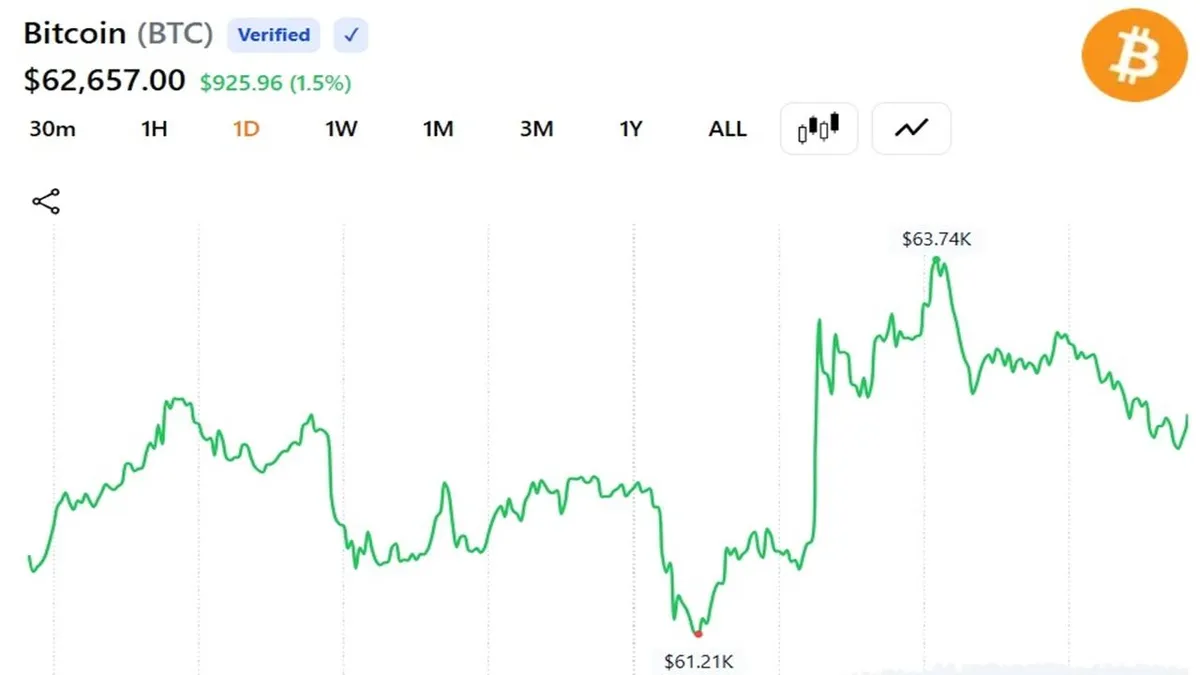
The immediate catalyst for this downturn was the release of a robust U.S. jobs report on Friday. An unexpectedly high number of new jobs, totaling 172,000, fueled concerns that the Federal Reserve might maintain higher interest rates for an extended period. This macroeconomic outlook triggered a broad sell-off across the cryptocurrency market. Bitcoin (CRYPTO: BTC) experienced a sharp decline, falling below the $60,000 threshold and reaching a weekend low of $59,100. In a single 24-hour period, over $1 billion in leveraged long positions were liquidated, with XRP being pulled down along with the general market, ultimately bottoming out at $1.08.
XRP's Recent Price Performance and Market Position
Over the past year, XRP has seen a depreciation of approximately 48%, and it remains roughly 69% below its cycle high of $3.65 reached in July 2025. Despite this significant drop, XRP maintains its position as the sixth-largest cryptocurrency by market capitalization, with a valuation hovering around $70 billion. While the price has shown a modest rebound of about 7% from its recent Friday low, the overarching market trend has yet to indicate a definitive reversal.

Interestingly, XRP's recent decline exhibited a divergence from its typical correlation with Bitcoin. Historically, XRP has tended to fall 1.3 to 1.6 times more than Bitcoin during downturns. However, in this recent instance, XRP's drop was only about 0.87 times that of Bitcoin. This suggests that XRP demonstrated relative resilience during this particular downturn, holding up better than historical patterns might predict. While this does not guarantee an immediate recovery, it indicates that XRP experienced less severe price erosion compared to expectations, prompting a closer examination of its future price trajectory.
Factors Driving Potential XRP Upside
Institutional Inflows and Investor Accumulation
A significant tailwind for XRP's potential recovery stems from sustained institutional buying. In contrast to the substantial outflows experienced by Bitcoin ETFs, which saw $4.4 billion withdrawn over 13 trading days, and Ethereum ETFs, which lost $401 million over 17 days, spot XRP ETFs recorded a record $131.94 million in inflows during May. This figure represents the strongest monthly performance for XRP ETFs this year. Furthermore, early June saw an additional $4.13 million in inflows, occurring even as the price faced downward pressure, bringing cumulative inflows to $1.43 billion.
Beyond ETF activity, on-chain data reveals increased accumulation. More than 25 million XRP tokens have been moved off exchanges in recent days, signaling a reduction in available supply for trading. The number of wallets holding 10,000 XRP or more has reached an all-time high of 332,230. Between May 31 and June 2, long-term holders notably increased their positions by 22%, indicating growing confidence among significant stakeholders.
The CLARITY Act and Regulatory Clarity
The potential passage of the CLARITY Act represents another significant catalyst that could positively reprice XRP. This proposed legislation aims to permanently classify XRP as a commodity under federal law. Having successfully passed the Senate Banking Committee in May, the bill has been placed on the Senate Legislative Calendar as of June 1. Should the bill be enacted, financial institutions like Standard Chartered project that it could trigger substantial XRP ETF inflows, potentially ranging from $4 billion to $8 billion by the end of the year. This projected inflow is a staggering 30 to 60 times the record monthly inflows observed in May.
Historical Performance and Market Leadership
XRP has historically demonstrated a tendency to lead market recoveries within the broader cryptocurrency space. This pattern was evident in the first week of January, when XRP surged by 24-25% while Bitcoin saw gains of only 5.5-6% and Ethereum experienced a 9.7-10% rise. A similar trend emerged following the February market crash, where XRP rallied by 38% compared to Bitcoin's 14% and Ethereum's 12% recovery. This historical performance suggests that when investor sentiment shifts positively and capital flows back into digital assets, XRP often experiences a more pronounced rebound compared to its major cryptocurrency counterparts.
Potential Headwinds and Risks to Recovery
Liquidity Constraints and Market Dynamics
Several factors could impede XRP's anticipated bounce. Binance's 30-day liquidity index for XRP has fallen to approximately 0.043, its lowest point since January 2020. For context, this index ranged between 3 and 4 during the 2022-2024 period, meaning the current reading is roughly 1% of its historical norm. Such thin liquidity implies that even minor selling pressure could disproportionately impact XRP's price, increasing volatility.
Compounding this issue, Ripple's monthly escrow unlock on June 1 introduced an estimated net new supply of 200 to 400 million XRP into a market already under pressure. Furthermore, short positions on XRP currently outweigh long positions by a nine-to-one ratio, which could amplify price movements significantly, regardless of Bitcoin's direction.
Bitcoin's Influence and Macroeconomic Pressures
The overarching challenge for XRP's recovery is its dependence on Bitcoin's performance. Bitcoin ETFs have only recently broken a 13-day streak of outflows with a marginal $3 million inflow on June 4, following substantial earlier outflows totaling $4.4 billion. A single day of positive performance does not yet constitute a confirmed trend reversal for Bitcoin. Market sentiment analysis, such as on Polymarket, indicates a 64% probability that Bitcoin could test $55,000 before the year concludes, with a 51% chance of it testing $50,000.
Under such scenarios, even with XRP's recent correlation ratio of 0.87 to Bitcoin, a drop to $55,000 for BTC could place XRP near $1.05. If Bitcoin's price falls further to $50,000, XRP could potentially decline below the crucial $1 support level. Losing the $1 support on a daily closing basis would likely lead to the next support test at $0.95. Below this, the $0.75 to $0.85 zone, which served as a bottom in previous market cycles, would become a critical area. Intensified selling could push XRP towards the $0.50 to $0.60 range, reminiscent of its trading levels in November 2024.
Assessing the Potential Upside for XRP
While XRP has the capacity to rebound from its current price levels, the extent and sustainability of such a bounce remain key questions. A short-term upward movement to the $1.20-$1.30 range appears plausible, contingent upon institutional buyers maintaining their support and Bitcoin avoiding further significant price drops. Achieving levels above $1.50 would likely necessitate stabilization in Bitcoin's price and the CLARITY Act being scheduled for a floor vote before the August legislative recess.
If both of these conditions are met, XRP could potentially retrace towards the $1.50-$1.60 range in the near term. A move towards $2 or higher would depend more significantly on accelerating institutional inflows and positive regulatory developments, rather than on XRP's performance in isolation.