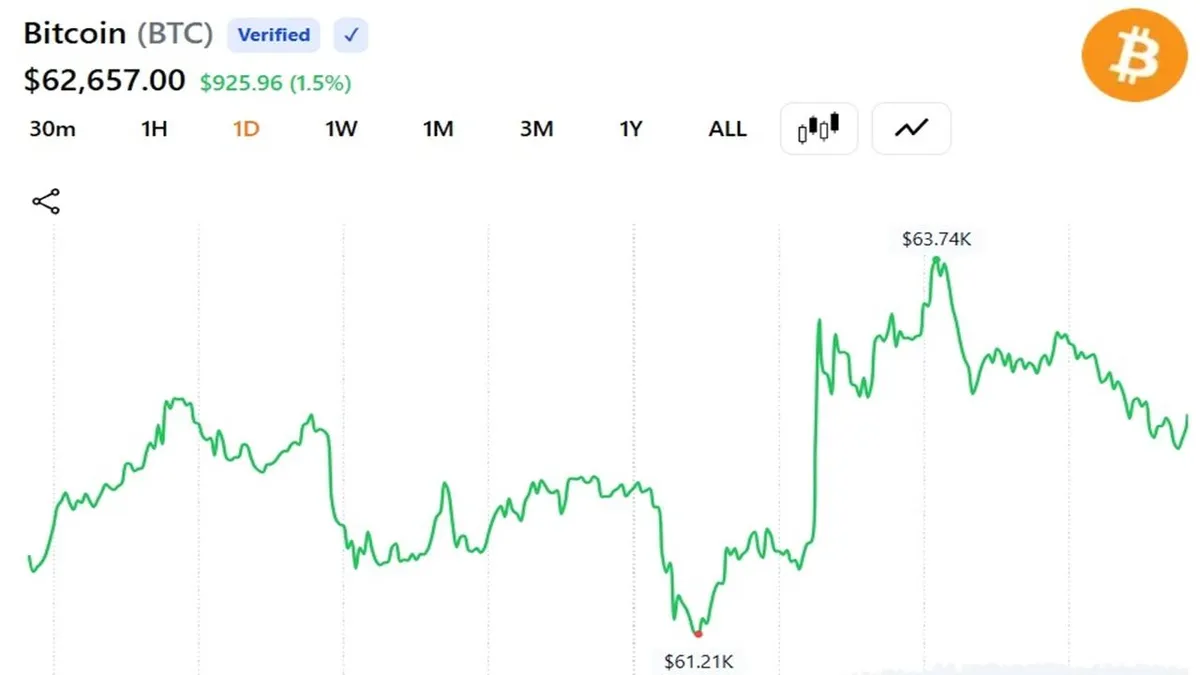
Bitcoin experienced a significant upward movement, climbing approximately 5% to reach the $64,000 mark on Sunday. This surge occurred shortly after U.S. President Donald Trump indicated that Israeli Prime Minister Benjamin Netanyahu would have "no choice" but to accept a U.S.-brokered deal with Iran. The cryptocurrency's price, which had hit a low near $59,100 on June 5, showed resilience, although it later dipped below $63,000. This volatility highlights Bitcoin's sensitivity to geopolitical developments and its role as a high-beta risk asset.
The market's reaction suggests that traders interpreted Trump's remarks not merely as speculation but as a firm signal of Washington's intent to finalize the agreement. The news effectively provided a much-needed catalyst for a market that had been showing signs of being oversold, according to short-term chart analysis. While this rally offers temporary relief, particularly to leveraged traders who faced significant liquidations during the recent downturn, the broader implications for Bitcoin's sustained recovery remain contingent on the definitive resolution of these geopolitical tensions and macroeconomic factors.
Bitcoin's Response to Geopolitical Signals
The recent price action saw Bitcoin reclaim approximately $64,000, marking a recovery of about 5% from its recent low of $59,100 recorded on June 5. This rebound was directly attributed to comments made by former President Trump, who described a potential U.S.-Iran deal as "almost complete." His statement implied a strong U.S. push for an agreement, suggesting it would proceed with or without full Israeli endorsement, a stance that appeared to influence market sentiment rapidly.
This development contrasts with the preceding week, where Bitcoin experienced its weakest performance of 2026, touching an intraday low around $59,100. At these lower levels, a significant portion of Bitcoin holdings were in an unrealized loss, a condition historically associated with market bottoms. The quick recovery, however, was fueled by the geopolitical news, acting as a direct catalyst for an oversold market that was poised for a bounce. Despite the surge, Bitcoin remains substantially below its mid-May all-time high of $82,000, indicating that the recent decline had erased considerable gains.
Trump's Diplomatic Push and Market Perception
The market interpreted Trump's assertion that the U.S.-Iran deal was "almost complete" as a more concrete commitment compared to previous speculative reports regarding a ceasefire. His emphasis on Netanyahu having "no choice" but to agree signaled a determined U.S. diplomatic effort that traders responded to swiftly. The expectation of an announcement at the start of the new business week amplified the market's reaction, leading to the immediate uptick in Bitcoin's price.
This event underscores how geopolitical narratives, particularly those involving the Middle East, have become a significant driver for cryptocurrency markets in 2026. The digital currency's performance has consistently shown a high correlation with de-escalation or escalation signals in the region. Earlier in the year, anticipation surrounding Trump's stance on Iran coincided with Bitcoin topping $77,000, illustrating the potent influence of such events on risk asset valuations.
The Interplay of Geopolitics, Inflation, and Crypto
The recent geopolitical tensions, which contributed to higher oil prices, have stoked inflation concerns and complicated the Federal Reserve's monetary policy outlook. This macroeconomic backdrop, characterized by uncertainty over future interest rate hikes and delayed rate cut expectations, had previously weighed on the cryptocurrency market. The digital currency's tendency to behave as a high-beta risk asset means it experiences amplified downturns during periods of heightened fear and faster recoveries when sentiment eases.
While the current rebound offers a degree of optimism, analysts caution against premature conclusions. Sustained price appreciation is likely dependent on a confirmed diplomatic resolution. Conversely, any breakdown in talks or renewed conflict could trigger a reversal, pushing Bitcoin back towards its recent lows. The Federal Reserve's policy decisions and inflation data will continue to act as critical secondary factors influencing the trajectory of cryptocurrency markets, potentially capping any extended recovery.