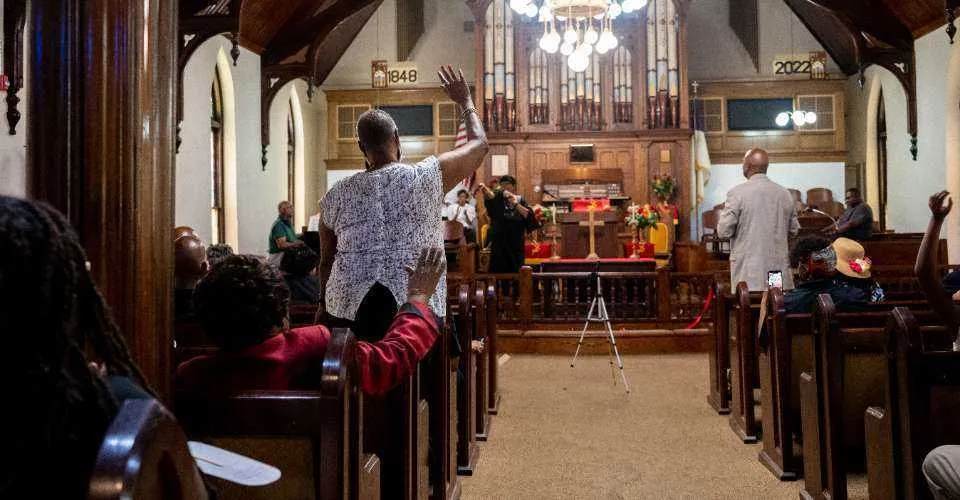
A recent survey by the Pew Research Center reveals that a significant majority of US adults who regularly attend religious services have encountered their clergy discussing political or social issues. The findings indicate that approximately two-thirds of individuals attending services at least once or twice a month reported hearing their religious leaders address at least one contemporary topic in recent months. This engagement highlights the intersection of faith and public discourse within American religious communities.
The survey identified several prominent issues that clergy have addressed, including abortion, the political situation concerning Israel, homosexuality, immigration, environmental concerns, transgender identities, and the US military involvement in Iran. Among these, messages focusing on abortion, homosexuality, and support for Israel were more frequently reported as being presented in a particular stance by religious leaders. This suggests a discernible leaning in the public pronouncements of clergy on these sensitive subjects.
Clergy's Influence on Social and Political Discourse
The research further illustrates the spectrum of viewpoints expressed by clergy on various social and political matters. On topics such as immigration, environmental protection, and transgender rights, congregants reported hearing messages that leaned towards welcoming and supporting immigrants, advocating for environmental stewardship, and embracing transgender individuals, more so than calls for stricter enforcement, opposition to regulations, or rejection of transgender identities. This pattern suggests a general trend in the pastoral messaging concerning social justice and inclusivity.
However, the findings on the US military action in Iran presented a more nuanced picture. While a small percentage of respondents (8%) reported hearing clergy oppose the conflict, a lesser share (4%) indicated support for it. An additional 9% noted that their religious leaders discussed the conflict without taking an explicit stance, either for or against. This diversity of commentary underscores the complexity and varied perspectives within religious communities regarding foreign policy and military engagement.
Political Leanings and Perceptions of Clergy
Regarding the perceived political affiliations of clergy, the survey indicated that 19% of respondents believe their religious leaders are predominantly Republican, while 8% perceive them as mostly Democrat. A larger segment, 27%, described their clergy's political leanings as mixed, and a significant 44% expressed uncertainty about their clergy's political orientation. This distribution suggests that while some clergy are perceived as having clear political leanings, a substantial portion are seen as politically ambiguous or apolitical by their congregations.
The survey also delved into how these perceptions vary across different religious denominations. Catholics were identified as the group most likely to be unsure about their clergy's political leanings, indicating a potential lack of overt political commentary or a more private approach to politics within Catholic leadership. This contrasts with other denominations where perceptions might be clearer.
Denominational Differences in Topic Focus
Specific religious groups showed distinct patterns in the topics they heard discussed by their clergy. Both Catholics and White evangelical Protestants were the most inclined to report hearing discussions about abortion from their religious leaders. This points to abortion as a significant issue resonating within these particular faith communities, often prompting pastoral guidance or commentary.
White evangelicals stood out as the group most likely to report frequent discussions of homosexuality from their clergy. In contrast, Catholics were most likely to report hearing about immigration. Black Protestants and Catholics shared a higher likelihood of hearing discussions related to the US military action in Iran. These differences highlight how the priorities and concerns of various denominations shape the public discourse within their services.
Impact Analysis
The Pew Research Center's findings underscore the evolving role of religious institutions in contemporary society, demonstrating that clergy are frequently engaging with pressing social and political issues. This active participation can significantly influence congregants' perspectives and civic engagement, acting as a conduit for information and opinion on topics ranging from social justice to foreign policy. The varied stances and levels of engagement across denominations and on specific issues reveal a complex tapestry of religious leadership interacting with the sociopolitical landscape, reflecting both the diversity of American society and the deeply ingrained nature of faith in public life.