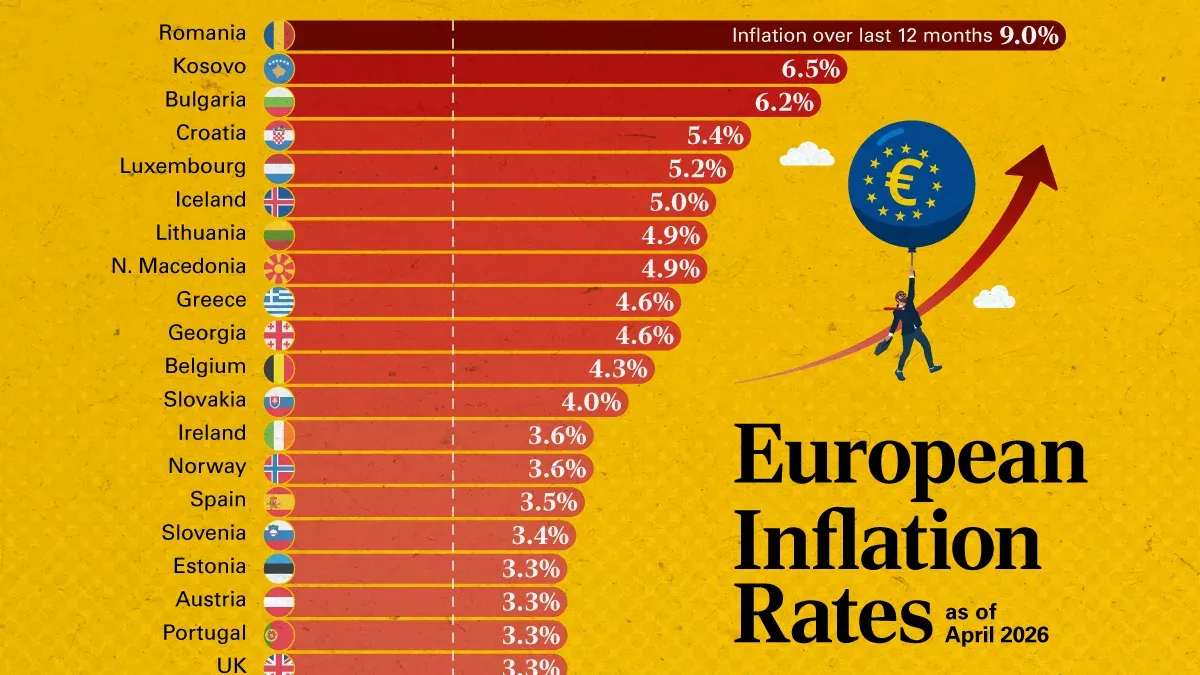
In early 2026, a significant portion of Europe continues to contend with elevated inflation rates, a persistent economic challenge even as global price pressures show signs of easing. While the overall trend indicates a deceleration from recent peaks, many nations are still operating considerably above their central banks' target rates. Data compiled from Eurostat and UK Parliament sources reveals a stark divergence across the continent, with Romania reporting the highest annual inflation at 9.0%, closely followed by Kosovo at 6.5% and Bulgaria at 6.2%. These figures underscore the localized and varied nature of inflationary pressures, with southeastern Europe particularly affected.
In contrast, a select few European countries have successfully anchored inflation within the commonly adopted 2% target. Switzerland leads this group with a notably low 0.6% inflation rate, demonstrating robust economic stability. Denmark, the Czech Republic, and Sweden also fall within or below the target range, achieving rates of 1.0% and 1.5% respectively. The absence of the Euro as a national currency in these successful economies is a point of interest, though Czechia and Sweden are theoretically poised for eventual Euro adoption. This economic landscape highlights the complex interplay of monetary policy, geopolitical events, and national economic structures in managing inflation across diverse European economies.
Inflation Landscape Across European Nations
The economic performance of European nations in managing inflation in early 2026 presents a mixed picture. Romania's 9.0% inflation rate signifies a critical economic juncture, exacerbated by a fiscal deficit and ongoing political instability, which complicates efforts to control rising prices. The surge is attributed not only to global commodity prices but also to domestic factors like increasing rental costs, impacting household budgets significantly.
Neighboring Bulgaria, having recently adopted the Euro in January 2026, faces its own inflationary concerns. There were pre-existing anxieties that joining the Eurozone could lead to price hikes for essential goods, a sentiment that may be amplified by current inflation figures. This situation puts added pressure on the Bulgarian government and the European Central Bank to ensure price stability and public confidence in the new currency.
Economic Success Stories and Targets
The European Central Bank (ECB), Bank of England (BoE), and Swiss National Bank (SNB) all adhere to a 2% inflation target as a primary objective for price stability. As of March 2026, only four countries have achieved this benchmark: Switzerland at 0.6%, Denmark at 1.0%, and the Czech Republic and Sweden both at 1.5%.
The fact that these countries do not currently use the Euro is noteworthy. Denmark has secured an opt-out from Euro adoption, while the Czech Republic and Sweden have yet to meet the convergence criteria for joining the eurozone. Switzerland, with its long-standing independent monetary policy, has consistently demonstrated an ability to maintain low inflation and avoid deflation, a testament to its economic resilience and prudent fiscal management.
Inflationary Challenges in Major European Economies
Despite concerted efforts by central banks, Europe's largest economies continue to battle inflation rates that exceed the 2% target. Germany is experiencing an inflation rate of 2.9%, France 2.5%, and the United Kingdom 3.3%. These figures suggest that global inflationary drivers, such as those linked to energy prices influenced by geopolitical conflicts, continue to exert significant pressure.
The sustained high cost of living remains a dominant political issue across these influential economies. Policymakers are challenged to balance the need to curb inflation with the imperative of supporting economic growth, a delicate act that requires careful calibration of interest rates and fiscal policies.
Impact Analysis
The persistent, albeit moderating, inflation across Europe in early 2026 presents a complex economic environment. For consumers, continued price increases erode purchasing power, potentially leading to reduced consumer spending and slower economic growth. Central banks face a difficult trade-off: maintaining tight monetary policy to combat inflation risks triggering a recession, while easing too soon could reignite price pressures.
The divergence in inflation rates across countries suggests varying levels of economic resilience and differing policy effectiveness. Countries with high inflation rates, particularly those in Eastern Europe, may face greater challenges in achieving sustained economic development and could see increased social and political unrest. Conversely, nations like Switzerland, with strong inflation control, are better positioned to weather economic downturns and attract investment. The overall economic outlook for Europe in 2026 remains cautiously optimistic, contingent on effective monetary policy, global stability, and the resolution of ongoing geopolitical tensions.