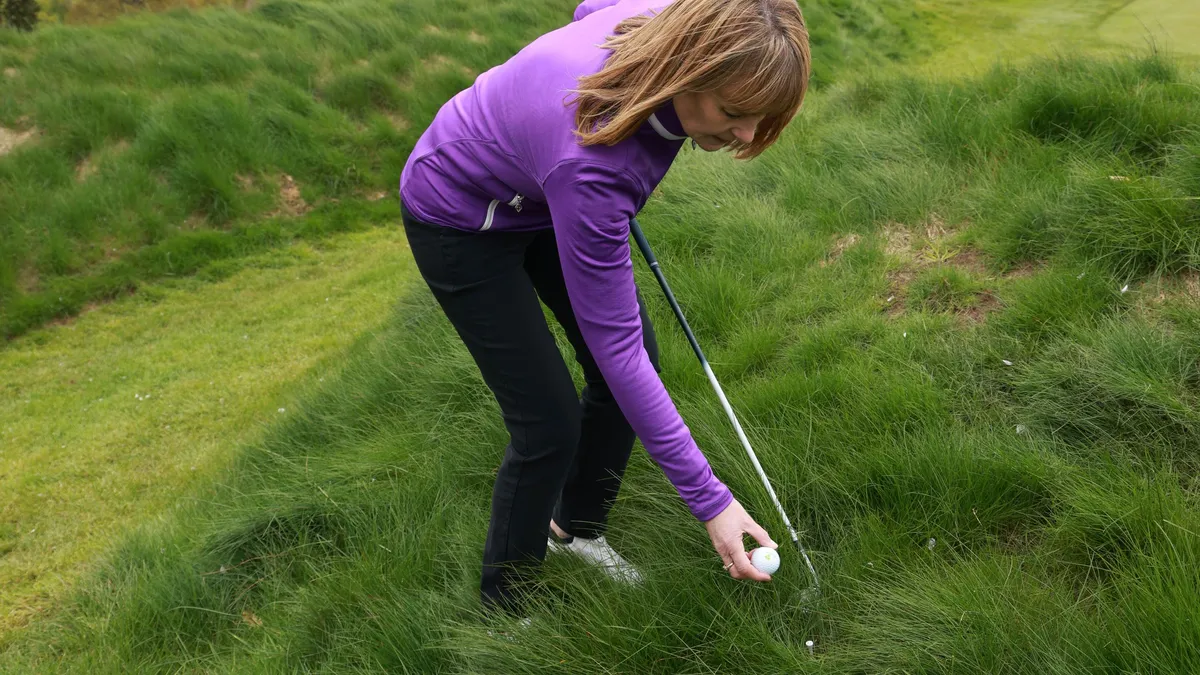
Golf's rules are designed to ensure fair play and consistent standards across the game. One scenario that frequently causes confusion among players, particularly amateurs, involves a ball that becomes embedded in the ground, especially when it lands in the rough. Historically, the rules around taking relief for such situations were more restrictive, often limiting free relief to areas with shorter grass, such as the fairway. However, recent updates to the Rules of Golf have broadened the scope of relief, aiming to simplify play and address the challenges posed by modern course conditions.
Understanding when and how to take relief is crucial for maintaining an accurate score and adhering to the game's integrity. This article delves into the specifics of Rule 16.3, which governs relief for an embedded ball in the general area, a category that encompasses the rough. We will clarify the conditions under which relief is permitted, the procedure for taking that relief, and the exceptions to these rules, providing golfers with the knowledge to navigate these situations confidently.
Relief for an Embedded Ball in the General Area
Rule 16.3 of the Rules of Golf, updated to provide greater clarity and fairness, explicitly allows a player to take free relief for a ball embedded in the general area. The 'general area' is defined as the entire course except for the putting green, penalty areas, bunkers, and the teeing area for the player’s ball. The rough, therefore, falls within this classification. If a player's ball is embedded in its own pitch mark in the general area, they are entitled to take relief.
For a ball to be considered 'embedded,' it must meet specific criteria: the ball must be in its own pitch-mark, which was made by the player’s last stroke. Furthermore, part of the ball must be below the level of the ground. This is a critical distinction; if the ball is merely sitting on the surface or only slightly depressed, it does not qualify as embedded. The intent of this rule is to prevent players from being unduly penalized by conditions that prevent a fair stroke.
The Procedure for Taking Relief
When a ball is deemed embedded in the general area and meets the criteria, the player must follow a precise procedure to take relief. First, the player must mark the exact position of the ball. This marked spot serves as the reference point for the relief area. It is important to mark the ball's position before lifting it, especially if there's any doubt about whether relief is permitted.
The player then determines their relief area, which extends one club-length from the reference point. This relief area must be in the general area, and crucially, it cannot be nearer to the hole than the reference point. Once the relief area is established, the player drops their ball, or another ball, from knee height. The ball must come to rest within this one-club-length relief area. If it settles within the designated area, it is then considered in play, and the player continues their round.
Exceptions and Considerations
While the rule provides for free relief, there are important exceptions. A player is not entitled to free relief for a ball embedded in sand within the general area. However, this exception has a nuance: relief *is* permitted if the ball is embedded in sand in a part of the general area that is cut to fairway height or less, and the sand is not considered a hazard. The primary intention is to provide relief from difficult lies, not to offer an advantage in sandy conditions.
Another key exception relates to the possibility of making a stroke. If the ball is embedded in the rough but in a location where playing the ball as it lies is clearly unreasonable (for example, lodged in a dense bush where a stroke is impossible), free relief is not granted under the embedded ball rule. In such cases, other rules, such as those concerning immovable obstructions or abnormal course conditions, might apply depending on the specific circumstances.
When Relief is Not Permitted
It is essential for golfers to understand the situations where the embedded ball rule does not apply. Free relief is explicitly not granted for a ball embedded in a penalty area, regardless of the condition of the ground. Similarly, a ball embedded within a bunker does not qualify for free relief under Rule 16.3. Players must consult the specific rules pertaining to penalty areas and bunkers in these instances, which often involve different relief options, potentially with penalty strokes.
Furthermore, if a player is uncertain whether their ball is embedded, they have the option to mark its position and lift the ball to check. If relief is allowed, the ball may be cleaned before proceeding with the drop. However, if relief is not permitted, the ball must be replaced in its original position. The exception to cleaning is when the ball is on the putting green, where it can always be cleaned.
Historical Context and Rule Changes
The current rule allowing free relief for embedded balls in the general area represents a significant evolution from previous regulations. Prior to the 2019 Rules of Golf update, free relief for an embedded ball was generally restricted to closely mown areas. This meant that finding a ball plugged in the rough typically did not grant the player the right to a free drop; they would often have to play the ball as it lay, even from a very difficult position.
The revision in 2019 aimed to simplify the game and make it more accessible, recognizing that a ball embedded in the rough can be just as penalizing as one embedded in the fairway. This change acknowledges the challenges presented by varying course conditions and the desire to reduce frustration for recreational golfers, ensuring that the game remains enjoyable and fair for a wider range of players.
Impact Analysis
The liberalization of the embedded ball rule, particularly extending free relief to the general area like the rough, has several implications for golf. It reduces the number of instances where players face severe disadvantage due to poor luck in ball placement, thereby promoting more equitable play. This change can lead to faster play as players spend less time debating or enduring difficult lies. From a strategic standpoint, it might slightly alter course management decisions, as the penalty for an errant shot into thick rough is now less severe if the ball becomes embedded.