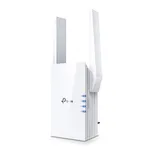
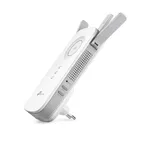
In the quest for seamless and robust Wi-Fi coverage throughout larger homes or offices, network extenders play a crucial role. The TP-Link AX1800 Wi-Fi Range Extender emerges as a compelling solution, leveraging the latest Wi-Fi 6 (802.11ax) standard to deliver significantly improved speeds, capacity, and efficiency over its predecessors. This device is engineered to tackle common dead zones and weak signal areas, ensuring a more stable and responsive internet experience for all connected devices. Its dual-band capabilities, offering speeds up to 1800 Mbps (574 Mbps on 2.4 GHz and 1201 Mbps on 5 GHz), are particularly noteworthy for supporting bandwidth-intensive activities like streaming high-definition content, online gaming, and concurrent use by multiple users.
Beyond raw speed, the AX1800 integrates advanced Wi-Fi 6 technologies such as OFDMA and MU-MIMO, which are designed to enhance network efficiency, especially in environments with a high density of connected devices. OFDMA allows the router to communicate with multiple devices simultaneously in a single transmission, reducing latency and improving overall network performance. MU-MIMO (Multi-User, Multiple Input, Multiple Output) enables the router to send data to multiple devices at the same time, further boosting capacity. This makes the TP-Link AX1800 a forward-thinking investment for users looking to future-proof their home network and ensure optimal performance as the number of smart devices continues to grow.
Key Features and Performance
The TP-Link AX1800 distinguishes itself with its robust hardware and intelligent software features. The dual-band operation is critical, allowing it to aggregate speeds of up to 1800 Mbps, split between the 574 Mbps on the 2.4 GHz band and a substantial 1201 Mbps on the 5 GHz band. This split is ideal for balancing range and speed, with the 2.4 GHz band offering broader coverage and the 5 GHz band providing faster, less congested connections for demanding applications. For enhanced connectivity and easier management, the extender features a Gigabit Ethernet port, which can be utilized to create a wired backhaul to the main router or to provide a wired connection for a stationary device, such as a smart TV or gaming console, effectively turning the extender into a wireless access point.
Seamless Roaming and Installation
One of the standout benefits for users experiencing Wi-Fi dead spots is the promise of a more cohesive network experience. While the specifications don't explicitly detail OneMesh support, TP-Link's ecosystem often integrates this feature, which aims to provide seamless roaming between the main router and the extender. This means devices can automatically switch to the strongest Wi-Fi signal as you move around your home without interrupting your connection. Furthermore, the setup process is typically streamlined, often featuring a WPS button for quick pairing with compatible routers and a user-friendly web interface or mobile app for more advanced configuration, making network expansion accessible even for less technical users.