
For many, the productivity mantra 'Eat the Frog' — tackling the most daunting task first — has always been logically sound but practically challenging. The inherent difficulty of identifying and then initiating these 'frogs' often leads to procrastination, even when the benefits of completion are clear. This internal struggle, where essential tasks are circumvented by less critical, yet seemingly more manageable, activities, highlights a common bottleneck in personal and professional productivity. The core issue isn't a lack of understanding the principle, but rather the emotional friction and perceived magnitude of the task that prevents the initial step.
The integration of artificial intelligence, specifically large language models like Google's Gemini, offers a novel approach to overcoming this common hurdle. By leveraging AI's analytical capabilities, individuals can move beyond simply identifying a 'frog' to understanding the underlying reasons for avoidance and breaking down daunting tasks into actionable, bite-sized components. This AI-assisted strategy reframes procrastination not as a failure of willpower, but as a solvable problem of task management and cognitive load.
Leveraging Gemini for Enhanced Productivity
The 'Eat the Frog' methodology, popularized by Brian Tracy, advocates for confronting the most challenging or unpleasant task at the start of the day. The rationale is that completing this 'frog' first liberates mental energy and makes subsequent tasks feel significantly easier. However, the effectiveness of this rule hinges on accurately identifying the true 'frog' and overcoming the psychological resistance to starting it. For many, the perceived 'hardness' of a task generates anxiety, leading to avoidance behaviors rather than direct engagement.
Google's Gemini, when prompted strategically, can act as a sophisticated productivity assistant. It can dissect the emotional and cognitive barriers associated with specific tasks, offering tailored insights that traditional productivity tools often lack. This goes beyond simple task management; it involves understanding the user's relationship with their workload and providing actionable strategies to dismantle procrastination patterns.
Identifying the 'Real Frog' with AI Assistance
The initial step in applying the 'Eat the Frog' rule is accurately identifying the primary task to be addressed. Often, individuals default to broad or urgent tasks rather than the ones that truly represent their biggest obstacle. A prompt designed to probe Gemini for the task causing the most underlying stress, rather than just the closest deadline, can yield significant insights.
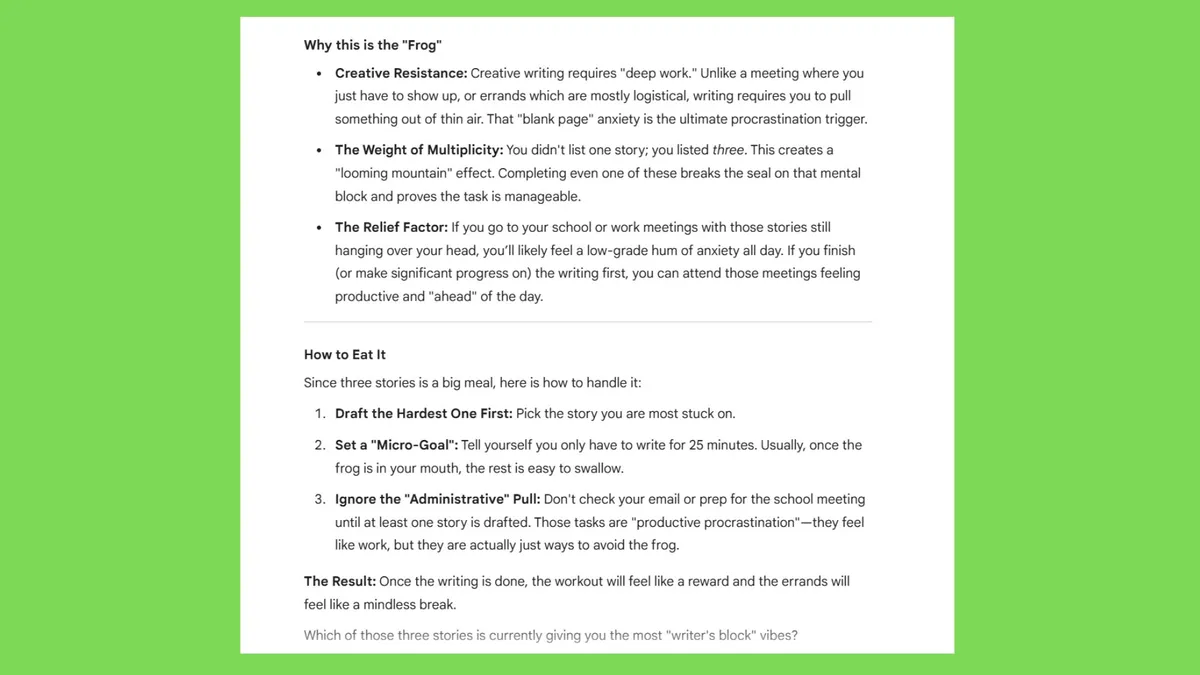
By asking Gemini to analyze a list of tasks and identify the one most likely being avoided due to its emotional weight or the sense of relief its completion would provide, users can gain clarity. Gemini can highlight tasks that are consistently thought about, circled around with less important activities, and whose completion would genuinely lighten the mental load for the rest of the day. This AI-driven identification moves beyond superficial urgency to address the core of procrastination.
Unpacking the Reasons for Avoidance
Once the 'frog' is identified, understanding the root causes of avoidance is crucial. Generic reasons like 'it's hard' are insufficient. Gemini can be prompted to dissect these reasons into more specific, actionable components. For instance, the AI can identify if a task feels overwhelming because it is too broad, if the outcome is uncertain, or if the initial steps are not clearly defined.

By breaking down the avoidance into these granular reasons, Gemini helps reframe the task. Instead of a monolithic obstacle, it becomes a series of more manageable challenges. This process encourages users to see that the resistance often lies in the anticipation or the undefined nature of the task, rather than an inability to perform it. Gemini's ability to offer such nuanced analysis is a powerful tool for overcoming psychological barriers.
Shrinking the Task for Actionability
Perhaps the most impactful application of Gemini in this context is its ability to 'shrink' the identified 'frog' into a 10-minute actionable version. This approach directly combats the feeling of overwhelm by removing the expectation of immediate completion of the entire task. It transforms the choice from 'do it all or do nothing' into 'take a small, meaningful first step.'

This AI-assisted task reduction is akin to the '2-minute rule,' focusing on creating momentum rather than demanding immediate mastery. By defining a small, achievable segment of the larger task—such as drafting an opening paragraph for a lengthy document—Gemini makes the initiation phase significantly less daunting. This strategy is instrumental in overcoming the inertia that often accompanies difficult tasks.
Defining the Precise First Action
Even with a shrunk task, the 'blank page' problem or the ambiguity of where to begin can still be a barrier. Gemini can be prompted to provide an extremely specific, almost ridiculously simple, first action or question. This level of detail removes any need for self-negotiation or decision-making at the outset, making it easier to start even with minimal motivation.

For example, instead of a general instruction like 'start writing,' Gemini might provide a precise directive such as 'write the first sentence of your introduction.' This hyper-specificity ensures that the user's focus is solely on executing a single, small step, thereby building momentum and reducing the perceived complexity of the overall task.
The Unexpected Benefit: Reduced Overwhelm
The most significant discovery from using Gemini with the 'Eat the Frog' method was not an increase in personal optimization, but a profound reduction in feelings of overwhelm. Unlike many productivity tools that can sometimes amplify pressure to perform, Gemini's approach focused on making the tasks themselves feel less burdensome. It facilitated a shift from facing an enormous, dreaded task to engaging with a small, manageable initial action.

While Gemini cannot complete the work itself, its ability to demystify daunting tasks, identify the root causes of avoidance, and break down actions into the smallest possible steps is invaluable. This AI-powered strategy transforms the intimidating 'frog' into a less impossible challenge, making the act of starting—often the hardest part—achievable.
Impact Analysis
The integration of AI tools like Gemini into established productivity frameworks, such as 'Eat the Frog,' signifies a potential paradigm shift in how individuals approach task management and procrastination. By providing personalized, analytical support, AI can address the psychological and cognitive barriers that often undermine traditional methods. This approach not only enhances efficiency but also promotes a healthier relationship with work by reducing anxiety and overwhelm. As AI continues to evolve, its role in personal productivity is likely to expand, offering more sophisticated solutions for overcoming procrastination and achieving goals.