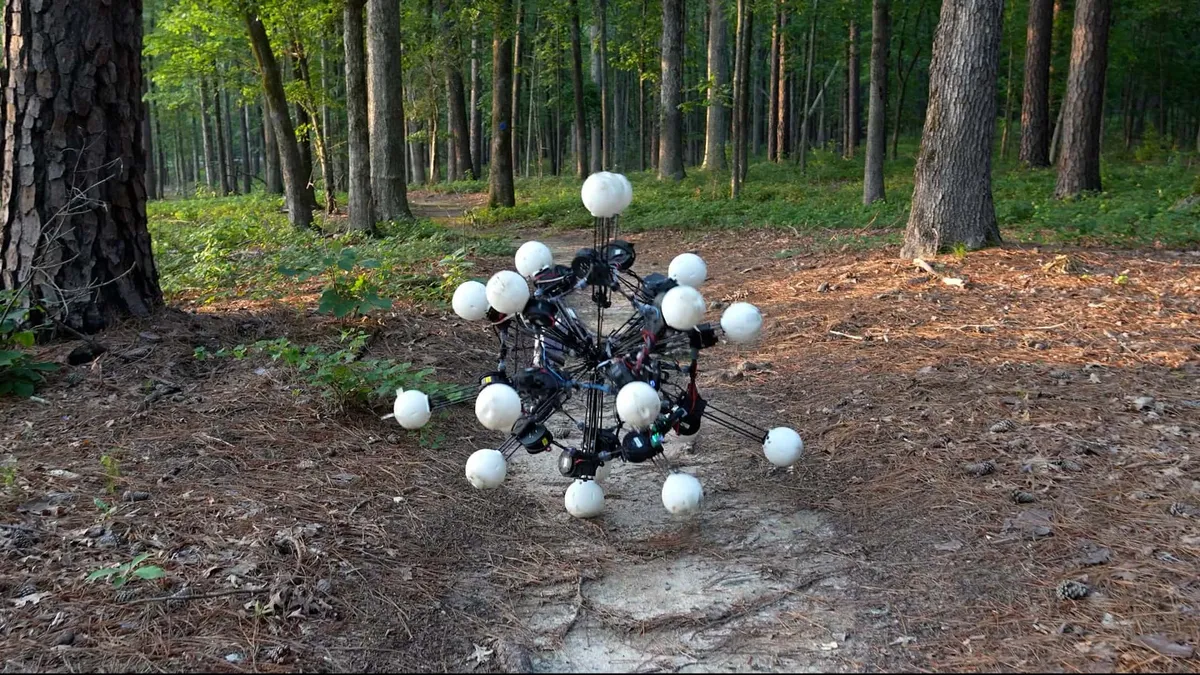
The field of robotics has long drawn inspiration from the natural world, mimicking the forms and gaits of animals like dogs and insects to create agile machines. However, a groundbreaking development from Duke University challenges this conventional approach. Researchers have introduced Argus, a novel robot that eschews traditional biological resemblance in favor of a design centered on a principle they term "dynamic isotropy." This unique spherical robot, equipped with 20 telescoping legs tipped with cameras, navigates complex terrains by focusing on its ability to exert equal force and accelerate uniformly in all directions, a radical departure from designs optimized for forward motion or specific postures.
Argus's design is characterized by its lack of a discernible front or back, allowing it to move and adapt without needing to reorient itself. Each of its 20 legs is fitted with depth cameras, providing a near-360-degree view of its surroundings. This omnidirectional perception and propulsion system enable Argus to traverse challenging landscapes, including grass, sand, and dense foliage, with remarkable resilience. The development suggests a paradigm shift in robotic engineering, moving away from anthropomorphic or zoomorphic forms towards a more physics-based approach to mobility and control.
Rethinking Robot Design: The Principle of Dynamic Isotropy
Traditional robotics often relies on bio-mimicry, with humanoid robots mirroring human movement and quadrupedal robots emulating canine or equine locomotion. While this has led to sophisticated robotic systems, it inherently carries a bias towards specific forms and functions. The Duke University team, however, posed a different fundamental question: what if the ideal robotic form is one that can act with equal efficacy in every direction?
This question led to the concept of "dynamic isotropy," a metric that quantifies how evenly a robot can accelerate its center of mass across all possible directions. A score of 1 signifies near-perfect uniformity in this capability. In contrast, many advanced robots, including sophisticated quadrupeds and humanoids, typically score below 0.6 on this scale. Argus, in its current iteration, achieved an impressive score of 0.91, demonstrating its exceptional omnidirectional performance capabilities.
Argus: Design and Capabilities
The development of Argus involved extensive simulations, with researchers testing over 1,500 potential robot designs to identify the optimal configuration for dynamic isotropy. The physical prototype that emerged features 20 identical cable-driven linear legs arranged around a central frame, geometrically resembling a dodecahedron. These legs extend outward like the spines of a sea urchin, enabling the robot's unique rolling and shuffling locomotion.
In practical tests, Argus exhibited remarkable adaptability and robustness. It successfully navigated diverse surfaces such as concrete, grass, bark, dense vegetation, soft sand, and wet terrain. The robot demonstrated the ability to overcome obstacles approximately five inches high and maintained functionality even when one, two, or three legs were disabled. Furthermore, it could carry a 10-pound payload mounted to its side while sustaining nearly its commanded speed, showcasing its capacity for stable manipulation alongside locomotion.
Addressing Real-World Challenges
Despite its promising performance, Argus is not yet ready for deployment in complex, unstructured environments like disaster zones or extraterrestrial exploration. Real-world trials revealed a significant drop in success rates for object-tracking and pushing tasks compared to simulations. A primary challenge encountered was the overheating and desynchronization of the robot's time-of-flight cameras during repeated operational cycles. The increased number of legs also introduces complexities, including more actuators, greater weight, heightened control demands, and a higher potential for component failure.
The research team acknowledges these inherent trade-offs. Their objective is not to mandate that all future robots adopt Argus's specific form, but rather to introduce a new, more effective metric for evaluating robotic design. By shifting the focus from biological imitation to principles of dynamic symmetry, they aim to unlock new possibilities in robotic agility and adaptability. The success of Argus serves as a proof of concept, demonstrating that robots designed for dynamic symmetry can indeed operate effectively in challenging, real-world conditions, even in reduced gravity environments.
Impact Analysis
The Argus project represents a significant conceptual leap in robotics, proposing "dynamic isotropy" as a fundamental design principle. This approach moves beyond the limitations of bio-mimicry, suggesting that optimal robotic mobility might be achieved through a deeper understanding of physics and mathematics rather than direct imitation of nature. The implications are far-reaching, potentially leading to the development of robots that are inherently more resilient, adaptable, and versatile in unpredictable environments. Such robots could revolutionize fields ranging from search and rescue operations and industrial inspection to planetary exploration, where the ability to move and operate effectively in any direction, without the need for constant reorientation, is paramount.