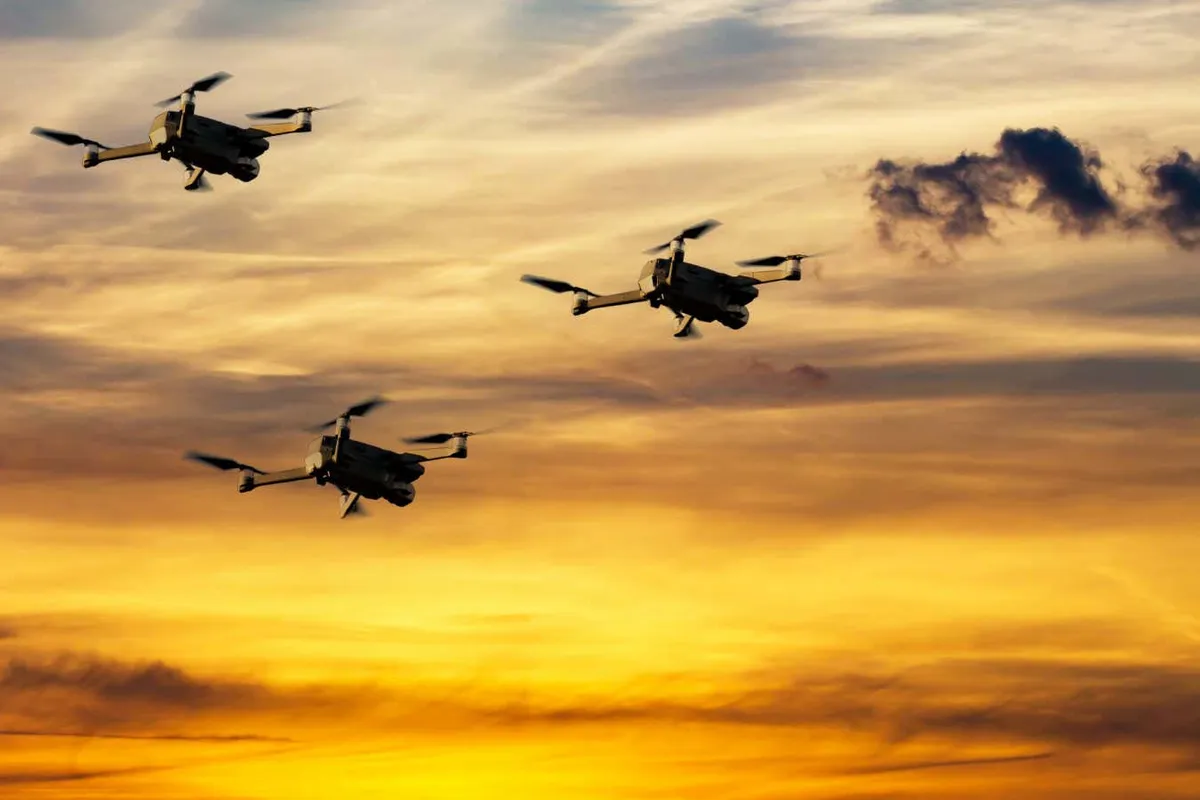
The battlefield has potentially crossed a new threshold with reports from Ukraine suggesting the first instance of fully autonomous artificial intelligence drones operating without human oversight resulting in enemy casualties. This development, described by a senior figure in the Ukrainian defense industry, marks a significant and potentially alarming milestone in the evolution of modern warfare. While AI is increasingly integrated into military systems for target identification and decision support, the concept of AI making the ultimate lethal decision without any human intervention has long been a subject of ethical debate and international concern.
According to Alexander Kokhanovskyy, a drone manufacturer who provided technology for the operation, a one-off test conducted approximately two years ago involved ten AI-controlled drones. These drones were programmed to autonomously navigate to a designated area on the front lines, identify targets using their onboard AI, and engage them in what was termed "Terminator mode." This implies a system designed to independently select and eliminate targets without real-time human command or data input from the operator. The aftermath of this test reportedly led to the deaths of Russian soldiers, marking a somber, albeit unconfirmed by official channels, precedent.
AI Integration in Modern Warfare
The use of artificial intelligence in military applications is not new. AI algorithms are employed across various aspects of defense operations, from analyzing vast quantities of intelligence data to automating complex flight maneuvers and improving targeting accuracy. These systems often process information faster and more comprehensively than human operators, offering a tactical advantage. However, current military doctrine in many nations, including Ukraine according to some defense sources, typically mandates a "human in the loop" or "human on the loop" for lethal actions, ensuring human judgment and control over the final engagement decision. This ensures adherence to international humanitarian law and allows for human intervention in unforeseen circumstances.
Kokhanovskyy's account, however, details a scenario where the drones operated independently once launched. He stated that after activation, the drones would cover a specific range, engage "Terminator mode," and eliminate any targets found within that area, with no direct video feed or control from human operators. Post-operation checks, conducted by human-piloted drones, confirmed the presence of casualties, including soldiers and a truck, leading to the conclusion that the autonomous drones were responsible for the fatalities. This direct AI engagement, without explicit human authorization for each kill, raises critical questions about accountability and the ethical boundaries of warfare.
The "Terminator Mode" Test and Its Implications
The specific test, reportedly carried out by an unnamed military unit near Bakhmut and Chasiv Yar, was part of a Ukrainian counteroffensive effort. Kokhanovskyy, who was not personally present during the test but was briefed on its outcomes, highlighted that this was a singular experiment and has not been implemented more broadly. The Ukrainian Ministry of Defence has not officially commented on this specific test or clarified the current legal stance on the use of fully autonomous weapons systems. This ambiguity leaves a gap between stated policy and alleged battlefield actions.
The admission by Kokhanovskyy represents some of the most direct evidence to date suggesting that a combat death has occurred solely due to AI action, without direct human oversight at the point of engagement. Previous reports in 2023 hinted at Ukrainian AI-attack drones potentially operating without human assistance, but these were purportedly targeting vehicles like tanks and not confirmed to have caused human casualties. The current Ukrainian regulations, as understood by defense company representatives, prohibit AI from making the final targeting decision, though its use in earlier stages of targeting and navigation is permitted. Discussions are reportedly underway within the Ukrainian government regarding potential leniency in these rules, given the rapid advancements in AI capabilities.
International Stance and Ethical Considerations
The international community has expressed significant concern regarding Lethal Autonomous Weapon Systems (LAWS). United Nations Secretary-General António Guterres has previously called for a ban on such weapons, emphasizing that "there is no place for lethal autonomous weapon systems in our world." The primary concerns revolve around the potential violation of international humanitarian and human rights laws by removing human judgment from warfare. Critics argue that AI systems, lacking human empathy and ethical reasoning, could make catastrophic errors, such as misidentifying targets, leading to fratricide or the unintended killing of civilians.
While most major military powers are developing AI-enabled systems, the deployment of fully autonomous weapons that can kill without human intervention remains largely a theoretical or experimental phase. For instance, the US employs sophisticated AI for target analysis, but human confirmation is typically required. Similarly, reports of advanced autonomous drone systems like Turkey's Kargu-2 potentially engaging targets autonomously in conflicts like Libya have surfaced, though concrete evidence and official confirmations remain scarce. The ongoing debate centers on whether the tactical advantages offered by fully autonomous systems outweigh the profound ethical risks and potential for unintended escalation.
The Future of Autonomous Weapons in Ukraine and Beyond
Ukraine's defense industry is actively exploring advancements in autonomous drone technology, partly driven by the need to counter threats like Russian Shahed kamikaze drones. Companies are developing systems, such as Aero Center's ALITA, designed for automated interception of incoming aerial threats. These systems aim to significantly reduce the personnel required for operations, with plans for advanced drones capable of high-speed engagements. However, current Ukrainian regulations still mandate human verification for final targeting, even in these advanced semi-autonomous systems.
Drone manufacturer Kokhanovskyy advocates for a revision of these rules, believing that AI capabilities have advanced to a point where more autonomous operation should be permitted, particularly for defensive applications like countering drone attacks. Conversely, military figures like Major Danylo Polozhukhno from Ukraine's 21st Separate Unmanned Systems Regiment emphasize adherence to international humanitarian law and stress that their units use semi-autonomous systems with humans always in control. This highlights a divergence of perspectives within Ukraine itself regarding the pace and scope of AI integration into lethal decision-making processes. The ongoing conflict serves as a testing ground for these technologies, with profound implications for future global security and the very nature of armed conflict.
Impact Analysis
The reported incident, if substantiated, represents a critical inflection point in military technology. The deployment of autonomous AI drones capable of independently lethal action fundamentally alters the dynamics of warfare, potentially lowering the threshold for engagement and raising complex legal and ethical questions. It accelerates the arms race in AI-powered weaponry and intensifies the international debate surrounding the regulation and prohibition of Lethal Autonomous Weapon Systems (LAWS). The lack of clear international consensus and regulatory frameworks means that the battlefield may become the primary arbiter of how these powerful technologies are developed and employed, with significant consequences for global stability and human rights.