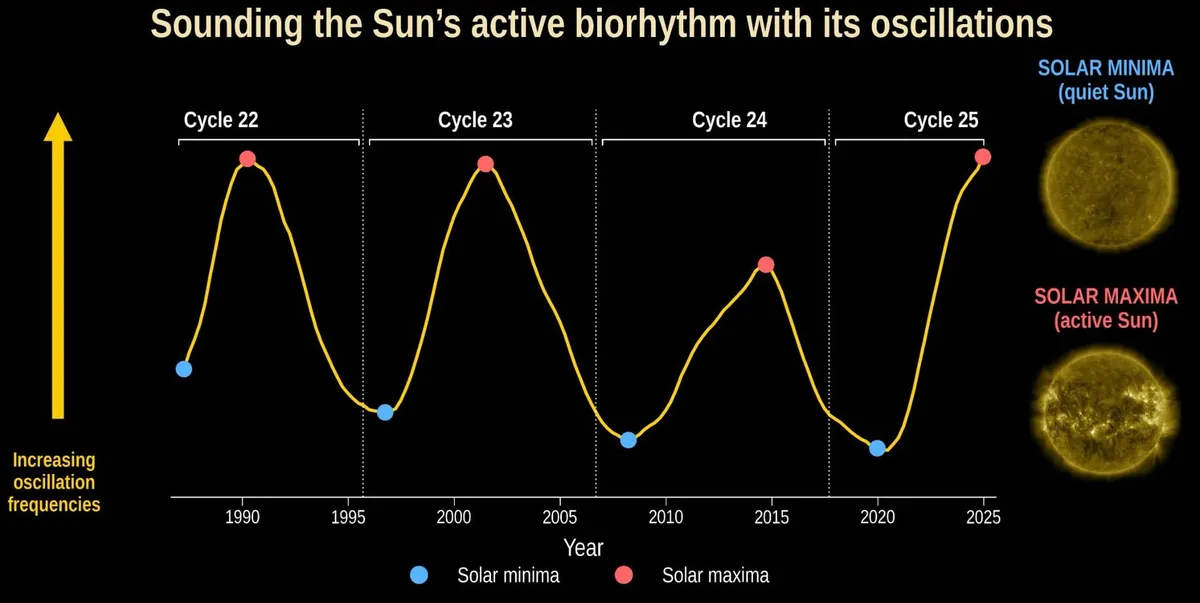
Astronomers have identified significant long-term shifts in the Sun's behavior, distinct from its typical 11-year cycle. Utilizing four decades of data from the Birmingham Solar Oscillations Network (BiSON), researchers observed a peculiar mismatch between the Sun's internal oscillations (p-modes) and surface activity proxies such as sunspots.
The study, published in the Monthly Notices of the Royal Astronomical Society, indicates that in the current solar cycle, internal magnetic activity appears stronger just below the surface, while surface indicators like sunspot numbers are relatively weaker. This suggests that the Sun's magnetic flux is becoming increasingly concentrated in subsurface layers, a trend that has grown over successive cycles.
These findings, derived from helioseismology, highlight the limitations of relying solely on surface observations and underscore the complexity of the solar dynamo. The research could lead to improved space weather predictions by incorporating a deeper understanding of the Sun's internal dynamics.