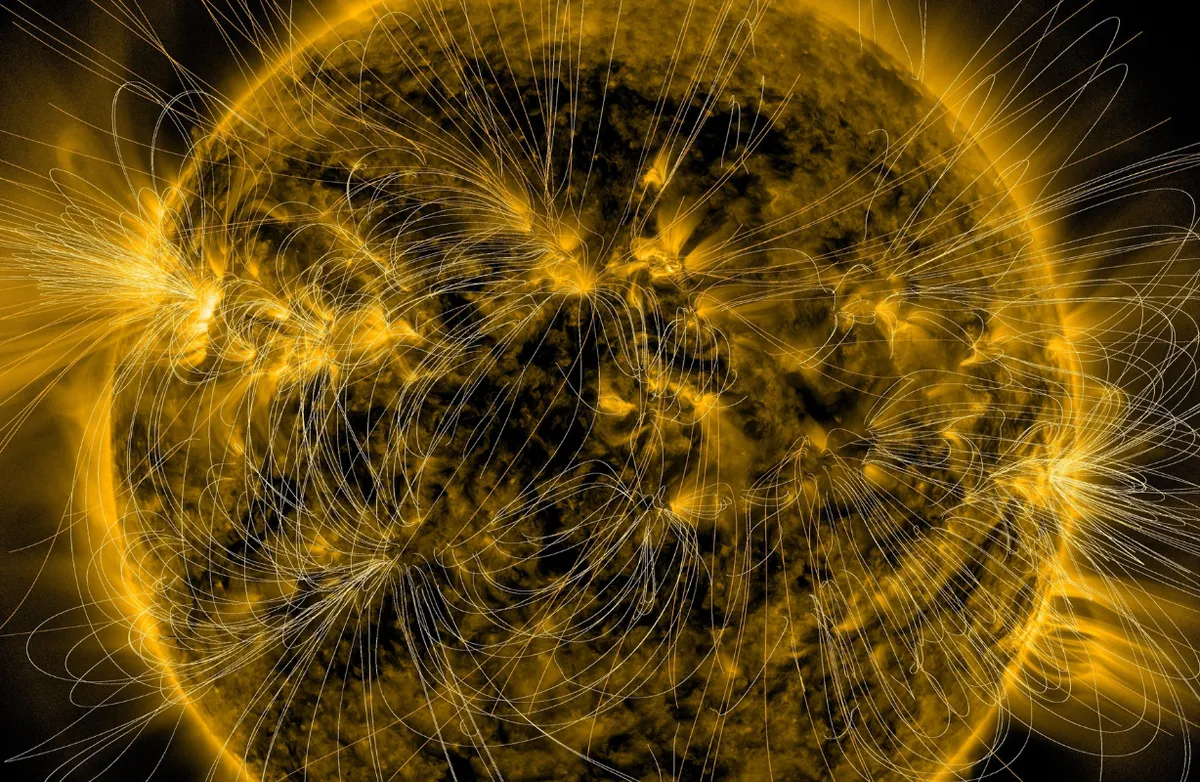
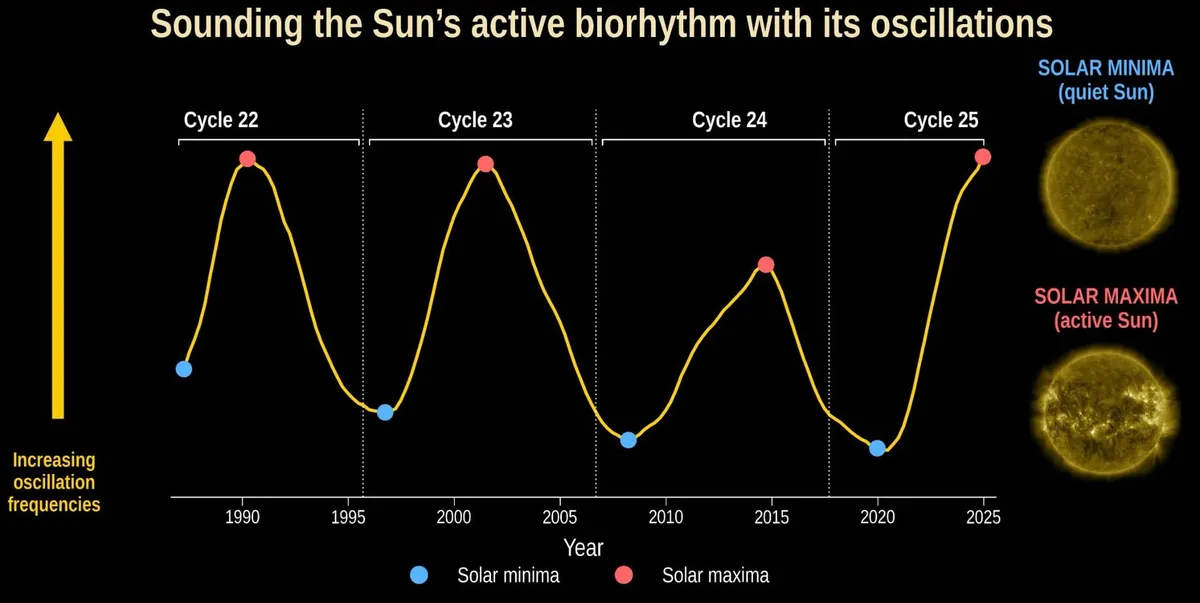
Recent findings published in the Monthly Notices of the Royal Astronomical Society reveal significant, long-term changes in the Sun's behavior that have remained undetected for over a decade. These shifts are particularly notable in the internal oscillations of the star, a phenomenon studied through helioseismology. While the Sun is known to undergo an approximately 11-year cycle of magnetic activity, peaking at solar maximum with increased sunspots and solar flares, and quieting down at solar minimum, new analysis of extensive observational data has uncovered a peculiar divergence between surface activity and internal wave patterns.
The study, led by Bill Chaplin, a professor of astrophysics at the University of Birmingham, utilized four decades of data from the Birmingham Solar Oscillations Network (BiSON). This network has been meticulously tracking the Sun's oscillations, specifically the pressure (p-mode) waves, since 1976. These p-modes act as internal seismometers, their frequencies changing in response to variations in the Sun's magnetic field. By comparing these internal signals with surface proxies like sunspot numbers and radio flux, astronomers have identified a growing mismatch, suggesting that the Sun's magnetic activity is behaving in ways not fully captured by traditional surface observations.
Emerging Discrepancies in Solar Activity Proxies
P-mode Oscillations Reveal Hidden Magnetic Activity
The research highlights that while surface proxies such as sunspot counts and radio flux are indicators of the Sun's magnetic field strength, they do not provide a complete picture of the internal dynamics. The BiSON data shows that in the current solar cycle, Cycle 25, the high-frequency p-mode oscillations – which penetrate just beneath the Sun's visible surface – exhibit a strength comparable to previous cycles like 22 and 23. However, the corresponding surface activity, measured by sunspots and radio flux, appears comparatively weaker. This discrepancy implies that the Sun's magnetic flux is increasingly concentrated in a layer several hundred miles below the surface, a trend that has become more pronounced with each successive solar cycle.
Professor Chaplin emphasized that surface proxies offer a generalized view, whereas p-modes allow for a more nuanced investigation into what is actually occurring beneath the visible photosphere. The tendency to assume that solar cycles are identical and repetitive is being challenged by these findings. "I think what's becoming clear is that that isn't the case. No cycle is the same as another," Chaplin stated, underscoring the unique characteristics of each solar cycle and the need for more sophisticated analytical tools to understand them.
Helioseismology as a Tool for Solar Insight
Helioseismology, the study of seismic activity within the Sun, has been crucial in uncovering these subtle but significant changes. Unlike traditional methods of observing sunspots, which have been practiced for centuries, helioseismology provides a window into the Sun's interior. The long-term, continuous data collected by BiSON has enabled astronomers to detect phenomena previously undetectable, including the so-called "glitches" and these emerging patterns of internal magnetic activity.
The implications of this research extend beyond understanding solar cycles. It suggests that surface-based observations alone might be insufficient for accurately characterizing the Sun's magnetic behavior. As solar activity continues to evolve, a deeper comprehension of its internal processes is vital for refining space weather predictions, which have direct impacts on Earth's technological infrastructure, including satellites and power grids. The study's findings pave the way for a more integrated approach, combining both surface and internal observations for a more holistic view of solar dynamics.
Long-Term Solar Trends and Future Research
Investigating the Hale Cycle and Solar Dynamo
Researchers are speculating that these long-term structural changes in the Sun's magnetic field might be linked to the Hale cycle, a longer magnetic cycle spanning approximately 22 years, which encompasses two consecutive 11-year solar cycles. The Sun's magnetic poles reverse their polarity after each 11-year cycle, and the Hale cycle represents the time required for the Sun to return to its original magnetic state. Understanding this longer cycle could provide further context for the observed discrepancies in activity proxies.
The ultimate goal of such detailed solar observation and analysis is to improve our understanding of the solar dynamo – the complex mechanism responsible for generating the Sun's magnetic field. This fundamental process remains one of the most significant mysteries in astrophysics. By employing helioseismology and correlating it with surface phenomena, scientists are making incremental progress in demystifying the Sun's inner workings. This knowledge is not only academically significant but also has practical applications in anticipating and mitigating the effects of hazardous space weather events.
Impact Analysis
The discovery of a consistent divergence between internal solar oscillations and surface magnetic activity proxies signifies a critical advancement in solar physics. This finding necessitates a re-evaluation of how solar magnetic behavior is monitored and predicted. For space weather forecasting, which relies heavily on understanding solar activity to predict geomagnetic storms and other phenomena impacting Earth, these new insights could lead to more accurate models. The implication is that future forecasts might need to incorporate internal solar dynamics more prominently. Furthermore, this research contributes to the broader field of stellar astrophysics by providing a unique case study of stellar dynamo evolution, potentially offering insights into the behavior of other stars in the universe. The ongoing monitoring of Cycle 25 will be crucial in determining if this trend continues and what its long-term consequences may be for solar activity and its terrestrial effects.