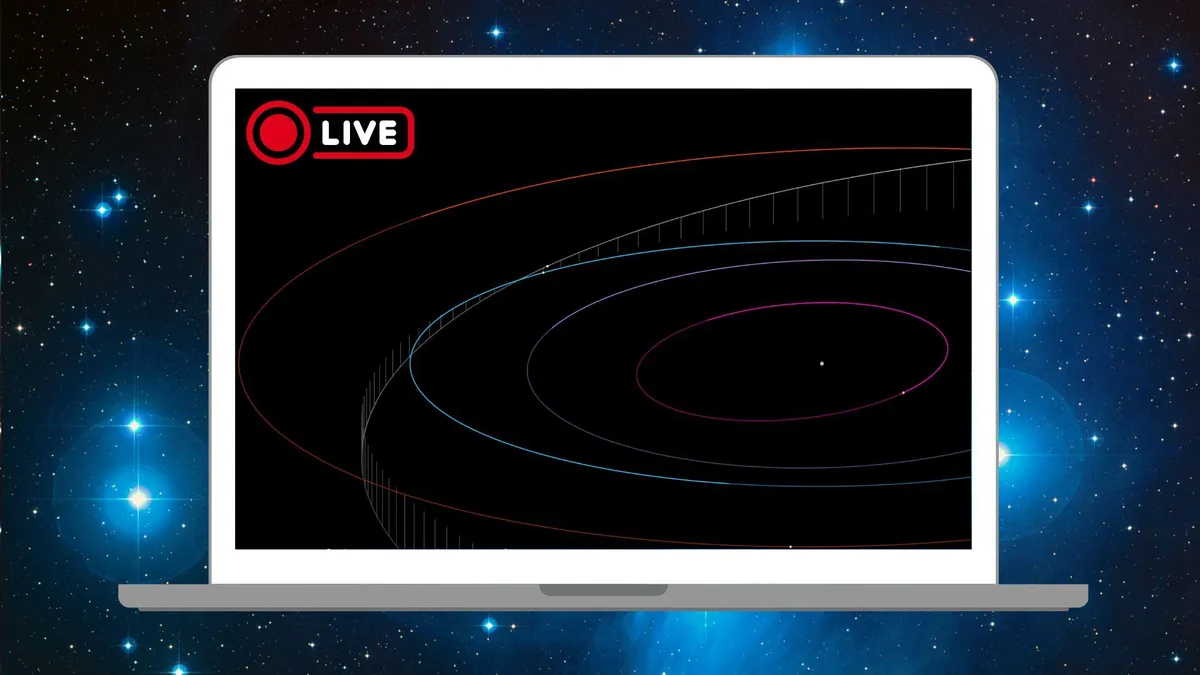
An asteroid comparable in size to an adult blue whale is scheduled to make a close flyby of Earth on May 18th. Designated 2026 JH2, this near-Earth object will pass our planet at a distance of approximately 56,628 miles (91,135 kilometers), which is about 24% of the average distance between the Earth and the Moon. While this is a close approach in astronomical terms, it poses no threat to Earth or its inhabitants. The event offers a unique opportunity for public observation through a live online stream.
The asteroid 2026 JH2 was identified on May 10th by the Mount Lemmon Survey, an astronomical observatory located in Arizona. Initial estimates, based on its observed brightness, suggest that the asteroid measures between 52 and 114 feet (16 to 35 meters) in diameter. Traveling at a significant velocity of approximately 19,417 miles per hour (31,248 km/h) relative to Earth at the time of its closest approach, the asteroid's trajectory is well-understood and poses no impact risk. This close encounter is an excellent chance to witness a celestial body of this magnitude pass by our planet without the need for specialized equipment, thanks to the efforts of astronomical organizations.
Observing the Asteroid Flyby Live
For enthusiasts eager to witness this celestial event, the Virtual Telescope Project is offering a free live broadcast via its YouTube channel. The stream is scheduled to commence at 3:45 p.m. EDT (19:45 GMT) on May 18th, provided that weather conditions are favorable. This initiative aims to make astronomical phenomena accessible to a global audience, allowing anyone with an internet connection to observe the asteroid's passage.
During the observation window, asteroid 2026 JH2 is expected to reach a peak apparent magnitude of 11.5. While this magnitude is too faint to be seen with the naked eye, advanced telescopes equipped for tracking fast-moving celestial objects will be able to capture it. The Virtual Telescope Project's founder, Gianluca Masi, noted that the asteroid will appear as a sharp point of light moving against a background of stars, which will appear as streaks due to the telescope's tracking of the asteroid. The observation will take place from the organization's facilities in Manciano, Italy, before the asteroid dips below the horizon.
The Trajectory and Future of Asteroid 2026 JH2
Following its close pass by Earth, asteroid 2026 JH2 will continue on its orbital path. Its orbit is notably elongated, taking it as far out as the vicinity of Jupiter before it swings back towards the Sun. This elliptical journey has a period of approximately 3.8 years, illustrating the dynamic nature of objects within our solar system and their vast orbital ranges.
The next time asteroid 2026 JH2 is predicted to approach Earth closely will be in the year 2060. On that occasion, its closest pass will be significantly farther than the current encounter, estimated to be around 17 times the Earth-moon distance. This future flyby, while still relatively distant, highlights the ongoing monitoring and prediction efforts by space agencies to understand and track near-Earth objects, ensuring planetary safety.