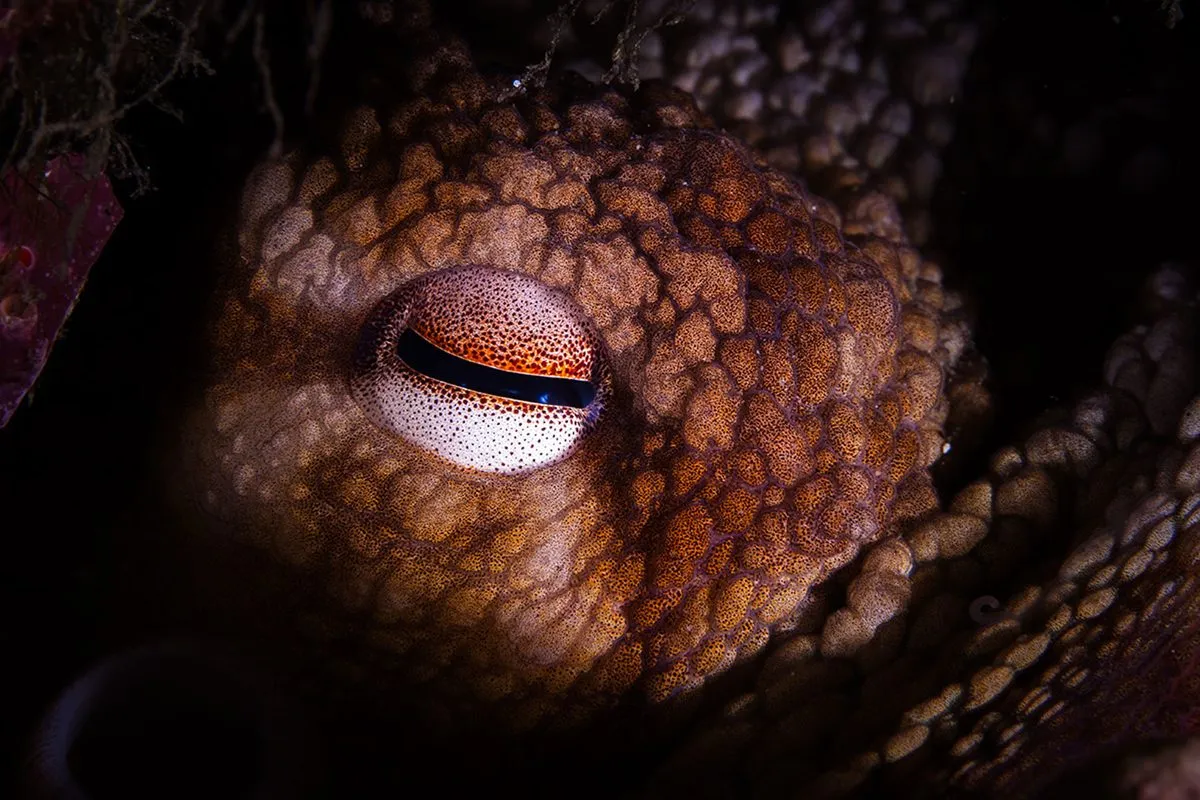
A groundbreaking study has revealed that colossal octopuses, some stretching up to an astonishing 19 meters (62 feet) in length, were the dominant apex predators in the oceans during the age of dinosaurs. These ancient cephalopods, identified from fossilized jaws, were not merely large but actively hunted and consumed other marine life, establishing themselves at the zenith of the Cretaceous marine food web.
Researchers meticulously analyzed fossilized jaw elements from two distinct species of finned octopus, Nanaimoteuthis jeletzkyi and N. haggarti, unearthed from Late Cretaceous sedimentary layers that date back approximately 100 to 72 million years. The extensive wear patterns observed on the jaws of adult specimens provide compelling evidence of their formidable predatory capabilities. These octopuses possessed powerful feeding apparatus capable of routinely crushing the hard shells and bones of their prey, positioning them as significant marine carnivores of their era. Their sheer size rivaled that of the largest marine reptiles that coexisted with them.
Fossil Evidence Reveals Ancient Cephalopod Dominance
The oceans of the dinosaur age were a complex ecosystem teeming with diverse life forms, including large marine reptiles, formidable fish, various shark species, ammonites, and substantial shell-bearing animals. Within this environment, the genus Nanaimoteuthis occupied a prime position. Lead author Yasuhiro Iba, an associate professor at Hokkaido University in Japan, explained that these creatures likely employed their immense bodies and elongated arms to capture prey, utilizing their powerful jaws to incapacitate and consume them. This combination of size and predatory strategy enabled them to be highly effective hunters operating at the very top of the marine food chain.
The scientific team employed an innovative technique known as digital fossil-mining. This advanced method involves converting the internal structures of rocks into high-resolution image datasets, subsequently utilizing artificial intelligence to extract detailed 3D fossil models. This sophisticated approach allowed for the discovery of 12 previously obscured octopus jaws, significantly enhancing the rate of fossil identification compared to conventional methods. Iba noted that this technique can boost fossil discovery rates by over 10,000 times.

The analysis of wear patterns on the fossilized jaws revealed an intriguing asymmetry, suggesting a consistent preference for using one side of the jaw over the other during feeding. This characteristic, akin to handedness in terrestrial animals, has led researchers to hypothesize that these ancient cephalopod giants may have possessed a high degree of intelligence. Such lateralized behavior is commonly observed in modern octopuses, which often exhibit a preference for specific arms and eyes.
Intelligence and Predatory Behavior of Ancient Octopuses
The possibility of such sophisticated behavior in these prehistoric invertebrates underscores their complex evolutionary history. The development of specialized predatory techniques, coupled with potential cognitive abilities like handedness, paints a picture of these ancient octopuses as highly developed organisms. Their successful reign as apex predators for millions of years suggests a sophisticated understanding of their environment and the hunting strategies required to maintain their position.
These formidable creatures may well represent the largest invertebrates ever documented. The research team has affectionately nicknamed them the “Cretaceous Kraken,” a moniker that aptly captures their immense size and presumed power. The existence of such colossal invertebrates challenges previous understandings of the limits of cephalopod evolution and the ecological dynamics of prehistoric marine ecosystems.
Extinction and Displacement by Modern Predators
Despite their dominance, the reign of the Cretaceous Kraken eventually came to an end. Their descendants, while still present in the deep sea, were ultimately supplanted by a new generation of apex predators. Professor Iba suggests that the decline of these giant octopuses was likely due to the rise of more modern predatory species, such as the early whales, which evolved to fill similar ecological niches.
This displacement highlights the continuous evolutionary arms race within ecosystems, where new adaptations and species can rapidly reshape the existing food web. The transition from giant cephalopods to marine mammals as the dominant predators marks a significant shift in the oceanic landscape, reflecting the ongoing processes of natural selection and adaptation over geological timescales.