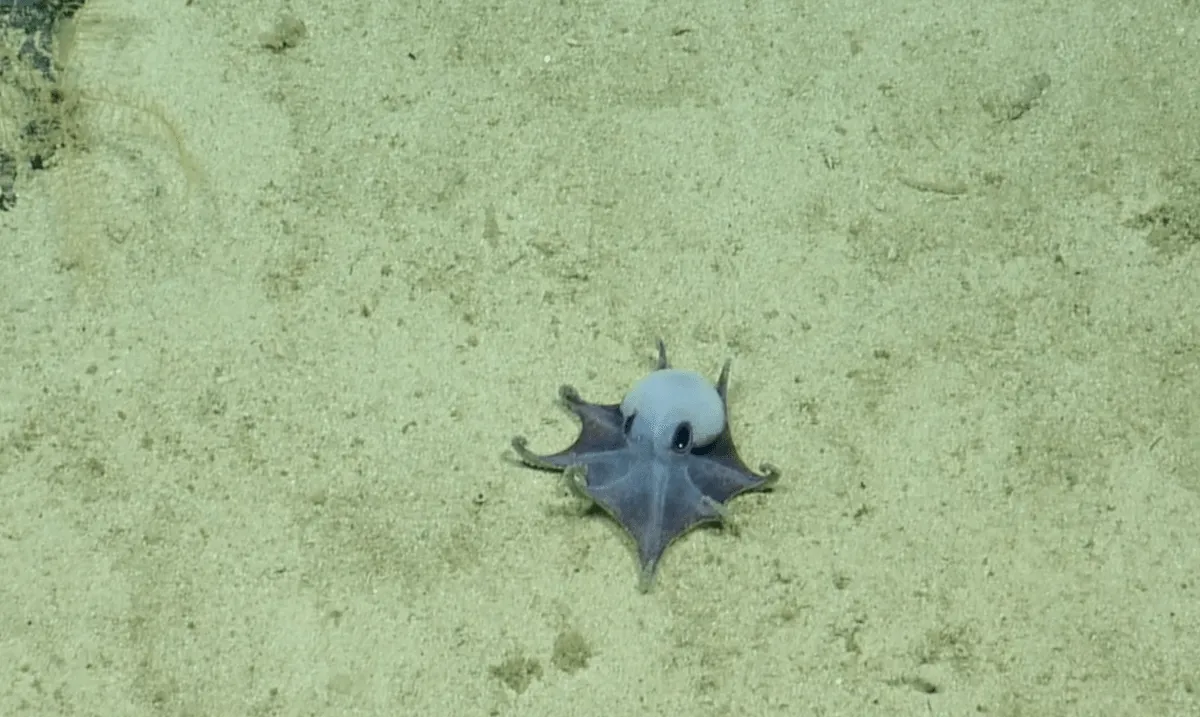
Marine biologists have announced the discovery of a new species of octopus, found thriving in the deep-sea underwater mountains adjacent to the Galápagos Islands. This remarkable cephalopod is small enough to fit in the palm of a hand, representing a significant find for deep-sea biodiversity research. The initial sighting occurred during a 2015 expedition aboard the research vessel E/V Nautilus, a collaborative effort involving the Charles Darwin Foundation (CDF) and the Galápagos National Park Directorate. Researchers were navigating a remotely operated vehicle (ROV) at a depth of approximately 5,800 feet (1,773 meters) when the vehicle's cameras captured an unusual, vibrant blue form against the abyssal plain.
The unexpected discovery was documented through video footage from the ROV, which also captured the scientists' audible expressions of surprise and wonder. Phrases like "It's blue!" and "Like one of those plushies" were recorded, highlighting the creature's striking coloration and diminutive size, which is comparable to a golf ball. Further exploration during the same expedition revealed two more individuals of the same species, suggesting a localized population. One of the initial specimens, along with other deep-sea organisms encountered, was carefully collected by the ROV and transported to the Charles Darwin Research Station on Santa Cruz Island for detailed study.
Discovery and Classification of Microeledone galapagensis
Upon initial examination at the research station, scientists were uncertain of the octopus's precise identity. They subsequently contacted Dr. Janet Voight, a renowned octopus expert at the Field Museum in Chicago, USA. Dr. Voight, who became the lead author of the study formally describing the new species in the journal Zootaxa, immediately recognized the specimen as something extraordinary. "Right away, I knew it was something really special," Dr. Voight stated, "I’d never seen anything like it." The preserved specimen was transported to Chicago for comprehensive analysis. To avoid invasive dissection, Dr. Voight utilized the Field Museum's advanced X-ray laboratory to perform micro-CT scans, allowing for an in-depth study of its internal structures without damaging the specimen.
The newly identified octopus has been scientifically named Microeledone galapagensis, a designation reflecting its Galápagos origin. Its classification places it within the genus Microeledone, sharing this group with Microeledone mangoldi, also known as the sickle-tooth pygmy octopus. Key characteristics that align Microeledone galapagensis with this genus include its smooth skin, which is notably lacking significant pigmentation on its dorsal side, a large rachidian tooth, and a well-developed funnel organ. These morphological traits provide strong evidence for its placement within this specific genus.
Distinguishing Features and Habitat
While sharing genus characteristics with Microeledone mangoldi, Microeledone galapagensis exhibits distinct differences, primarily observable in the distribution of pigment within its mantle. Furthermore, this new species is distinguished by its exceptionally small adult size, a relatively low number of arm suckers, and the notable absence of an ink sac, a common feature in many other octopus species. These unique attributes contribute to its specialized adaptation to its deep-sea environment.
Dr. Voight expressed profound gratitude for the opportunity to study these elusive creatures, emphasizing the vastness and unexplored nature of the deep ocean. "These are little octopuses that live in the deep sea, and hardly anybody on Earth has ever gotten to see them. I just feel lucky that I got to work with them," she commented. Her sentiment underscores the importance of continued deep-sea exploration, as vast regions of the Pacific Ocean, for instance, remain largely unmapped and unstudied, holding countless potential discoveries yet to be made.
The discovery was part of a broader 10-day expedition that surveyed various deep-sea habitats across the Galápagos archipelago. The expedition aimed to document the rich biodiversity of these underwater ecosystems, which are often less understood than terrestrial environments. The unique geological formations, such as underwater mountains, create specialized niches that can support endemic species, making areas like the Galápagos Marine Reserve critical for scientific research and conservation efforts.
The research team highlighted the significance of these findings in a scientific publication, providing detailed anatomical and genetic data that support the classification of Microeledone galapagensis as a new species. The study also touches upon the potential ecological role of these small octopuses within the deep-sea food web, though further research is needed to fully understand their behavior, diet, and reproductive strategies in such extreme conditions. The lack of an ink sac, for example, suggests alternative defense mechanisms or a reduced need for such a system in their specific environment, perhaps due to fewer predators or different predator avoidance strategies.