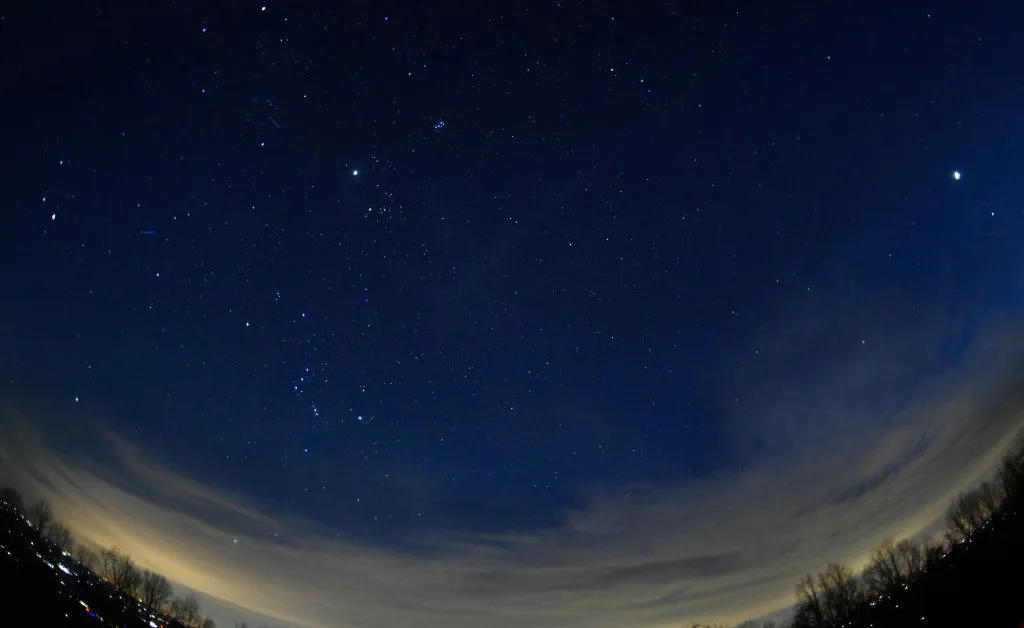
Celestial enthusiasts are in for a treat this weekend as multiple planets in our solar system prepare to align, creating a phenomenon known as a "planetary parade." This spectacular event occurs when several planets appear to gather together in the sky from our vantage point on Earth. Due to the nature of planetary orbits, which all lie roughly within the same plane around the Sun, opportune moments arise when their paths bring them into apparent proximity. NASA explains that this alignment makes the planets seem "bunched together in the sky," often appearing to form a line across the celestial sphere.
This particular planetary parade is notable for the number of celestial bodies involved. Observers will have the chance to witness six planets: Mercury, Venus, Jupiter, Saturn, Uranus, and Neptune, all aligning simultaneously. While seeing a few planets at once is a relatively common occurrence, with planetary parades happening annually, the alignment of as many as six planets is significantly rarer. Experts suggest that while spotting four or five planets concurrently is not unusual, the visibility of six distinct planetary bodies in such close apparent proximity is a less frequent event.
The Science Behind a Planetary Parade
A planetary parade is not a result of the planets physically clustering together in space, but rather a visual alignment from Earth's perspective. All planets in our solar system orbit the Sun in roughly the same orbital plane, a flat disk called the ecliptic. When multiple planets reach points in their orbits that are aligned along this plane and are also visible from Earth, they can appear to form a line or a "parade." This alignment is a geometric consequence of their positions relative to our planet and the Sun.
The Farmers’ Almanac highlights that such events, while not exceptionally rare in terms of frequency of occurrence each year, vary greatly in the number of planets involved and their visibility. The specific alignment involving six planets is considered a more uncommon spectacle, making it a noteworthy astronomical event for skygazers. The apparent closeness is purely coincidental from our viewpoint; the actual distances between these planets remain vast.
Optimal Viewing Conditions and Timing
The most favorable time to observe this impressive planetary alignment is anticipated to be on Saturday. For the best possible viewing experience, astronomers recommend finding a location with minimal light pollution. Areas far from city lights offer darker skies, which significantly enhances the visibility of fainter celestial objects. Furthermore, a clear, unobstructed view of the horizon is crucial, especially for spotting planets that may be closer to sunrise or sunset.
Checking the weather forecast is essential, as cloud cover can completely obscure the view. Patience is also a virtue for stargazing; allowing your eyes to fully adjust to the darkness can take up to 20-30 minutes. Once adapted, four of the planets—Jupiter, Saturn, Venus, and Mercury—may be visible to the naked eye under ideal conditions. However, to clearly see Uranus and Neptune, which are fainter and more distant, optical aid such as binoculars or a telescope will be necessary. Even Mercury, due to its proximity to the Sun and faintness, can be challenging to spot without magnification.
Impact Analysis
While a planetary parade is a captivating astronomical event that sparks public interest in space and science, its broader impact is primarily educational and inspirational. Such phenomena provide excellent opportunities for amateur astronomers and the general public to engage with celestial observation, fostering curiosity about our solar system. For educators and scientific communicators, it presents a timely chance to discuss planetary motion, orbital mechanics, and the vastness of space. From a scientific research perspective, while these alignments themselves do not typically lead to new discoveries, they serve as a reminder of the dynamic and observable nature of our cosmic neighborhood, encouraging further exploration and study of planetary science.