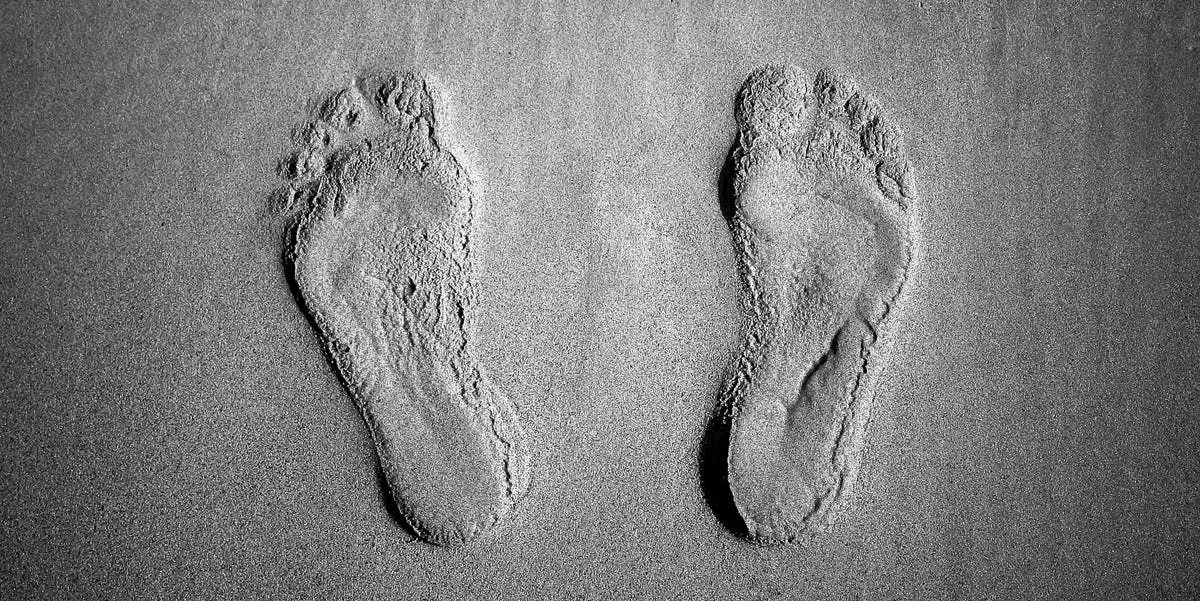
In the vast and arid expanses of Saudi Arabia's Nefud Desert, a remarkable discovery has been made: fossilized human footprints dating back approximately 115,000 years. Unearthed in 2017 at a site known locally as "the trace," these seven footprints offer a rare glimpse into the lives of early Homo sapiens during a pivotal period in Earth's history. The discovery, made possible by the erosion of overlying sediment revealing a prehistoric mudhole, places these individuals at the edge of a coming ice age, showcasing human presence and adaptation in a region that would dramatically transform with changing climate patterns.
The significance of these footprints is amplified by their context. They were found alongside hundreds of animal prints, indicating the mudhole was a vital watering source that attracted diverse fauna. This provides crucial insights into ancient ecosystems and the migratory routes of both humans and animals. The preservation of these delicate impressions in mud is a testament to the unique geological conditions that allowed such ephemeral traces to endure for millennia, offering a tangible connection to our distant ancestors.
Early Hominin Presence in the Arabian Peninsula
The preservation of these ancient footprints is a scientific marvel. Unlike typical fossilization, which often requires mineralization, these prints were preserved in a prehistoric mudflat. The research highlights that such detailed imprints in mud can degrade rapidly, often becoming unrecognizable within days. The exceptional preservation of the Alathar footprints suggests they were formed under specific environmental conditions that allowed the fine details to be captured and subsequently protected from rapid erosion, possibly by a subsequent layer of sediment or rapid drying.
Scientists utilized a combination of geological context and comparative analysis to date and attribute these footprints. Similar to methodologies like carbon dating, which relies on the decay of radioactive isotopes, paleontologists examine sedimentary layers and the surrounding fossil evidence. The footprints' size and morphology were compared to known Homo sapiens and Neanderthal populations of the era. The evidence strongly suggests that these prints were made by Homo sapiens, distinguishing them from other hominin species that may have inhabited the region or broader parts of Eurasia during that period.
Dating and Attribution of the Footprints
Determining the precise age of the Alathar footprints involved meticulous analysis of the geological strata in which they were found. The team examined the surrounding sediments and the faunal remains present at the site to establish a chronological framework. Radiometric dating techniques on associated materials, though not directly on the footprints themselves, provided an age estimate for the layer containing the human and animal tracks.
The attribution to Homo sapiens is based on comparative anatomy and the known migratory patterns of early hominins. The size and stride length of the footprints align more closely with early Homo sapiens than with the typically larger prints associated with Homo neanderthalensis. Furthermore, the archaeological evidence for the expansion of Homo sapiens into the Levant and Arabia between 130,000 and 80,000 years ago supports this conclusion, as Neanderthals were not prevalent in the Levant during that specific timeframe.
Paleoenvironmental Reconstruction and Behavioral Insights
The location of the Alathar site, identified as a former lakebed, is key to understanding the behavior of these early humans. During a dry period of the last interglacial, this lake would have been a crucial oasis in an increasingly arid landscape. The presence of numerous animal tracks alongside the human ones indicates that this was a shared resource, a vital stop on migration routes for many species seeking water.
The absence of significant archaeological evidence, such as stone tools or butchered animal bones, suggests that the human presence at Alathar was transient. The scientists propose that these early humans were primarily motivated by the need for potable water, stopping briefly at the lakeshore rather than establishing a long-term settlement or engaging in extensive hunting activities at this specific location. This points to a nomadic lifestyle dictated by resource availability and climatic conditions.
Implications for Understanding Early Human Dispersal
These ancient footprints provide compelling evidence for early Homo sapiens dispersal across the Arabian Peninsula, a region now recognized as a significant corridor for hominin migrations out of Africa. The findings underscore the adaptability of our species, capable of navigating and utilizing diverse environments, even those on the brink of climatic shifts like the onset of an ice age.
The discovery also contributes to a broader understanding of human-environment interactions in the Pleistocene epoch. It highlights how crucial water sources acted as focal points for both human and animal populations, shaping migration patterns and resource utilization. The study of such trace fossils is invaluable for reconstructing past behaviors and ecological dynamics that are not readily apparent from skeletal remains or artifact assemblages alone.
Impact Analysis
The discovery of these 115,000-year-old human footprints in Saudi Arabia is a significant addition to the paleoanthropological record. It provides tangible evidence of early Homo sapiens presence in the Arabian Peninsula, reinforcing its role as a critical pathway for human dispersal out of Africa during a period of climatic transition. The findings challenge previous assumptions about the timeline and routes of early human migrations, suggesting that hominins were more widely distributed and capable of adapting to challenging arid environments much earlier than previously thought.
Furthermore, the detailed preservation of these footprints and their surrounding faunal traces offers a unique window into Pleistocene ecosystems and the behavioral strategies of early humans. The interpretation of these tracks as evidence of brief, water-seeking visits provides a nuanced understanding of nomadic lifestyles and resource exploitation. This research enhances our ability to model early human movements and interactions with their environments, contributing to a more comprehensive picture of human evolution and dispersal across the globe.