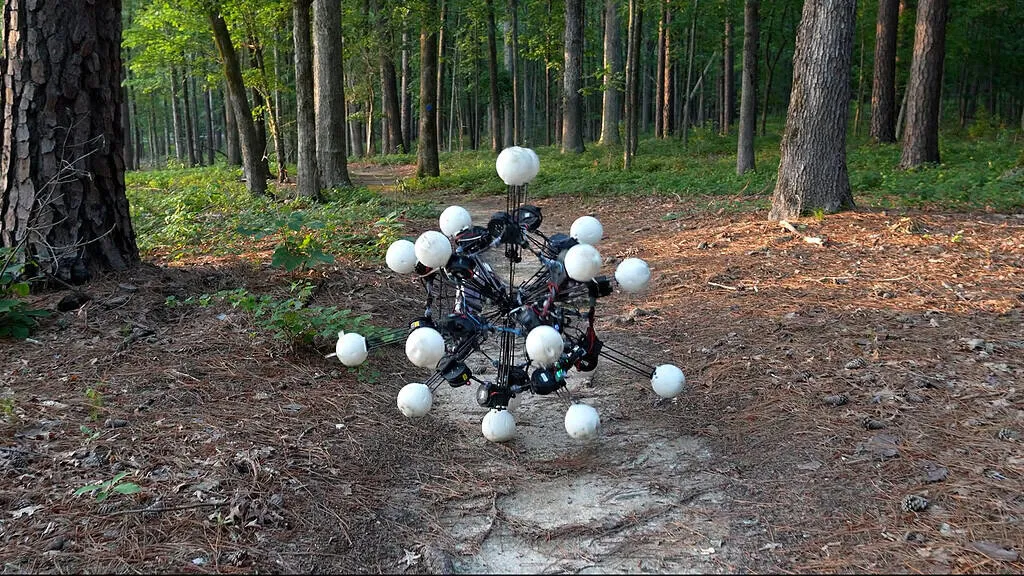
Duke University researchers have developed Argus, a unique robot that abandons traditional animal-like locomotion. Instead of walking or trotting, Argus rolls and shuffles using 20 telescoping legs, each equipped with a depth camera. This design is centered around the principle of 'dynamic isotropy,' enabling the robot to push and accelerate with equal efficiency in any direction, making its orientation irrelevant for movement and control.
Argus has demonstrated impressive capabilities in tests, navigating rough terrains, grass, sand, and wet surfaces, and maintaining stability even when legs are disabled or when pushed. Its omnidirectional vision system further enhances its ability to perceive and interact with its environment. This novel approach suggests a future for robotics that is less about mimicking biology and more about optimizing physical and mathematical principles for extreme adaptability in complex, unstructured environments.