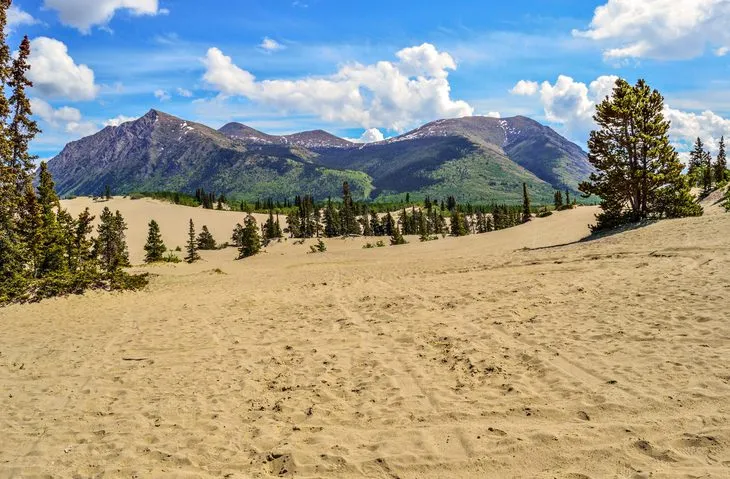
While often cited as the world's smallest desert, the Carcross Desert in Yukon, Canada, presents a fascinating case study in geographical classification. Spanning approximately 1 square mile (2.59 square kilometers) with a width of about 600 meters, its diminutive size has contributed to its popular, albeit inaccurate, moniker. However, scientific definitions of deserts hinge on precipitation levels, a metric that Carcross Desert significantly deviates from, challenging its status as a true arid environment.
The popular perception of deserts conjures images of extreme aridity and minimal rainfall. Geologists and climatologists typically classify arid deserts as those receiving less than 250mm (approximately 10 inches) of annual precipitation. Semi-arid regions, while drier than typical climates, receive a slightly higher but still limited amount, generally between 250mm and 500mm (10-20 inches) annually. It is within this latter category that the Carcross Desert technically falls, often receiving more rainfall than the strict threshold for an arid desert, particularly when considering its significant winter snowfall.
The Misconception of Carcross as a Desert
The designation of Carcross Desert as the 'world's smallest desert' is a widespread misconception. The key factor differentiating it from a true desert is its precipitation. Unlike hyper-arid regions characterized by extreme water scarcity, Carcross experiences a climate that, while still relatively dry compared to lusher environments, receives enough moisture to disqualify it from the 'arid desert' classification. The substantial amount of snowfall it accumulates during winter months further underscores this point, as snowmelt contributes to the overall annual precipitation.
Instead of a desert, Carcross is more accurately described as an extensive area of sand dunes. These dunes, formed over millennia, create a landscape that superficially resembles a desert, leading to the popular, yet scientifically imprecise, label. The unique conditions that created and maintain these dunes are a result of specific geological and climatic factors present in the region, rather than the extreme aridity characteristic of true deserts.
Geological Formation and Environmental Factors
Origins of the Carcross Sand Dunes
The formation of the Carcross Desert's unique landscape dates back approximately 11,000 to 24,000 years, a period following the retreat of massive glaciers from the surrounding valleys. As these colossal ice sheets receded, large glacial lakes formed. Over time, these lakes began to shrink, leaving behind extensive, exposed lakebeds. These lakebeds, rich in sand and fine sediment, became the foundation for the dunes.
The prevailing winds in the region played a crucial role in shaping these deposits into the dunes seen today. Strong north-westerly winds continuously picked up the sand and sediment from the former lakebeds, transporting and accumulating it. This aeolian process, driven by wind erosion and deposition, is responsible for the characteristic ripple patterns and undulating topography of the Carcross dunes, a process that continues to influence the landscape.
Climate and Precipitation Levels
The classification of a desert is fundamentally tied to its aridity, defined by low annual precipitation. True deserts receive less than 250mm of rain or equivalent moisture per year. Carcross, however, often exceeds this threshold, especially when its winter snowpack is factored into the annual precipitation totals. This higher moisture content means it doesn't meet the stringent criteria for an arid desert.
While not arid, the region can be classified as semi-arid, experiencing drier conditions than temperate zones but still receiving enough precipitation to support a different ecological profile than hyper-arid deserts. The presence of significant snow cover during winter months is a testament to this, creating a stark visual contrast with the sandy landscape and further challenging its desert classification.
Ecological Significance and Biodiversity
Flora of the Carcross Dunes
Despite not being a true desert, the Carcross area supports a unique array of plant life adapted to its sandy, relatively dry conditions. Species such as the Yukon lupine (Lupinus arcticus) and Baikal sedge (Carex baicalensis) are found here, notable for their often restricted geographical ranges, making Carcross a vital habitat for their survival.
These hardy plants have developed adaptations to thrive in the sandy substrate, enduring wind erosion and fluctuating moisture levels. Additionally, the edges of the dune system and surrounding areas are often bordered by resilient coniferous trees, such as spruce, which help stabilize the soil and provide a transition to the broader subarctic environment.
Fauna Inhabiting the Region
The Carcross dunes and the surrounding Yukon territory serve as a habitat for a variety of animal species. Mammals like mountain goats (Oreamnos americanus) and Dall sheep (Ovis dalli) are known to inhabit the mountainous terrain near Carcross, benefiting from the diverse vegetation and rocky outcrops that provide both food and shelter.
The area is also a haven for various insect species, particularly moths. Several species of moths, including Gnorimoschema moths and various species of dart moths (e.g., coast dart moths), have been documented in this environment. These insects play essential roles in the local ecosystem, contributing to pollination and serving as a food source for other wildlife.
Conservation and Recreational Use
Preserving the Unique Landscape
The Carcross Desert, despite its misnomer, is a geologically and ecologically significant site. Efforts are made to preserve its unique dune formations and the specialized flora and fauna that inhabit it. Understanding its true nature as a dune system rather than an arid desert is crucial for appropriate conservation strategies.
Balancing human activity with environmental protection is key. The delicate nature of sand dunes means they are susceptible to erosion from foot traffic and other disturbances. Conservation initiatives focus on educating visitors about responsible use and implementing measures to mitigate human impact, ensuring the long-term integrity of this distinctive Yukon landscape.
Recreational Activities
The Carcross Desert is a popular destination for various recreational activities, attracting both locals and tourists. Its expansive sandy slopes offer opportunities for activities such as sandboarding and dune buggy riding, providing a unique adventure experience in the subarctic landscape.
Hiking and photography are also popular pursuits, allowing visitors to explore the visually striking dune formations and the surrounding natural beauty. The stark contrast between the sand dunes and the often snow-capped mountains in the background creates a unique photographic backdrop. It's important for visitors to be mindful of the environment while engaging in these activities to minimize their impact on this sensitive ecosystem.