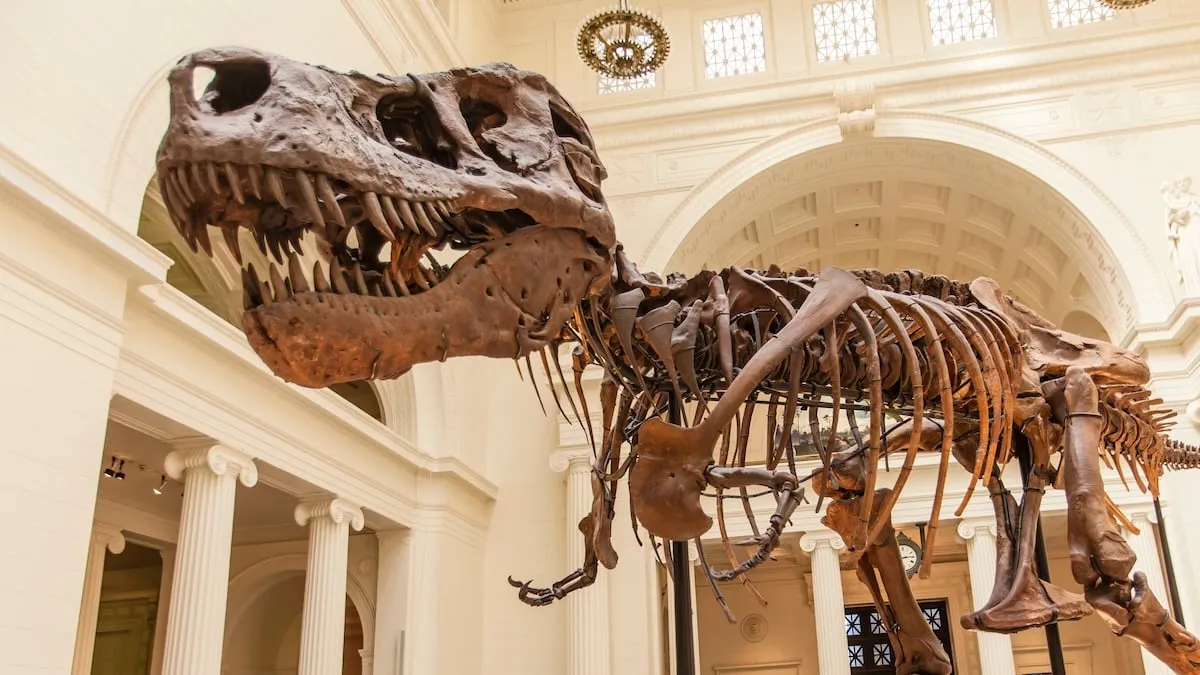
The iconic Tyrannosaurus rex, a dinosaur often depicted as a fearsome predator, has long been a subject of humor due to its conspicuously small forelimbs. While these diminutive arms have fueled countless jokes, recent scientific research offers a compelling explanation for their evolutionary development, potentially settling the long-standing debate about their purpose.
New findings suggest a direct correlation between the shrinking arms and the concurrent evolution of powerful jaws and heads in large predatory dinosaurs like the T. rex. As their prey grew in size and ferocity, these apex predators appear to have adapted by emphasizing their cranial weaponry, leading to a reduced reliance on and subsequent shrinkage of their forelimbs over evolutionary time. This hypothesis posits a clear evolutionary trade-off: as the head became the primary tool for hunting and dispatching prey, the arms gradually became less useful, eventually diminishing in size through the principle of 'use it or lose it'.
Evolutionary Adaptations of Predatory Dinosaurs
The prevailing theory supported by this new research indicates that the dramatic reduction in forelimb size observed in theropods, particularly the T. rex, was not a random occurrence but a strategic evolutionary adaptation. As the Mesozoic Era progressed, the scale of prey animals, especially large sauropods, increased significantly. Confronting a multi-ton herbivore with smaller appendages would have been an inefficient and potentially dangerous strategy. Consequently, dinosaurs like the T. rex evolved immensely powerful skulls and jaws, capable of delivering devastating bites with incredible force.
This shift in predatory tactics meant that the forelimbs, once perhaps crucial for grappling or tearing flesh, became largely vestigial. The energy and resources that might have been allocated to maintaining larger limbs could instead be channeled into developing and supporting the massive cranial structures and musculature required for a powerful bite. This evolutionary path optimized survival and hunting success in an environment populated by increasingly larger and more formidable prey species.
The Interplay Between Skull Robustness and Forelimb Size
A comprehensive study examining 61 theropod species revealed a consistent pattern: a strong correlation between reduced forelimb length and increased skull robustness. This robustness was measured by various factors, including skull size, estimated bite force, dental characteristics, and the degree of bone fusion in the skull. The research identified this trend across five distinct theropod families – Tyrannannosauridae, Abelisauridae, Carcharodontosauridae, Megalosauridae, and Ceratosauria – suggesting it was a convergent evolutionary development driven by similar ecological pressures.
Interestingly, the study found that neither overall body size nor skull size alone dictated forelimb reduction. Some theropods achieved immense sizes with proportionally small arms and robust skulls, while others remained relatively smaller yet exhibited the same cranial and appendicular adaptations. This highlights that the evolutionary pressures favoring powerful jaws over forelimb strength were pervasive across various lineages of large carnivorous dinosaurs, irrespective of their final adult size.
Potential Functions of Vestigial Arms
Despite their reduced size, the forelimbs of T. rex were not entirely devoid of strength. Estimates suggest they could still exert significant force, potentially capable of lifting over 100 kilograms. This retained strength has led to several hypotheses regarding their possible secondary functions. These include assisting the dinosaur in rising from a resting position, aiding in stabilizing during mating, or even serving as a tool for slashing at prey at close range.
Another intriguing, albeit speculative, theory suggests that the arms evolved to be short to prevent T. rex from accidentally biting their own limbs or those of their conspecifics during intense feeding frenzies. This would have been particularly relevant in a social hunting or scavenging scenario where multiple large predators might have vied for the same meal, increasing the risk of cannibalistic or fratricidal injuries.
Evolutionary Precedence and Future Research
The study proposes that the development of large, robust skulls likely preceded the reduction of forelimbs. This sequence is considered evolutionarily logical, as abandoning a functional hunting appendage would be disadvantageous without a compensatory adaptation, such as a more potent bite. While correlation does not establish causation, the consistent pattern observed across multiple theropod groups strongly suggests that the evolution of powerful jaws was a primary driver behind the miniaturization of their arms.
While this research provides a robust framework for understanding the evolution of T. rex's arms, the exact evolutionary trajectory and specific functions remain subjects of ongoing scientific inquiry. Future research may involve more detailed biomechanical analyses and comparative studies across a broader range of dinosaur species to further elucidate the complex interplay of evolutionary forces that shaped these ancient predators.