
Prediction markets indicate a waning likelihood for the Digital Asset Market Clarity Act to pass into law this year, with odds dropping to 59% from a previous peak of 68% following a Senate committee vote. This decline in perceived probability suggests growing apprehension within the cryptocurrency sector, which had anticipated legislative clarity before the close of the current year.
The bill's journey through Congress has encountered significant headwinds, particularly concerning its progression through the full Senate. The initial advancement by the Senate Banking Committee in May was marked by a narrow margin, with only two Democratic members lending their support alongside Republican votes. This slender bipartisan consensus has raised substantial doubts regarding the bill's ability to secure passage on the full Senate floor without undergoing significant amendments.
Legislative Outlook for the CLARITY Act
The CLARITY Act's path forward requires approval from both chambers of Congress, followed by the signature of the U.S. President. Currently, this legislative process appears more protracted than the cryptocurrency industry had initially projected. The vote within the Senate Banking Committee, while hailed as bipartisan by its chairman, has been characterized by critics as representing a minimal level of cross-party support, thus casting uncertainty over its broader viability.
The banking sector, led by prominent figures such as JPMorgan CEO Jamie Dimon, has voiced strong opposition to the current iteration of the bill. Dimon, in recent public statements, articulated that traditional financial institutions are actively contesting the legislation due to provisions perceived as conferring an inequitable advantage to crypto firms over established banking entities. The banking industry's stance suggests a determined effort to influence the bill's final form or potentially obstruct its passage.
Core Disagreements and Industry Challenges
At the heart of the controversy are two primary concerns raised by the banking sector. Firstly, the bill's provisions are seen as potentially enabling cryptocurrency firms to offer interest on customer deposits and stablecoin balances, a function that traditional banks consider a direct encroachment on their core business operations. This aspect of the legislation is viewed as creating a competitive imbalance.
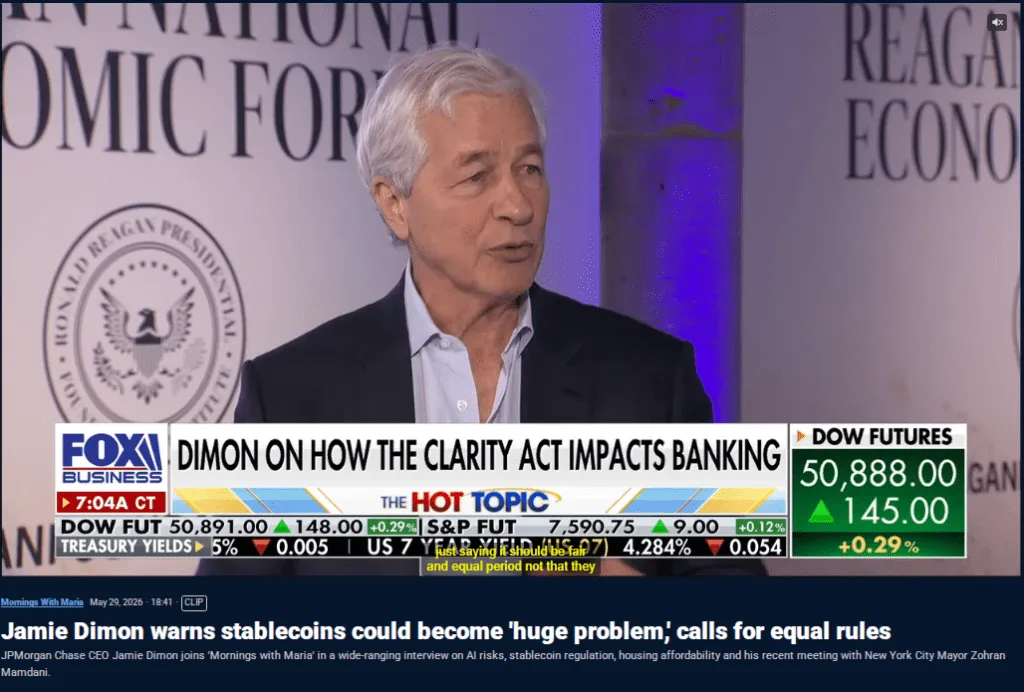
Secondly, concerns have been voiced regarding the regulatory standards applied to crypto service providers. Specifically, critics argue that the bill does not impose the same stringent Anti-Money Laundering (AML) regulations, Bank Secrecy Act (BSA) requirements, and capital reserve standards that are mandated for traditional banks. Dimon has proposed a clear condition: should crypto firms wish to offer yield-bearing accounts, they should pursue a formal banking charter and adhere to the identical regulatory framework. This proposal underscores the banking industry's demand for a level playing field.
Industry Lobbying and Key Players
The legislative efforts surrounding the CLARITY Act have also highlighted the significant role of industry players in shaping policy. Brian Armstrong, CEO of Coinbase, has been a central figure in lobbying initiatives aimed at advancing the bill through Congress. His involvement, alongside reports indicating substantial financial investment in lobbying by Coinbase, has drawn considerable attention and commentary from various stakeholders in the debate.
Dimon's public remarks have also specifically targeted Armstrong and Coinbase, acknowledging the potential for banks to face challenges in influencing the legislative outcome. Nevertheless, he asserted that opposition from the banking sector would persist regardless of the immediate results, indicating a long-term strategic engagement with the regulatory landscape. The bill's ultimate success now hinges on the ability to garner sufficient support from senators before the legislative session concludes.