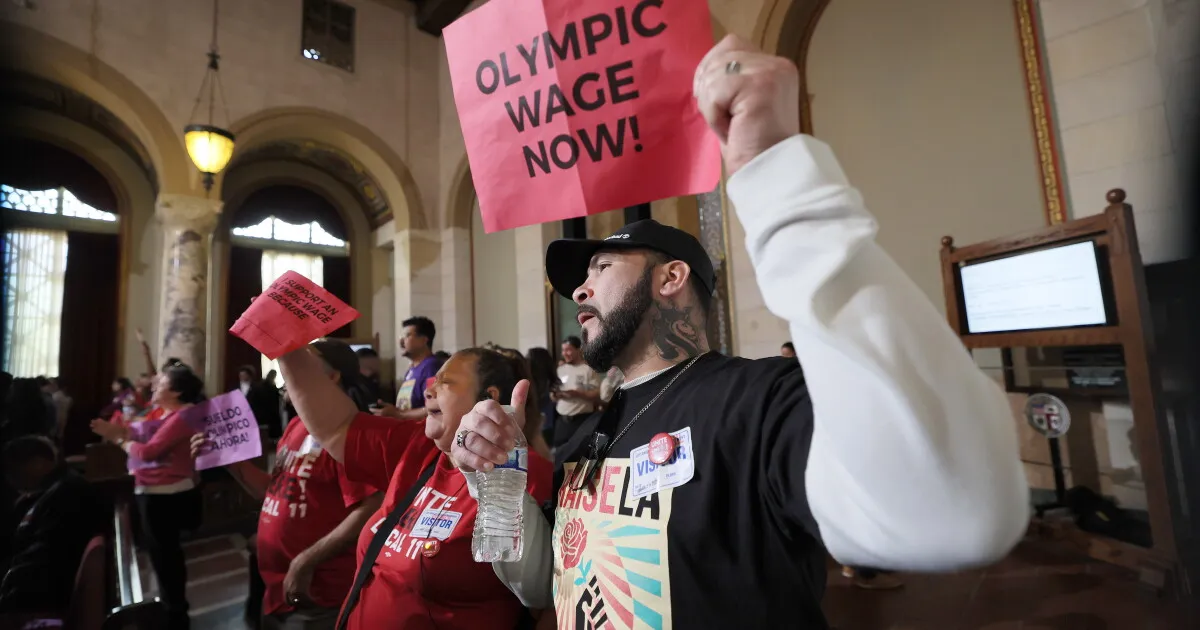
The Los Angeles City Council has officially postponed significant minimum wage increases initially slated for tourism sector employees. This decision, finalized on Tuesday, effectively pushes back the planned hourly wage of $30 for airport and hotel workers from its original target of 2028 to 2030. The move represents a substantial shift from the initially celebrated "Olympic Wage" initiative, which had tied the pay raise directly to the city's hosting of the 2028 Olympic Games.
This controversial delay is a direct consequence of intense pressure exerted by business interests. These groups had successfully gathered sufficient signatures to place a measure on the November ballot aimed at repealing the city's business tax. The potential passage of this measure posed a significant financial risk to the city's budget. In response to the City Council's vote to postpone the wage increase and remove it from the November ballot, the proponents of the business tax repeal measure subsequently withdrew their initiative, averting a potentially destabilizing fiscal showdown.
Labor Backlash and Business Rebuttals on Minimum Wage Delay
The postponement has ignited strong opposition from labor advocates and workers who had anticipated the wage increase. Jordan Long, a bartender at LAX, voiced his disappointment at a recent council meeting, stating, "I would expect my councilmember to stand up for working Angelenos, not help giant companies take money out of our pockets." This sentiment highlights the deep division between worker expectations and the council's decision, which labor groups have decried as a "shakedown." The "Olympic Wage" was initially seen as a progressive step to ensure a living wage for workers in an industry often characterized by lower pay.
Conversely, business groups have defended their stance, citing concerns over economic viability and the impact of escalating labor costs. Stuart Waldman of the Valley Industry & Commerce Association explained that the decision to advance the ballot measure was a response to a perceived unwillingness by unions to negotiate directly. He indicated that the business community felt compelled to take a more assertive approach to address their economic concerns. This dynamic underscores the complex interplay between labor demands, business interests, and municipal policy-making in a major metropolitan area gearing up for a significant global event.
Economic Implications and Political Strategy
The delay in implementing the $30 minimum wage for tourism workers is more than just a labor dispute; it is a strategic maneuver with broader economic and political implications for Los Angeles. By agreeing to postpone the wage hike, the City Council effectively neutralized the immediate threat of the business tax repeal ballot measure. This allowed the city to avoid a potentially crippling financial blow, especially in the lead-up to the substantial logistical and financial demands of hosting the Olympic Games.
The negotiations highlight a delicate balancing act faced by city leaders. On one hand, there is pressure to uphold commitments to workers and ensure fair wages, particularly in sectors poised for growth due to major events. On the other hand, the city must maintain a favorable business climate to attract investment and manage its fiscal health. The decision to delay the wage increase suggests that, in this instance, fiscal caution and business appeasement were prioritized over immediate labor gains, a move that is likely to shape future discussions on economic policy and worker rights in Los Angeles.
Worker Advocacy and Council Dissent
Despite the council's final vote, a vocal contingent of council members expressed their opposition to the wage delay. Council members Eunisses Hernandez, Ysabel Jurado, and Hugo Soto-Martinez voted against the motion, signaling continued support for the original wage increase timeline. Their dissent underscores a continuing ideological divide within the council regarding economic fairness and the balance of power between employers and employees.
The situation illustrates the challenges faced by workers in advocating for improved wages and working conditions, especially when their demands conflict with powerful business lobbies. While the delay may have secured short-term fiscal stability for the city, it has generated significant distrust among the very workforce that will be essential to the success of the 2028 Olympic Games and the broader tourism industry.
Impact Analysis
The LA City Council's decision to delay the minimum wage increase for tourism workers from $30/hour (originally planned for 2028) to 2030 represents a significant political compromise. It averted a potentially damaging ballot battle over business taxes but has strained relations with labor unions and workers. This move suggests a current administration prioritizing fiscal stability and business appeasement over immediate wage gains for low-income workers, potentially impacting worker morale and future labor negotiations. It also raises questions about the city's commitment to leveraging major events like the Olympics for broader economic equity. The long-term effects on worker retention, service quality in the tourism sector, and the city's reputation as a fair employer remain to be seen.