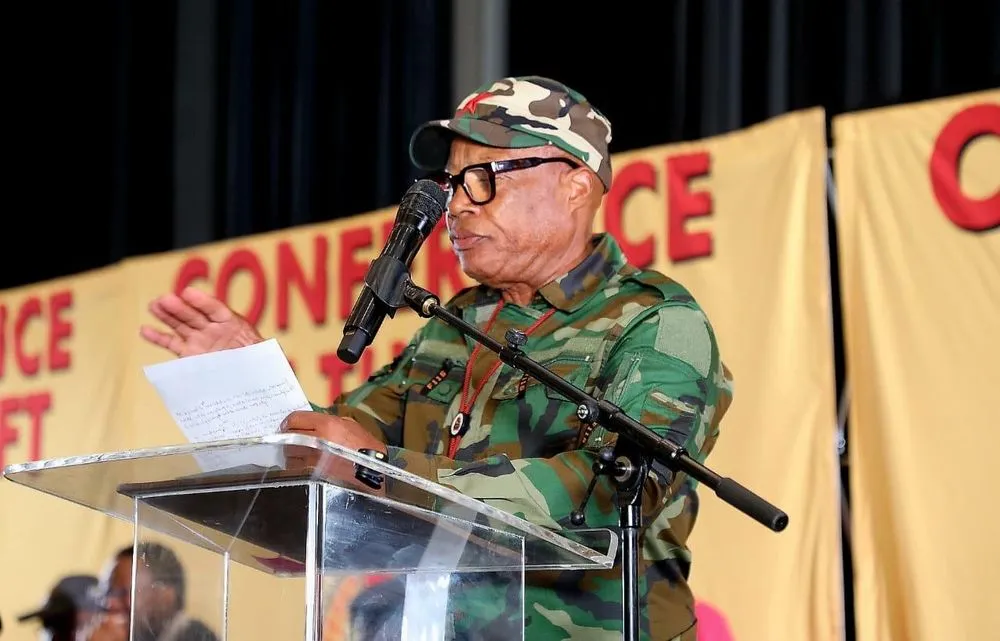
The uMkhonto we Sizwe (MK) Party, represented by its Deputy President Tony Yengeni, has issued a strong call for unity among leftist political formations in South Africa. Speaking at the South African Communist Party’s (SACP) Conference of the Left in Boksburg, Ekurhuleni, Yengeni articulated a vision centered on reclaiming political power and achieving the long-standing aspirations of the nation's majority. He directly accused the Democratic Alliance (DA) and the Freedom Front Plus (FF Plus) of actively working to preserve historical colonial-era privileges and to dismantle the progress made since the end of apartheid, framing their political agenda as detrimental to genuine liberation.
Yengeni emphasized that the MK Party's participation in the conference stems from a commitment to building solidarity and unified action, particularly among the Black majority. He posited that the conference carries the significant responsibility of restoring and continuing the revolutionary struggle's historical mission: to consolidate the Black majority's political power and govern the country effectively, thereby realizing the nation's noble objectives. This objective, he noted, was echoed by former President Jacob Zuma during a recent visit to EFF leader Julius Malema, reinforcing the call for Black unity to seize political control.
Consolidating Leftist Unity and Political Power
The core message delivered by Tony Yengeni at the SACP's Conference of the Left was a fervent plea for cohesive action and strategic alignment among progressive forces. He articulated that the MK Party's presence was not merely symbolic but a concrete commitment to forging unity. The ultimate aim, Yengeni stressed, is to leverage consolidated political power to liberate the populace. He advocated for the conference to transition into a robust and unified left platform, proposing the establishment of a revolutionary council to steer its affairs. This council, he suggested, should be subordinate to the conference itself, ensuring the conference remains the supreme decision-making body for the left movement.
Further elaborating on the principles that should guide this emerging left platform, Yengeni highlighted the imperative to address historical injustices, specifically the restitution of land to its rightful owners and the restoration of dignity to the people and their traditional leadership. He also underscored economic freedom as a paramount objective, asserting that the economy must fundamentally serve the aspirations of the Black majority. This entails ensuring Black ownership of key economic sectors, including banks, mines, farms, and factories, thereby positioning the Black majority at the economy's center rather than its periphery. The platform, he added, should be guided by democratic, non-racial, anti-colonial, and anti-imperialist principles.
Addressing Socio-Economic Disparities and State Reform
Yengeni detailed a vision where the restructured state machinery would serve the populace effectively. He proposed that Parliament should function as a true organ of people's power and sovereignty, with representatives democratically elected to enact policies and laws that serve the interests of the disadvantaged. The final decision-making authority, he argued, should rest with Parliament, making it the ultimate arbiter of the people's sovereignty. Furthermore, he emphasized the critical importance of citizen security and the integrity of national borders, calling for a robust state-led campaign against crime and corruption to ensure safety and security for all, with the law applied equally to everyone, regardless of status.
He also stressed the need for peaceful coexistence and robust economic cooperation with neighboring countries across the African continent. The call for continental unity against war, aggression, and tyranny was presented as a crucial element for fostering economic development, peace, and solidarity. The proposed program of action for the left formations, Yengeni stated, must be guided by clear, progressive, and revolutionary principles, aiming for the total social, economic, political, and cultural emancipation of the Black majority. This commitment extends beyond local struggles to encompass unwavering solidarity with progressive African and international forces, resisting terrorism, neocolonialism, domination, and capitalist exploitation.
Critique of Opposition and Vision for Economic Restructuring
Yengeni directed sharp criticism towards the Democratic Alliance and the Freedom Front Plus, characterizing them as representatives of societal elements deeply rooted in the defense of colonial privilege, 'white monopoly culture,' and neo-liberal domination. He contended that their political objectives were designed to weaken, fragment, and ultimately reverse the gains achieved by the liberation struggle, alleging a deep entanglement with the interests of international capital and imperialist networks. This stance, he argued, necessitates a strategic counter-effort by the left to dismantle the efficacy of apartheid and racism, forging a powerful state capable of decisive intervention in favor of the majority.
The Deputy President reiterated that South Africa's economy remains fundamentally colonial and neo-colonial, with wealth concentrated in the hands of a few while the Black majority endures dispossession and marginalization. He asserted that the left's strategic objective must be the restructuring of the economy to serve the majority, not private monopolies or foreign capital. This restructuring, he emphasized, requires addressing historical land dispossession, not through cosmetic reforms but through genuine solutions that restore ownership and control to the people, led by the Black majority. The authority and historical role of traditional leadership, as custodians of land, culture, and heritage, must also be restored and protected within the nation's democratic framework.
Call for Principled Unity and Transformative Action
SACP General Secretary Solly Mapaila, also serving as the chairperson of the conference's steering committee, underscored the necessity for the Conference of the Left to transcend mere abstract declarations and rhetorical displays. He urged the conference to emerge as a substantive instrument for political coordination, ideological clarity, and practical mobilization of the working class. Mapaila emphasized that the task at hand is not to manage the crisis of capitalism but to organize for its defeat, which demands principled unity among left forces, built on shared understanding and a commitment to confronting entrenched power structures.
Mapaila stressed that the fragmentation within leftist forces must cease, advocating for unity forged through struggle and a shared understanding that class struggle remains the decisive driver of history. He asserted that the liberation of the working class necessitates organized power and that meaningful social transformation requires confronting capitalist power relations at every level—economic, political, and ideological. He called for leadership capable of translating analysis into concrete organization and action, building solidarity with worker struggles and advancing the interests of the working class. The Unemployment People’s Assembly (UPA) echoed these sentiments, highlighting the deepening socio-economic crisis and the urgent need for progressive unity to advance people-centered alternatives and restore the revolutionary mission of genuine transformation.
Impact Analysis
The pronouncements made at the SACP's Conference of the Left, particularly by MK Party's Tony Yengeni and SACP's Solly Mapaila, signal a significant push towards consolidating opposition and left-leaning political forces in South Africa. The explicit call for unity, coupled with sharp critiques of established political parties like the DA and FF Plus, suggests a strategic realignment aimed at challenging the current political landscape. The emphasis on reclaiming economic power, land, and addressing historical injustices aligns with core tenets of liberation movements and could resonate strongly with a significant portion of the electorate. If these factions can effectively translate their rhetoric into cohesive action and a unified electoral strategy, it could lead to a substantial shift in the political balance, potentially influencing future election outcomes and policy directions concerning economic restructuring and social justice initiatives.