

Deep Dive into Network Splitter Architectures and Advanced Applications
Understanding Network Splitter Fundamentals
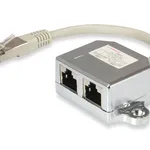
Network splitters, at their most basic, facilitate the replication or division of network signals. Historically, passive network splitters, often simple Y-ccables, were employed to share a single Ethernet cable's wire pairs between two low-bandwidth devices. However, this method is highly prone to signal attenuation, impedance mismatch, and significant performance degradation, often limiting shared connections to 10/100 Mbps and requiring specific wiring schemes. Modern network environments primarily leverage more sophisticated active devices that perform the function of signal distribution with integrity. These include specialized hubs (now largely superseded by switches), media converters with multiple outputs, and sophisticated network TAPs.
Active splitters incorporate electronic circuitry to regenerate, amplify, and distribute network signals. This approach mitigates signal loss over distance and ensures that each output receives a clean, robust signal, often at full line rate. Unlike simple passive devices, active splitters can manage signal timing, reduce collision domains (in the context of older Ethernet designs), and provide power to connected devices through PoE, significantly enhancing network reliability and flexibility.
Architectural Distinctions: Passive vs. Active Splitting
Passive splitters operate without external power, relying solely on the incoming signal's energy. While cost-effective and simple to deploy, their limitations in signal integrity make them unsuitable for high-speed or critical network segments. They essentially create a shared electrical path, which can introduce reflections and increase the potential for data corruption, especially over longer cable runs or with higher frequencies. Their use is predominantly confined to very niche, low-speed, non-critical applications or legacy telephony setups.
Active splitters, conversely, require an external power source. This power enables crucial functions such as signal amplification, re-timing, and filtering. For instance, a fiber optic splitter for GPON networks intelligently divides an optical signal from one upstream port to multiple downstream subscriber ports using beam splitters or planar lightwave circuit (PLC) technology, ensuring each subscriber receives a viable optical signal. In copper-based networks, active splitters often incorporate buffering and switching logic, effectively functioning as mini-hubs or specialized switches designed for specific distribution tasks, such as creating multiple monitoring points from a single link.
Advanced Applications and Performance Considerations
One of the most critical modern applications for devices performing a 'splitting' function is network monitoring via Test Access Points (TAPs). Network TAPs are active devices inserted inline on a network link to create an exact copy of all traffic flowing in both directions, without introducing latency or altering the data stream. This copied traffic is then sent to monitoring tools such as Intrusion Detection Systems (IDS), packet sniffers, or performance analyzers. TAPs are invaluable for ensuring comprehensive visibility into network operations, security analysis, and troubleshooting, offering superior reliability compared to port mirroring (SPAN) on switches, which can drop packets under heavy load.
Performance considerations for any network splitter revolve around several key metrics: throughput, latency, signal-to-noise ratio (SNR), and port isolation. High-quality active splitters maintain full line-rate throughput across all ports, minimizing latency to microsecond levels. SNR is crucial for data integrity, particularly in noisy environments or over long distances, while excellent port isolation prevents crosstalk between connections, preserving data confidentiality and preventing interference. For fiber networks, insertion loss and return loss are paramount, directly impacting the optical power budget and overall link stability. When deploying splitters, especially active ones, it's essential to consider power redundancy options to maintain network uptime in critical applications.