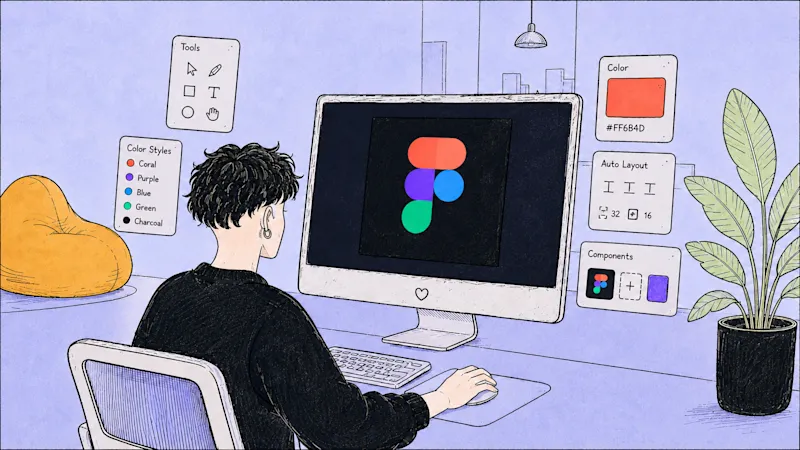
Figma, the prominent cloud-based design software company, is significantly advancing its AI design assistant, Figma Make. Originally a tool for prototyping, it is now evolving into a fully integrated visual editor that directly connects with production codebases. This pivotal update allows professionals, including product managers, designers, and individuals with limited coding experience, to import existing Git repositories into the Figma desktop application. Users can then visually modify the application's underlying code directly within the Figma canvas and submit these changes back to engineering teams through standard GitHub pull requests. This integration aims to streamline the design-to-development pipeline by bridging the gap between design iterations and live code.
This enhancement is particularly crucial for enterprise environments, as it operates within established engineering governance frameworks. Figma Make functions as a local development environment, consolidating design modifications as local commits. When a designer is ready to deploy changes, they can generate a new branch and initiate a pull request directly from Figma Make. From an enterprise governance standpoint, this ensures that visual AI edits undergo the same rigorous continuous integration pipelines, security checks, and code reviews as any traditional engineering commit. Figma Make continues to be a proprietary commercial service, available on Figma’s paid plans, but it interfaces seamlessly with both open-source and proprietary Git repositories without imposing new licensing restrictions on the generated code.
Figma Make's Evolution from One-Way to Two-Way Integration
When Figma Make was first introduced in May 2025, it successfully connected static wireframes with interactive prototypes. However, its initial architecture was limited to a one-way push mechanism. Users could export AI-generated projects to new GitHub repositories, but Figma Make could not synchronize with existing codebases or receive upstream changes. The latest update fundamentally alters this paradigm by enabling connections to any Git provider. This means teams can now connect to a production or sandbox repository, select specific UI elements, and use natural language prompts to instruct Figma’s multi-model AI to generate or modify the underlying code. The AI dynamically interprets the surrounding code architecture, implements visual edits, and ensures the generated code adheres to the team's existing design system guidelines.
Engineering Governance and Licensing Implications
A key aspect of this new integration is its adherence to enterprise engineering governance. Figma Make does not circumvent existing control structures. Instead, it operates entirely within a standard version control workflow, treating the canvas as a local development environment where design changes are logged as local commits. When a designer is prepared to push their work, they create a branch and open a pull request directly from the Figma Make interface. This process ensures that all visual AI-driven modifications are subject to the same continuous integration (CI) pipelines, security protocols, and code review processes as conventional engineering commits. This approach maintains the integrity and security expected in enterprise software development workflows.
Figma Make remains a commercial service accessible through Figma's paid subscriptions, with pricing varying based on team size and features. Despite its proprietary nature, it integrates smoothly with various Git repositories, including both open-source and private ones. Importantly, this integration does not introduce new licensing constraints on the code generated or modified through the platform, allowing organizations to maintain flexibility in their codebase management and licensing strategies.
Competitive Landscape: Figma Make, Lovable, and Claude Design
The evolving landscape of AI-assisted software development sees Figma Make competing with distinct platforms like Lovable and Anthropic's Claude Design. Each platform offers a different approach tailored to specific user needs and development philosophies.
Figma Make: Positioned for established product teams that prioritize design fidelity and adherence to brand guidelines. It leverages existing design systems, including color tokens, typography, and component variants, to ensure consistency. Figma Make excels in detailed canvas manipulation and maintaining code ownership within established GitHub architectures, targeting teams with mature engineering practices and well-defined design systems.
Lovable: This platform functions as a standalone, full-stack application builder designed for speed and production readiness. It emphasizes a code-first approach, often integrating with backend services like Supabase. Lovable enforces automatic two-way synchronization with GitHub, treating the repository as the single source of truth. It is particularly suited for solo developers or lean startups aiming to build production-ready SaaS applications rapidly without extensive vector design files.
Claude Design: Anthropic's offering focuses on AI-native prototyping, ideal for product managers and engineers who need to quickly generate functional UI prototypes from prompts. While it may lack the granular vector control of Figma Make or the full-stack capabilities of Lovable, its strength lies in its immediacy for rapid prototyping and handoff to coding agents. However, its token limitations can make it less suitable for extensive, iterative design sprints.
The Era of "Vibe Coding" and Enterprise Adoption
The advent of two-way repository synchronization marks a significant shift in product development, highlighting architectural governance and design intent as key bottlenecks, potentially surpassing raw engineering bandwidth. In this new paradigm, the "vibe coding" era, technical leaders must critically assess which tools best serve their specific needs.
Figma Make is not positioned as a universal application builder. Rather, it is a specialized tool for frontend optimization, designed for cross-functional product teams within mid-to-large organizations. Figma explicitly recommends it for designers who already have access rights to their company's codebase. Enterprises with mature engineering organizations, robust design systems, and stringent repository controls can leverage Figma Make to accelerate iteration cycles. It addresses the common challenge faced by designers and product managers who contribute to code but prefer visual interfaces over command-line environments, thereby offloading frontend implementation tasks from core engineers.
Conversely, teams or individuals embarking on greenfield projects, such as solo developers building lightweight SaaS applications, may find greater utility in full-stack platforms like Lovable. Lovable's ability to natively orchestrate backend logic and database integrations makes it efficient for rapid application development from scratch. For those seeking swift UI wireframing through text prompts without strict design system adherence, Claude Design offers immediate benefits.
For enterprises concerned about vendor lock-in or proprietary AI backends, a compartmentalized approach is advisable. Figma Make's commitment to standard Git workflows—encompassing local commits, isolated branches, and mandatory pull request reviews—reinforces enterprise stability and security. By strategically deploying Figma Make as a frontend integration layer for existing systems and utilizing platforms like Lovable for external, new development, organizations can adopt advanced AI tooling without compromising their core architectural integrity.
Figma's Strategic Imperative for Continued Innovation
Following its initial public offering (IPO) on July 31, 2025, where it priced shares at $33 and saw significant demand, Figma's stock experienced a sharp decline. By May 2026, its market capitalization had fallen considerably, trading below its IPO price. Analysts attributed this correction to a combination of structural IPO pricing, a low float, and a broader market rotation away from traditional SaaS products towards AI-native workflows.
In this evolving market, Figma faces an existential challenge. As enterprise software spending increasingly shifts towards generative AI and localized coding agents, traditional design software risks becoming commoditized. Figma Make represents a critical strategic initiative to address this trend. The company must demonstrate to the market that its platform is more than just a static design canvas; it must prove to be an essential orchestration layer where human intent, enterprise design systems, and AI-generated code converge seamlessly.
The introduction of Figma Make's bidirectional GitHub integration and its emphasis on governance mechanisms are crucial steps in this direction. These advancements aim to solidify Figma's position in the AI-powered development era, reassuring investors and users alike of the platform's ongoing relevance and value proposition.