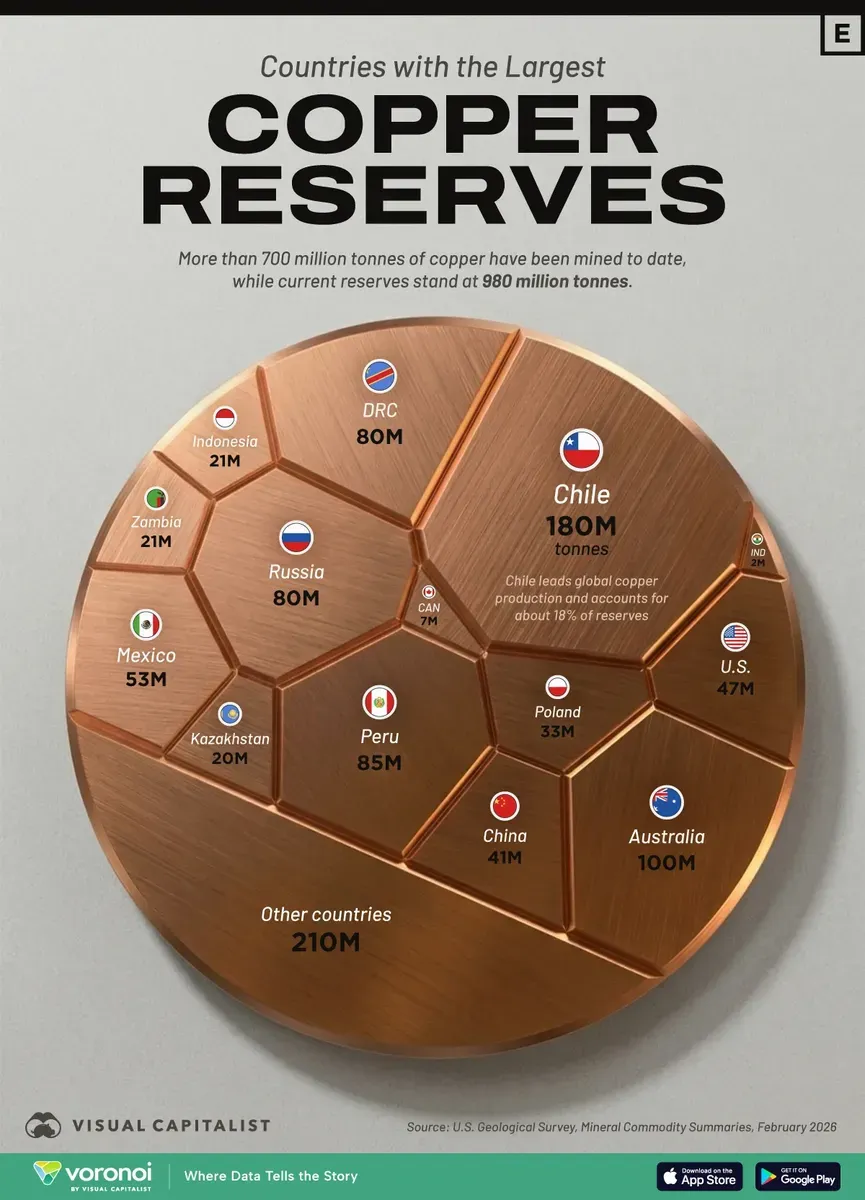
Copper, a fundamental element powering modern infrastructure and the transition to sustainable energy, has seen its importance amplified by surging global demand. Its indispensable role in everything from construction and electronics to electric vehicles and renewable energy systems underscores the critical nature of its supply chain. Understanding the geographic distribution of copper reserves is therefore paramount, especially as the world navigates increasing reliance on this vital commodity. The U.S. Geological Survey's 2026 data provides a clear picture of which countries hold the most significant known deposits, revealing a concentration of supply that has major implications for global markets and technological development.
The projected surge in copper demand over the coming decades, fueled by widespread electrification, the expansion of data infrastructure for AI, and the necessary upgrades to global power grids, makes the location and accessibility of these reserves more strategically significant than ever before. This article delves into the distribution of global copper reserves, highlighting the leading nations and the implications of this concentration for future resource availability and economic stability.
Global Copper Reserves by Country
Chile stands as the undisputed leader in global copper reserves, possessing an estimated 180 million tonnes. This figure is nearly double that of Australia, the second-largest holder, which has approximately 100 million tonnes. This substantial lead grants Chile unparalleled influence over the global copper supply, a position that is becoming increasingly critical as demand escalates.
Following Chile and Australia, Peru holds the third-largest reserves with 85 million tonnes, closely trailed by the Democratic Republic of Congo (DRC) and Russia, both with around 80 million tonnes. Mexico, the United States, and China also feature prominently, holding substantial reserves, though significantly less than the top contenders. The top five countries collectively account for well over half of the world's known copper reserves, underscoring a notable concentration of this essential resource in a limited number of geographic locations.
| Rank | Country | Reserves (Mt) |
|---|---|---|
| 1 | 🇨🇱 Chile | 180 |
| 2 | 🇦🇺 Australia | 100 |
| 3 | 🇵🇪 Peru | 85 |
| 4 | 🇨🇩 Congo (DRC) | 80 |
| 5 | 🇷🇺 Russia | 80 |
| 6 | 🇲🇽 Mexico | 53 |
| 7 | 🇺🇸 United States | 47 |
| 8 | 🇨🇳 China | 41 |
| 9 | 🇵🇱 Poland | 33 |
| 10 | 🇮🇩 Indonesia | 21 |
| 11 | 🇿🇲 Zambia | 21 |
| 12 | 🇰🇿 Kazakhstan | 20 |
| 13 | 🇨🇦 Canada | 7 |
| 14 | 🇮🇳 India | 2 |
| -- | 🌍 Other countries | 210 |
| -- | 🌐 World total (rounded) | 980 |
Chile's reserves, representing approximately 18% of the global total, solidify its position as the world's leading copper producer. The vast mineral wealth found in regions like the Atacama Desert has historically placed Chile at the center of international copper supply chains. While Australia and Peru also possess significant reserves, they are notably behind Chile's dominant share.
Concentration of Copper Reserves
The global distribution of copper reserves is characterized by a high degree of concentration. The top five nations—Chile, Australia, Peru, the Democratic Republic of Congo, and Russia—collectively hold more than half of all known copper resources worldwide. This concentration implies that geopolitical events, trade policies, or production disruptions in these key regions can have a disproportionately large impact on global copper availability and pricing.
The significant reserves in Australia (around 100 million tonnes) and the substantial holdings in Peru, the DRC, and Russia (each between 80-85 million tonnes) further emphasize the geographical clustering of this critical metal, primarily in Latin America, Africa, and Eurasia.
Historical Production Versus Remaining Reserves
Throughout history, humanity has extracted over 700 million tonnes of copper. Current known reserves, however, stand at nearly 1 billion tonnes, indicating a substantial quantity of the metal still available for extraction. This comparison highlights both the immense scale of remaining resources and the inherent challenges associated with their economic recovery.
A significant portion of the remaining copper deposits is more difficult and costly to access and extract than historically mined resources. As global demand intensifies, driven by the imperative for electrification and advanced energy systems, the potential gap between accessible supply and future needs presents a profound challenge for the global economy. Managing these resources effectively will be crucial for supporting technological advancements and sustainable development initiatives.
Impact Analysis
The pronounced concentration of copper reserves in a few key countries, particularly Chile, presents both opportunities and risks for global economic and technological development. For industries heavily reliant on copper, such as the automotive sector (especially electric vehicles) and renewable energy infrastructure, this concentration necessitates robust supply chain management strategies. Diversification of sourcing, investment in exploration in less-explored regions, and advancements in extraction and recycling technologies will be critical to mitigate potential supply disruptions and price volatility.
Furthermore, the strategic importance of copper reserves may influence geopolitical relationships and international trade policies. Countries with significant reserves can leverage their resource wealth, while import-dependent nations must foster stronger diplomatic and economic ties to ensure stable access. The ongoing energy transition, coupled with advancements in AI and digitalization, is set to accelerate demand for copper, making resource security and responsible management of these concentrated reserves a defining issue for the coming decades.