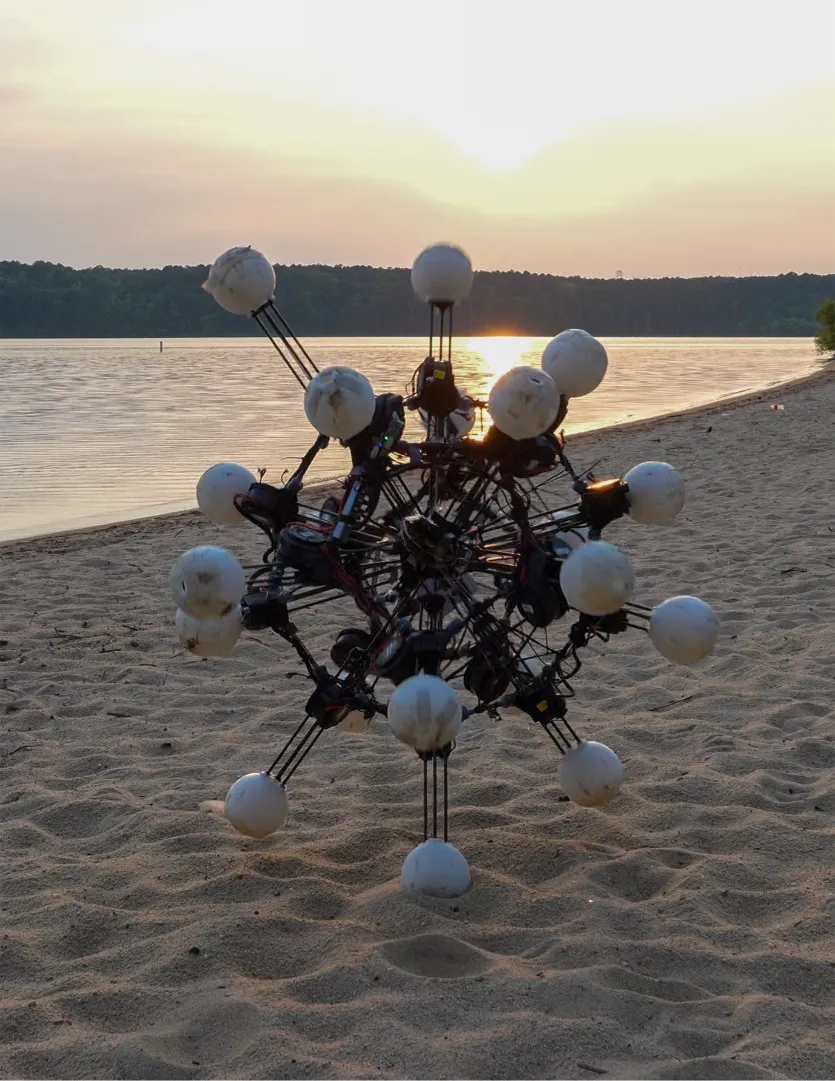
Researchers have developed a novel robot, Argus, featuring 20 telescoping legs arranged in a dodecahedron shape. This design prioritizes dynamic isotropy, enabling the robot to move and stabilize with equal efficiency in any direction, unlike conventional robots limited by specific orientations.
[IMAGE_1] Argus has demonstrated remarkable versatility, navigating challenging terrains including sand, grass, and foliage, while also exhibiting resilience by continuing to function with damaged legs. Its capacity to carry payloads and climb walls further highlights the potential of this dynamically symmetrical approach.
This research suggests that optimal robot design may stem from mathematical principles like dynamic symmetry rather than direct biological mimicry, potentially revolutionizing robot capabilities in complex environments.