
Economic indicators in Australia are pointing towards a significant decrease in population mobility regarding both employment and housing. Data suggests a growing trend of Australians becoming less inclined to switch jobs, initiate new businesses, or relocate between states, signaling a more risk-averse and static economic landscape compared to previous decades. This shift is attributed to a confluence of factors including advancements in artificial intelligence, global economic uncertainties, and a more competitive job market.
The psychological impact of these economic shifts is also notable. Business strategist Kate McCready highlights a prevalent sense of apprehension within the workforce, fueled by concerns over job security in the face of technological advancements and economic volatility. This environment fosters a reluctance to embrace change, leading individuals to remain in their current positions or avoid entrepreneurial ventures due to perceived risks.
Declining Job Mobility Rates
Historical data reveals a steep decline in job switching among the Australian workforce. In 1989, nearly 20% of individuals changed jobs annually. This rate dropped to approximately 11% by 2005. The most recent figures, for the year ending February 2025, indicate that just over 1.1 million people, or about 7.7% of the workforce, switched jobs. This represents a substantial decrease in job mobility over the past three decades.
Economists like Rachel Lee from the e61 Institute interpret these statistics as evidence of Australians being “stuck” or constrained in their current employment. This immobility is exacerbated by factors such as the high cost of housing and the significant financial commitment associated with acquiring a mortgage, estimated around $700,000 for a 30-year term. These economic pressures create a barrier to career changes or relocation, forcing individuals to prioritize stability over opportunity.

The Appeal of Traditional Employment Benefits
The attractiveness of traditional, salaried employment has increased, largely due to the expansion of employee benefits. Superannuation contributions and paid parental leave are among the key advantages that have made wage-earning roles more appealing than self-employment. This trend has significantly reshaped the employment market, with a notable decrease in self-employment figures.
Research from the e61 Institute indicates a sharp decline in self-employment, falling to a 20-year low. The proportion of self-employed Australians has decreased from a peak of 20% in 2002 to approximately 14% currently. Similarly, the rate of sole traders has dropped from 12% to under 9%. This shift is not attributed to a lack of entrepreneurial ambition, but rather to workers increasingly prioritizing the income security and benefits offered by wage-paying jobs, alongside the rising costs and complexities of establishing and managing businesses that employ staff.

Regulatory Hurdles and the 'Red Tape' Effect
Economic commentators like Dimitri Burshtein of Eminence Advisory suggest that regulatory burdens, often referred to as “red tape,” are impeding economic dynamism, particularly for younger generations. These regulations, while often intended to de-risk systems and protect incumbents, can stifle innovation and make it significantly harder for individuals to start new businesses or accumulate wealth.
Mr. Burshtein likens these regulations to a “wet burlap sack,” indicating the considerable drag they place on entrepreneurial activity. New regulations impose a disproportionate burden on nascent businesses compared to established entities, thereby protecting existing market players and hindering the entry of new competitors. This environment discourages risk-taking and innovation, making it challenging for younger individuals to leverage their skills and time to get ahead in the economy.

Reduced Interstate Migration
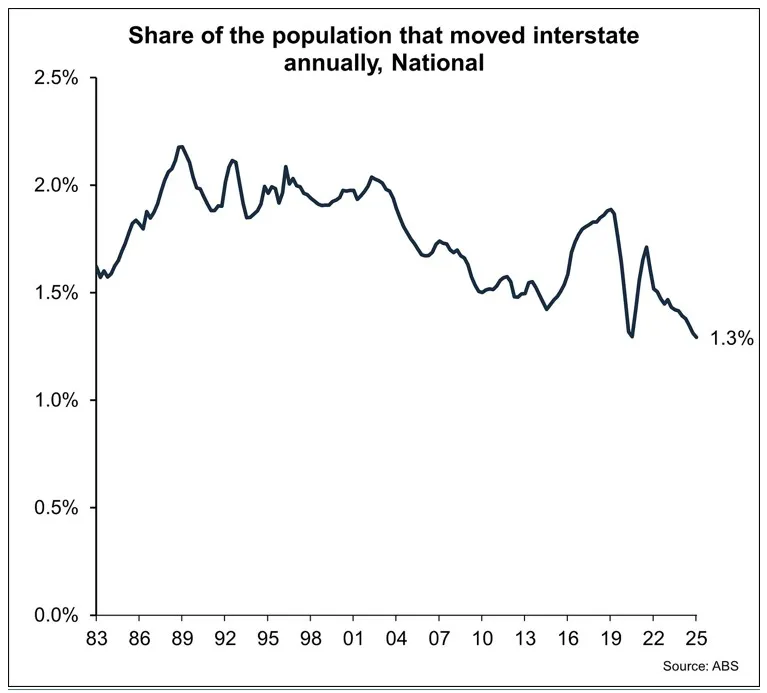
A further indicator of declining mobility is the reduced rate of interstate migration within Australia. Property market expert Cameron Kusher notes that the enticement to move between states has diminished significantly. While people are still moving, the preference is increasingly for intra-state relocation rather than cross-border moves.
The high cost of housing, coupled with transaction expenses such as stamp duty and increased agent fees, creates substantial barriers to interstate relocation. In a rising interest rate environment, the financial risks associated with moving, including potentially losing a home or incurring significant transaction costs, lead many individuals to prioritize safety and security within their current state. This phenomenon further contributes to economic inertia and reduced population fluidity.

Government Measures and Economic Dynamics
Recent government initiatives, such as those outlined in the federal budget, aim to address some of the factors contributing to the overheated housing market. Proposed changes to tax incentives for housing investors, including negative gearing and capital gains tax discounts, could potentially cool the market and make it more accessible for owner-occupiers. Slowing house price growth may also assist individuals in saving for deposits.
Furthermore, the government has acknowledged the restrictive nature of certain regulations, vowing to streamline access to mandatory Australian standards and simplify electronic record-keeping with financial regulators. While these measures may offer some relief, the broader challenge of fostering a more dynamic and adaptable economy requires sustained and comprehensive policy interventions. The shift towards increased economic participation and reduced risk aversion will likely be a long-term endeavor, akin to addressing the decades-long evolution of the housing market.
Rethinking Safety and Security in a Changing Economy
Kate McCready's work with individuals transitioning to self-employment highlights the ongoing re-evaluation of career paths and the perceived dichotomy between job security and professional fulfillment. While self-employment offers benefits like autonomy and uncapped earning potential, it also entails managing one's own superannuation, adapting to team dynamics, and greater susceptibility to economic downturns.
The relative rarity of recessions over the past four decades may have contributed to a collective underestimation of economic volatility. Ms. McCready expresses concern that this mindset leaves individuals unprepared for potential economic upheavals. The rapid pace of global change, including geopolitical events and their downstream economic impacts, underscores the need for greater adaptability. Fostering a more dynamic economy and encouraging a more proactive approach to career development will require time and concerted effort, mirroring the long-term strategies needed to address complex issues like the housing market.