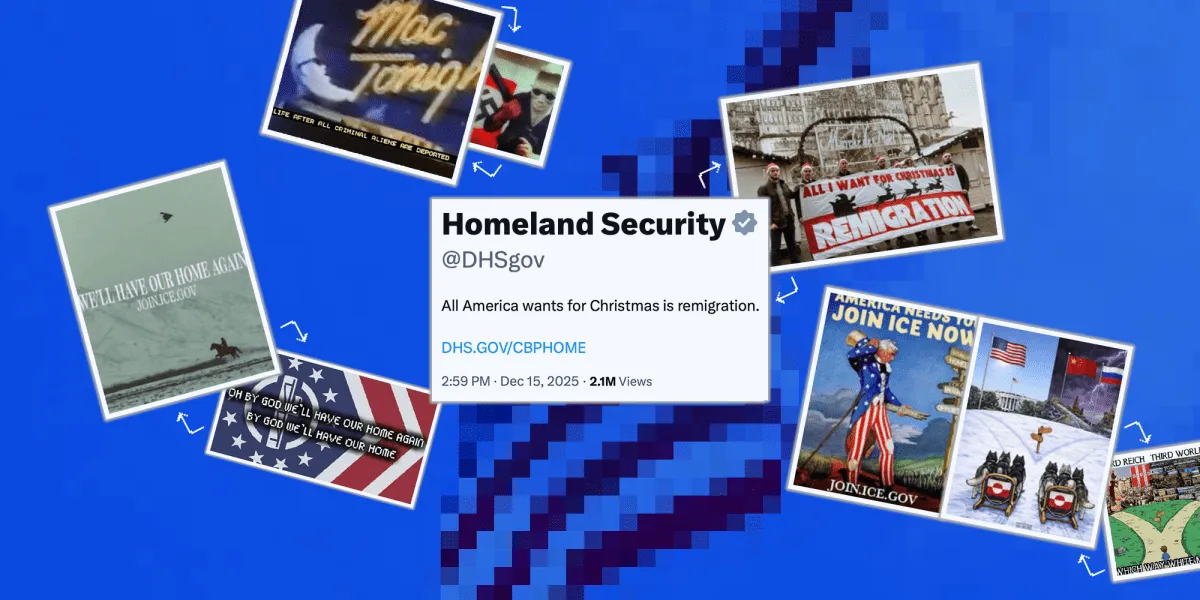
Colorado law enforcement officials have issued a stark warning to their national counterparts, expressing concerns that recruitment materials disseminated by the Department of Homeland Security (DHS) for Immigration and Customs Enforcement (ICE) contain themes perceived as white supremacist. According to internal records, these materials could potentially endanger the public by inciting vigilantism or violence against immigrants.
The Colorado Information Analysis Center (CIAC), a state agency tasked with counter-terrorism efforts, detailed these concerns in a March bulletin. The analysts cautioned that "violent extremists" might interpret the DHS recruitment content as embracing "White Supremacy Ideology," thereby creating a heightened threat environment. This bulletin advised law enforcement agencies across the United States that such messaging could foster a "permissive environment to engage in vigilante action and/or violence against individuals perceived to be immigrants." Furthermore, the CIAC warned that these posts could encourage "white supremacist violent extremists to attempt to join or infiltrate ICE and engage in bias motivated violence, endangering the public, other ICE personnel, and local law enforcement."
DHS Recruitment Campaign Sparks Widespread Concern
The DHS social media campaign, which circulated for months prior to the CIAC bulletin, was reportedly designed to bolster ICE recruitment and align with the Trump administration's agenda on immigration enforcement. Colorado officials specifically highlighted social media posts that mimicked memes prevalent in right-wing online subcultures. These posts incorporated rhetoric, lyrics, and tropes commonly associated with violent white supremacists, neo-Nazis, and historical extremist movements.
This approach drew significant criticism from organizations like the Southern Poverty Law Center, which alleged that DHS was employing "white nationalist imagery and language to recruit new employees and arrest immigrants." Despite the backlash, DHS defended its social media tactics, describing them as "bold and effective." The bulletin from the CIAC is notable as it represents one of the first instances where state officials within the U.S. counter-terrorism framework expressed alarm over the messaging strategies of a federal agency under the Trump administration.
Analysis of White Supremacist Tropes in Recruitment Materials
The CIAC bulletin meticulously examined DHS social media posts, noting their frequent reposting by white supremacists internationally. One specific January 9 post on X (formerly Twitter) featured an image of a lone man on horseback with the caption, "We’ll have our home again." While appearing to evoke frontier nostalgia, the memo explained that this phrase is a lyric from a song popular within and adopted by white nationalist organizations. The memo further elaborated that the song's lyrics, particularly lines about reclaiming "our home" by "blood or sweat," are frequently used in white supremacist rhetoric.
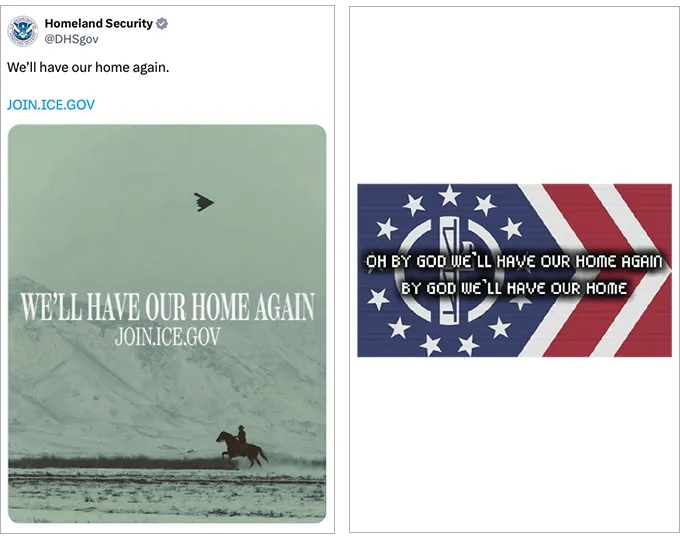 The bulletin underscored the gravity of this connection by referencing that members of the white nationalist group Patriot Front have been recorded chanting the song's refrain, and that the lyrics were included in the manifesto of a white supremacist who committed a fatal shooting in Jacksonville, Florida, in 2023. Following reporting by The Intercept on DHS's use of this song, lawmakers urged Meta, the parent company of Facebook and Instagram, to cease running the associated advertisement.
Broader Pattern of Extremist Overlap
The report detailed a pattern of "repeated use of visual or rhetorical elements that overlap with symbols historically referenced within extremist subcultures." DHS's use of the term "remigration," for example, was highlighted. The Colorado analysts pointed out that this term dates back to 1930s Germany, where it was used to advocate for the forced expulsion of Jewish populations.
Additionally, the bulletin addressed the use of the "Moon Man" meme, a character derived from a 1980s McDonald's advertising campaign that has been adopted by online racists for its resemblance to Ku Klux Klan imagery. 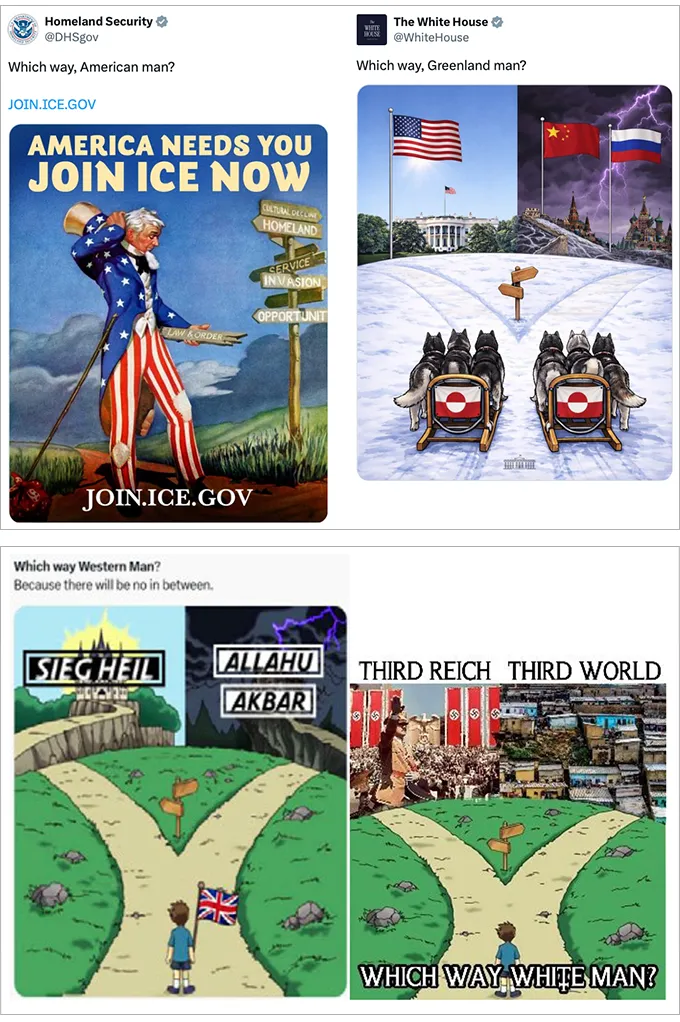 The CIAC noted a social media user's reply to a DHS post featuring the "Moon Man" character, which included the abbreviation "TND"—standing for "total n**der death"—a phrase prevalent among white supremacists. This user also shared a modified version of the meme depicting the character in front of a swastika flag, armed with a rifle.
Fusion Centers and Intelligence Sharing
The bulletin originated from a Colorado fusion center, which is part of a nationwide network of information-sharing hubs for local, state, and federal law enforcement. Initially established as counter-terrorism measures post-9/11, these centers have evolved into extensive surveillance apparatuses tracking various criminal activities, and at times, civil liberties-related matters such as student protests, often with limited evidence of their effectiveness in preventing terrorism.
Reports from fusion centers are widely disseminated among law enforcement agencies. The CIAC's bulletin is significant because it indicates a concern within the state-level counter-terrorism establishment regarding DHS's messaging. While the bulletin included a disclaimer stating it did not imply ideological alignment between DHS/ICE and white supremacist ideology, it provided evidence of how these social posts were being positively received and amplified within white supremacist circles, encouraging recruitment into ICE.
Potential for Violence and Misinterpretation
The intelligence bulletin specifically warned that during the period these DHS posts circulated, "white supremacist violent extremist groups have been simultaneously advocating for their followers to join ICE and/or musing about the potential for ICE to turn into a white supremacist militia."  In one instance, users on a neo-Nazi accelerationist social media channel discussed infiltrating ICE to establish a "breakaway militia" and instigate a "nationwide race war." Some users reportedly mused about the advantages of joining ICE for "accelerating conflict in the US" and "beating up race traitors," with one user claiming a network member was already a captain at an ICE-contracted detention facility.
Furthermore, the CIAC's report suggested that DHS's messaging could also provoke violence from anti-fascist groups who might misinterpret the communications. The bulletin cautioned that antifascist activists could perceive "all ICE personnel, and by extension law enforcement and government officials, as supportive of or complicit in white supremacy, therefore creating perceived justification for violence targeting those individuals." A spokesperson for the Colorado Division of Homeland Security and Emergency Management confirmed that bulletins are used to share information with their network to fulfill their mission but did not specify if DHS had responded to the CIAC's warning.
Impact Analysis
This incident highlights a critical disconnect between federal agency recruitment strategies and the perceptions of state-level law enforcement and intelligence bodies. The potential for recruitment materials to be co-opted or misinterpreted by extremist groups poses a significant public safety risk. It underscores the necessity for rigorous vetting of all public-facing communications by federal agencies to ensure they do not inadvertently provide fodder for extremist ideologies or incite violence from any end of the political spectrum. The reliance on fusion centers for intelligence dissemination also points to their evolving role in domestic security, moving beyond traditional counter-terrorism to encompass broader concerns about radicalization and social cohesion.