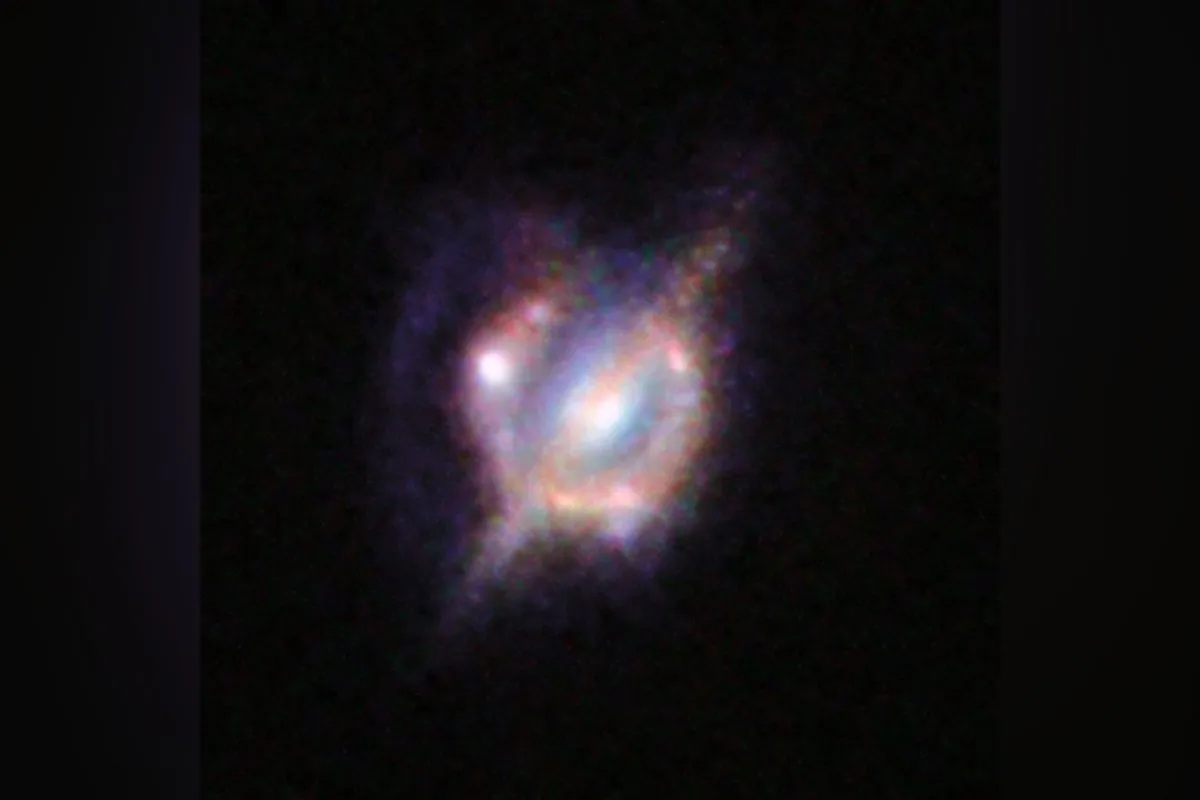
Astronomers utilizing South Africa's MeerKAT telescope have identified an exceptionally potent microwave laser emission, colloquially termed a 'space laser' or maser, originating from the depths of the cosmos. This high-energy beam is a consequence of a colossal cosmic event: the collision of two galaxies. The findings, detailed in a new paper accepted for publication in the Monthly Notices of the Royal Astronomical Society, reveal this phenomenon to be the most powerful of its kind ever documented.
The maser signal was detected nearly 8 billion light-years away, emanating from a galaxy designated H1429-0028. Its detection was significantly aided by gravitational lensing, a cosmic magnifying effect where the gravity of an intervening galaxy bends and amplifies light from more distant objects. This natural phenomenon allowed the powerful signal to be observed from Earth, revealing its extraordinary intensity.
Record-Breaking Cosmic Laser Emission
The phenomenon observed is fundamentally a maser, which is the microwave equivalent of a laser, producing a focused beam of electromagnetic radiation at a specific frequency. In astrophysical contexts, masers often originate from excited clouds of gas and dust. When these molecules are energized by intense radiation, such as from nearby stars or active galactic nuclei, they can transition to a higher energy state and subsequently release photons. These released photons can then stimulate nearby particles to emit more photons of the identical wavelength, amplifying the beam.
In the case of colliding galaxies, the immense gravitational forces compress vast clouds of gas, triggering intense star formation. The light emitted by these nascent stars can excite molecules, such as hydroxyl, to produce masers. While such events can generate highly luminous signals known as 'megamasers,' the intensity of the newly discovered emission has led researchers to classify it as a 'gigamaser,' signifying an unprecedented level of power.
Discovery and Detection Methods
The discovery was serendipitous. While analyzing the galaxy H1429-0028 with the MeerKAT radio telescope – an instrument composed of 64 interconnected antennae – astronomers noticed an unusually strong signal at a frequency of 1667 megahertz. The combined effects of gravitational lensing and the intrinsic luminosity of the maser made the signal immediately stand out as a record-breaker.
Lead author Thato Manamela, a researcher at the University of Pretoria, described the system as "truly extraordinary," noting that they were observing "the radio equivalent of a laser halfway across the universe." The amplified signal allowed for detailed study, revealing its immense power and the unique cosmic conditions that generated it.
Characterizing the Gigamaser
The gigamaser's luminosity is estimated to be approximately 100,000 times that of a typical star, but crucially, this energy is concentrated into a very narrow band of the electromagnetic spectrum. This high degree of spectral concentration is characteristic of laser emissions, distinguishing it from more diffuse astronomical radiation sources.
The extreme rarity of megamasers, and the even greater rarity of gigamasers, makes this discovery particularly significant. These events provide unique natural laboratories for understanding the physics of the early universe and the conditions within extremely energetic galactic environments.
Implications for Astrophysics
While classified as 'megamasers' or 'gigamasers' based on their extraordinary luminosity, these cosmic masers are invaluable tools for astronomers. The specific conditions required for their formation – typically involving dense gas clouds within galaxies undergoing mergers or experiencing intense energetic activity – allow scientists to probe the composition, dynamics, and physical states of gas in distant galaxies.
The detection of this gigamaser opens up new avenues for astrophysical research. With planned upgrades to sensitive radio telescopes like MeerKAT, scientists anticipate uncovering hundreds or even thousands of similar events. Each discovery will provide a clearer picture of the universe's most energetic phenomena and the processes driving galaxy evolution across cosmic time.