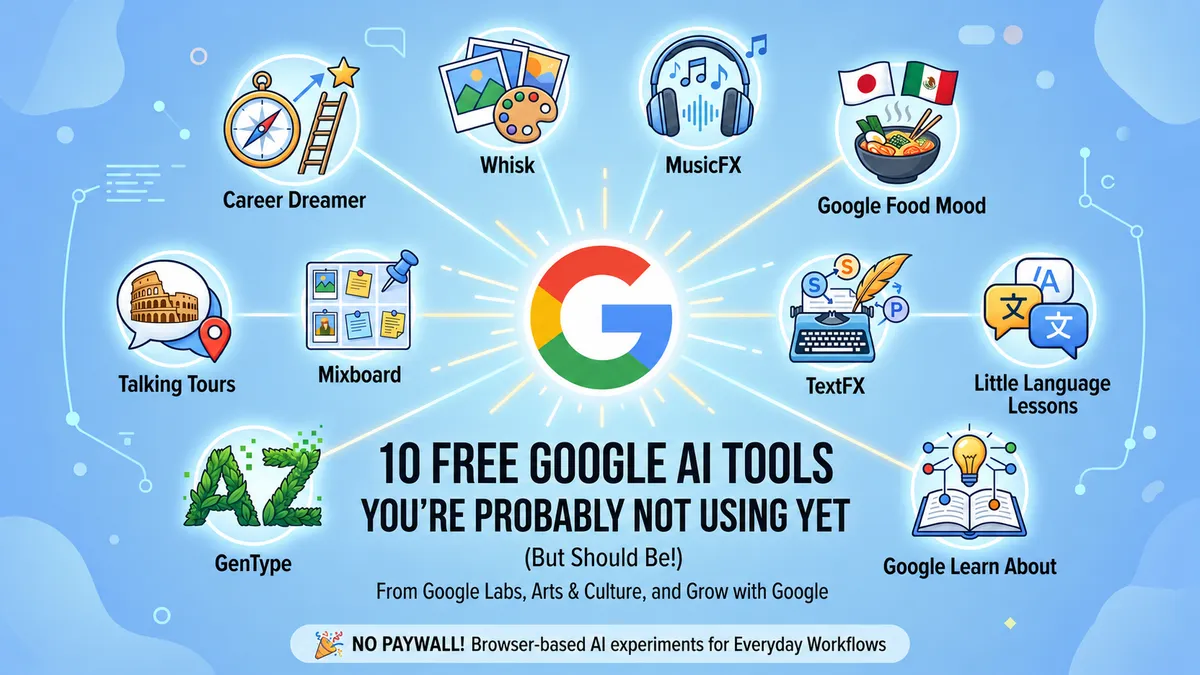
While Google's flagship AI chatbot, Gemini, often dominates discussions about the company's artificial intelligence endeavors, a vast ecosystem of less publicized, yet remarkably generous, free AI tools is quietly revolutionizing creative workflows and career planning. These experiments, housed within Google Labs, Arts & Culture, and Grow with Google, offer browser-based access to sophisticated AI capabilities without any paywall. They span diverse applications, from career guidance and music composition to culinary exploration, language learning, and visual design, representing a significant stride in making advanced AI accessible to a broad audience.
These tools are not mere demonstrations; they are functional, opinionated products designed for real-world use. For technical professionals, they serve as invaluable case studies in how large language models can be integrated into focused user experiences, offering insights into effective prompt engineering and user interface design for AI applications. For non-technical users, they provide an approachable and intuitive entry point into the world of generative AI, demystifying complex technologies through practical, engaging applications that can seamlessly integrate into daily routines and professional tasks.
Exploring Google's Generative AI Toolkit
Google Career Dreamer: Navigating Career Paths
The Grow with Google initiative presents Career Dreamer, an AI-powered platform designed to offer personalized career guidance. By analyzing a user's skills and professional background, the tool generates a visual map of potential job roles and related career trajectories. Furthermore, it assists in crafting compelling personal career statements and drafting initial versions of cover letters and LinkedIn summaries, which users can then refine. This makes it an exceptionally useful resource for individuals undergoing career transitions, students exploring future prospects, or those re-entering the workforce.
Career Dreamer's capabilities extend to mapping user-provided skills directly to relevant job titles, creating AI-generated career identity statements, and assisting with the foundational language for cover letters and resumes. Its intuitive interface and output facilitate easier editing and personalization, ensuring users can adapt the generated content to their specific needs and voice, thereby streamlining the often-daunting job application process.
Whisk: Innovative Image Generation
Within Google Labs' FX suite, Whisk stands out as a novel image generation tool that leverages reference images rather than traditional text prompts. Users can upload multiple images—representing a desired subject, scene, and artistic style—and Whisk, powered by Google's Imagen and Gemini models, intelligently synthesizes these inputs into a new, cohesive visual composition. This approach is particularly effective for rapid concept development, creating character designs, and exploring diverse aesthetic moods.
The tool’s sophisticated underpinnings allow for fine-tuning through an editable text prompt, offering users a layered control mechanism. This blend of visual input and textual refinement enables the generation of highly specific and nuanced imagery, making Whisk a powerful asset for designers, artists, and anyone needing to visualize abstract ideas or conceptual prototypes quickly and effectively.
MusicFX: AI-Composed Musical Creations
MusicFX, another experiment from Google Labs, utilizes advanced Lyria models from Google DeepMind to generate original instrumental music tracks from concise text descriptions. Users can specify genres, moods, instrumentation, and tempo, and the AI produces looping audio clips that can be extended, remixed, or downloaded. A notable feature is its 'DJ Mode,' which allows for live blending of prompts, offering an interactive and dynamic music creation experience.
This tool is invaluable for content creators, game developers, and musicians seeking to prototype background scores, create jingles, or experiment with sonic textures without requiring extensive musical expertise. The ability to generate up to 70-second clips and explore variations provides a robust foundation for audio production workflows, making sophisticated music generation accessible.
Google Food Mood: Culinary Fusion Explorer
Offered through Google Arts & Culture, Food Mood is an imaginative recipe generator that fuses cuisines from two selected countries. The AI creates a unique dish, complete with a detailed ingredients list and step-by-step instructions, often resulting in novel culinary combinations that extend beyond conventional recipe books. This experiment provides a playful yet educational approach to exploring global gastronomy.
Users can adjust difficulty and 'surprise' levels, enhancing the exploratory nature of the tool. Food Mood serves as an excellent creative primer for food bloggers, chefs, and home cooks interested in experimenting with cross-cultural flavors and developing innovative dishes.
TextFX: A Suite of Linguistic Tools
Developed in collaboration with rapper Lupe Fiasco, TextFX is a comprehensive suite of AI-driven language tools designed for writers, lyricists, and educators. It offers specialized modules for various creative writing tasks, including generating similes, expanding on concepts, creating unexpected word associations, forming alliterative chains, and rephrasing text from different points of view. The tools are built on the PaLM API, employing carefully engineered prompts to achieve specific linguistic effects.
TextFX is positioned as a brainstorming companion rather than a prose generator, making it ideal for overcoming writer's block, enhancing creative expression, and serving as a dynamic resource for educational settings and songwriting workshops. Its diverse modules cater to a wide array of creative writing challenges.
Mixboard: AI-Assisted Mood Board Creation
Mixboard, another Google Labs experiment, empowers users to create dynamic mood boards with AI assistance. Starting with a core idea, users can integrate images and textual annotations. The AI then generates related visuals and conceptual connections, enriching the board and fostering deeper creative exploration. The platform features an infinite canvas, allowing for intuitive drag-and-drop functionality, grouping, and annotation of elements.
This tool is particularly beneficial for designers, marketers, and product development teams during the initial discovery and ideation phases. Its browser-based nature eliminates the need for installation, providing immediate access to a powerful visual brainstorming environment.
Little Language Lessons: Interactive Language Learning
This trio of Gemini-powered experiments offers an engaging way to learn languages. 'Tiny Lesson' provides context-specific vocabulary, 'Slang Hang' focuses on natural conversational language and idioms, and 'Word Cam' enables object translation using a device's camera. These tools support dozens of languages and allow for adjustable proficiency levels, making language acquisition more interactive and practical.
Little Language Lessons transforms language learning from a static process into an interactive dialogue, adapting to the user's learning pace and focus, whether it's mastering everyday phrases or understanding nuanced slang.
Google Learn About: Structured Educational Content
Learn About revolutionizes online learning by presenting information in a structured, lesson-like format rather than simple chat responses. When a user poses a question, the AI provides a comprehensive answer accompanied by related concepts, potential follow-up questions to guide further learning, relevant images, and inline citations for verification. This approach fosters a more in-depth and self-directed learning experience.
The inclusion of suggested follow-up questions creates a natural learning path, while source citations ensure credibility and encourage critical evaluation of information. Learn About is highly effective for students, researchers, and anyone engaged in self-study, providing a framework for building knowledge systematically.
GenType: Custom Alphabet Design
GenType offers a unique capability to generate custom alphabets based on simple text descriptions. Users can input a theme, such as 'forest at dusk,' and the AI produces a complete set of unique, illustrated letterforms for the entire alphabet. These high-resolution designs can be downloaded and used for various creative projects.
This tool is exceptionally useful for graphic designers working on posters, social media graphics, or brand identity exploration. GenType also serves as an accessible primer on the controllability and creative potential of diffusion models in AI.
Talking Tours: Immersive Cultural Exploration
Google Arts & Culture introduces Talking Tours, an innovative feature that merges AI-powered narration with Google Street View imagery to offer virtual guided tours of global landmarks and cultural sites. This integration provides an immersive blend of travelogue, historical education, and language practice.
The AI narration is synchronized with specific locations within Street View, creating a cohesive and informative experience. Talking Tours offers a glimpse into the future of multimodal AI applications, combining visual, auditory, and informational elements to create rich, educational content that transcends geographical boundaries.
Impact Analysis
Google's strategic deployment of these free, focused AI experiments signifies a crucial shift in how advanced artificial intelligence is being integrated into public life. By offering specialized tools that address specific user needs—from career planning and creative arts to language learning and education—Google is democratizing access to powerful AI capabilities. This approach not only fosters broader AI literacy across diverse demographics but also provides valuable, low-friction learning opportunities for both technical and non-technical users. The company is effectively cultivating a generation of users who are not only more comfortable interacting with AI but are also developing a more nuanced understanding of its potential applications and limitations. This strategy builds goodwill, gathers user data for future development, and establishes Google's ecosystem as a primary interface for everyday AI engagement, positioning it advantageously for the ongoing AI revolution.