
The Turkish Armed Forces recently concluded the large-scale EFES-2026 Combined Joint Live Fire Field Exercise in the Doganbey Firing Exercise Area, located in the Seferihisar district of Izmir province. This extensive military drill, one of the most significant joint operations conducted by the Turkish military, demonstrated a wide array of modern military hardware and tactical capabilities. The exercise culminated with a distinguished observers' day, attended by high-ranking officials including Turkish President Recep Tayyip Erdogan, Parliament Speaker Numan Kurtulmus, and National Defense Minister. The event provided a platform to showcase the interoperability and combat readiness of various branches of the Turkish Armed Forces.
During the exercise, a comprehensive spectrum of military operations was simulated, ranging from amphibious landings and aerial assaults to live-fire demonstrations and the deployment of advanced defense systems. The objective was to test and refine joint operational procedures, enhance coordination among different military units, and evaluate the effectiveness of new equipment and technologies in realistic combat scenarios. The exercise underscored Turkey's commitment to maintaining a robust defense posture and its increasing role in regional security.
EFES-2026 Exercise: A Display of Modern Military Might
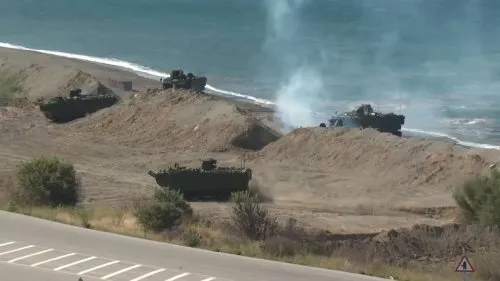
The EFES-2026 exercise featured a dynamic display of firepower and strategic maneuvering. Military helicopters, including heavy-lift Chinooks, were observed conducting troop insertions and supporting ground operations. Amphibious landings on the beach showcased the capability to project force from the sea, with soldiers and armored vehicles advancing under simulated fire. The detonation of mines on the beach and the precise targeting of fortified positions highlighted the comprehensive nature of the offensive and defensive strategies employed.
 The exercise also put on display advanced aerial defense systems, such as the "Steel Dome" system, along with sophisticated radar technologies, underscoring Turkey's efforts to bolster its air defense capabilities. The TCG Anadolu drone carrier vessel's presence demonstrated the integration of naval power with unmanned aerial systems, a key development in modern naval warfare. Fighter jets executed precision bombing runs, further emphasizing the air force's strike capabilities.
Amphibious Operations and Ground Assaults
A significant portion of the EFES-2026 exercise focused on complex amphibious operations. Soldiers were seen descending from military helicopters directly into the sea, preparing for coordinated beach assaults. Wide shots captured the intense action as troops utilized boats to reach the shore, engaging simulated enemy positions. The synchronized movements of tanks advancing on the beach, providing covering fire for infantry, illustrated the integrated approach to ground combat.
The precision with which targets were engaged, both on the beach and on elevated terrain, demonstrated the effectiveness of the combined arms approach. Massive flames rising from the beach and significant smoke plumes indicated the successful destruction of designated targets, reflecting the powerful ordnance employed during the drills. The exercise aimed to replicate the challenges of establishing a beachhead and expanding control in contested territory.
Aerial Demonstrations and Advanced Systems
The skies over the exercise area were alive with activity, showcasing the prowess of the Turkish Air Force. Military helicopters were not only involved in troop transport but also in direct fire support missions, engaging targets on hills with impressive accuracy. The Turkish Stars, the aerobatic team of the Turkish Air Force, along with the Hurjet advanced jet trainer, performed exhilarating aerial demonstrations, captivating the observers and highlighting the advanced training and skill of the pilots.
Beyond the kinetic aspects, the exercise also provided a glimpse into future military technologies. Various displays featured small unmanned ground vehicles, including a walking robot, demonstrating the increasing role of robotics and artificial intelligence in modern military operations. President Erdogan was observed closely examining these advanced systems, engaging with commanders and engineers, signaling Turkey's strategic investment in cutting-edge defense technology.
Distinguished Observers and Leadership Engagement
The presence of President Erdogan and other top government and military officials on the distinguished observers' day underscored the strategic importance of the EFES-2026 exercise. Their observation of the live-fire drills and demonstrations of new technologies provided direct insight into the current capabilities and future direction of the Turkish Armed Forces. The President's interaction with commanders, including allied forces commanders, highlighted the collaborative nature of defense initiatives and Turkey's role as a key NATO ally.
The ceremony concluded with a group photo of President Erdogan, commanders, and officials, symbolizing unity and commitment to national security. The overall impression was one of a highly professional, technologically advanced, and operationally capable military force, ready to meet contemporary security challenges. The exercise served as a potent reminder of Turkey's military strength and its ongoing modernization efforts.
Impact Analysis
The EFES-2026 exercise significantly reinforces Turkey's position as a major regional military power with advanced capabilities in combined arms warfare, amphibious operations, and air defense. The successful integration of new technologies, including drone carriers, advanced air defense systems, and robotic platforms, signals a strategic commitment to modernizing its armed forces and enhancing force projection capabilities. This demonstration of firepower and tactical proficiency not only bolsters domestic security confidence but also communicates a strong message of deterrence and readiness to international partners and potential adversaries alike. The exercise's emphasis on joint operations and interoperability with allied forces also highlights Turkey's ongoing commitment to NATO and its role in collective security arrangements.