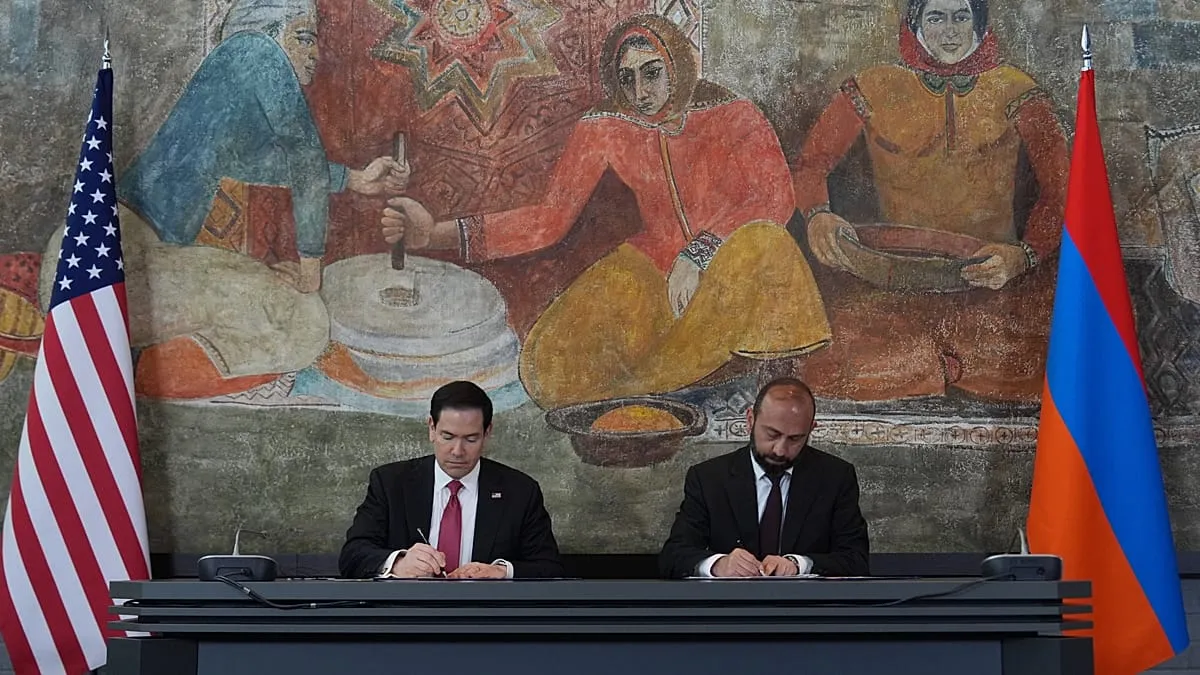
United States Secretary of State Marco Rubio's recent visit to Yerevan signaled a significant strengthening of bilateral relations, underscoring support for Prime Minister Nikol Pashinyan's pro-Western agenda. The visit, occurring amidst heightened geopolitical sensitivities and ahead of Armenia's upcoming elections, focused on deepening economic and strategic cooperation. Rubio's presence conveyed a clear message of U.S. backing for Armenia's independent trajectory and its pursuit of regional peace and prosperity.
The high-level engagement resulted in the signing of crucial agreements, most notably advancing the Trump Route for International Peace and Prosperity (TRIPP) economic corridor. This initiative, envisioned to connect Azerbaijan's Nakhchivan exclave with mainland Azerbaijan via Armenian territory, represents a pivotal step towards enhancing regional connectivity and economic integration. Furthermore, new accords were solidified to broaden the strategic partnership between the two nations and to collaborate on the critical minerals sector, a key area of focus for U.S. economic and technological security.
US and Armenia Deepen Strategic and Economic Ties
Advancing the TRIPP Economic Corridor Initiative
The cornerstone of Secretary Rubio's visit was the significant progress made on the TRIPP project, officially termed the Trump Route for International Peace and Prosperity. This ambitious corridor aims to establish a vital transportation link, integrating Armenia into a broader regional economic network. The agreement signed with Armenian Foreign Minister Ararat Mirzoyan is described as the most substantial advancement to date, signaling a tangible commitment to realizing this vision.
The TRIPP initiative builds upon the foundation laid by a historic peace agreement between Armenia and Azerbaijan, brokered previously. By fostering infrastructure development and economic interdependence, the corridor is expected to contribute to lasting peace and economic upliftment not only within Armenia but across the wider South Caucasus region. This project aligns with U.S. foreign policy objectives of promoting stability and economic growth in strategically important areas.
New Strategic Partnership and Critical Minerals Accord
Beyond the TRIPP corridor, the U.S. and Armenia cemented a renewed broad strategic partnership. This overarching agreement is designed to foster closer collaboration across various sectors, enhancing diplomatic, security, and economic ties. The U.S. has emphasized its commitment to supporting Armenia's sovereignty and its independent foreign policy choices.
A significant component of the renewed partnership involves cooperation on critical minerals. As global demand for resources essential to advanced technologies escalates, the U.S. seeks to diversify supply chains and reduce reliance on dominant players. Armenia's potential in this sector presents an opportunity for mutually beneficial cooperation, enabling economic development for Armenia while bolstering U.S. access to vital materials. Secretary Rubio highlighted that such economic engagement serves as a robust mechanism for binding nations together through shared prosperity.
Geopolitical Context and Armenian Foreign Policy Shift
Prime Minister Pashinyan's administration has notably steered Armenia towards a more pro-Western orientation, diverging from its traditional alignment with Russia. This shift has been marked by increased engagement with European institutions, including hosting the European Political Community summit. The U.S. visit and the agreements signed serve as a testament to this evolving geopolitical alignment.
The U.S. engagement comes at a critical juncture, with Armenia facing external pressures and narratives, including warnings from the Kremlin regarding the repercussions of its westward leanings. By reinforcing ties with the U.S., Armenia seeks to secure its sovereignty and economic future. The visit by Secretary Rubio, following that of Vice President JD Vance earlier in the year, underscores a sustained U.S. commitment to the region and its partnership with Armenia.
Impact Analysis
The agreements signed between the U.S. and Armenia, particularly the TRIPP corridor and the critical minerals cooperation, carry significant implications for regional economic integration and geopolitical dynamics. The TRIPP initiative, if fully realized, could reshape trade routes and foster unprecedented economic interdependence between Armenia, Azerbaijan, and potentially other regional players. This could serve as a powerful catalyst for sustained peace and stability in a historically volatile region.
Furthermore, the strategic partnership and focus on critical minerals signal a long-term commitment from the U.S. to Armenia's economic development and strategic autonomy. This could provide Armenia with valuable economic diversification opportunities and strengthen its position amidst complex regional relationships. For the U.S., it represents a strategic move to enhance its influence in the South Caucasus and secure access to essential resources, mitigating global supply chain vulnerabilities.