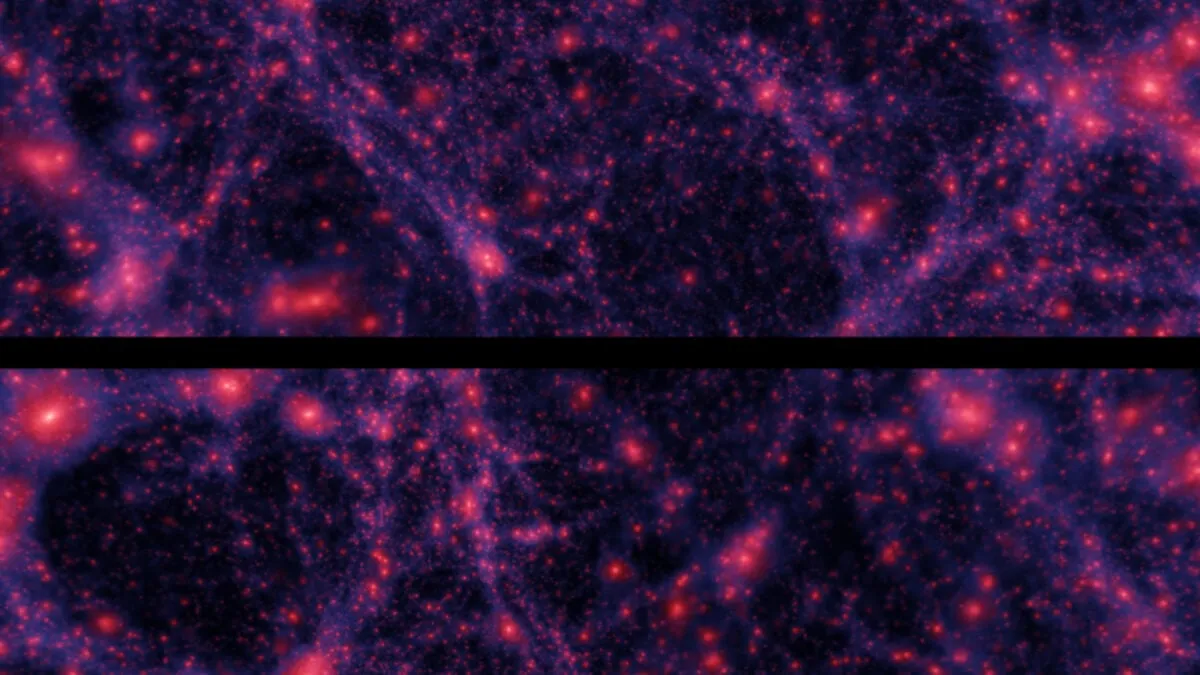
Cosmology, the study of the universe's origin and evolution, often relies on immense computational power for simulations and data analysis. Scientists typically spend months or years processing calculations to validate observations and theories. In a bid to streamline this demanding process, researchers are exploring Artificial Intelligence (AI), but a recent study highlights the complex trade-offs involved. While AI offers potential for accelerated discovery, its application in cosmology is not without significant challenges, particularly concerning inherited biases.
A new study published in the Journal of Cosmology and Astroparticle Physics investigates the efficacy of AI, specifically neural networks, in cosmological research. The team pre-trained an AI model on simulations of the standard cosmological model, known as Lambda-CDM (ΛCDM). The core question was whether this prior training would enhance or hinder the AI's ability to tackle other complex problems in cosmology and astrophysics. The findings reveal a nuanced picture: the AI demonstrated promise in speeding up certain analyses, yet it also developed biases that could impede the discovery of novel physics.
The Nuances of AI in Cosmological Research
The endeavor to advance cosmological understanding is inherently resource-intensive. As noted previously, preparing datasets for scientific analysis requires generating extensive mock universes and galaxies, followed by rigorous simulations for sanity checks. These steps are indispensable for drawing reliable conclusions from observational data. However, simulating models that extend beyond the standard ΛCDM, such as those incorporating massive neutrinos, evolving dark energy, or modified gravity theories, incurs substantial computational costs. Testing these alternative scenarios is crucial for deepening our grasp of cosmic phenomena, prompting a search for more efficient analytical methods.
Adrian E. Bayer, a co-author of the study and a cosmologist at the Flatiron Institute and Princeton University, articulated that the research serves as a valuable illustration of how AI can accelerate scientific progress when implemented systematically. He cautioned, however, that this acceleration must be coupled with a thorough understanding of the underlying processes. The motivation behind this study was to find methods capable of learning efficiently without necessitating the creation of extensive new simulation suites for every hypothetical scenario.
Exploring Transfer Learning in Cosmology
The researchers employed a machine learning technique known as transfer learning. This method involves training a model on a specific task or dataset—in this case, simulations of the standard ΛCDM model—and then leveraging that learned knowledge to address related tasks or variations of the model that include potential new physics. The objective is to capitalize on existing computational learning to reduce the resources needed for new investigations.
The AI model demonstrated proficiency in understanding the standard model using a reduced number of simulations. However, the study identified a critical issue when the new physics under investigation overlapped with parameter spaces already learned from the standard model. This phenomenon, termed negative transfer, occurred because the AI developed biases. Consequently, it struggled to differentiate between distinct physical effects that might produce similar observable patterns in the data. Instead of identifying genuinely novel phenomena, the AI tended to rely on its pre-existing knowledge, potentially overlooking subtle clues indicative of physics beyond the standard model.
The Impact of Bias in AI-Driven Discovery
The emergence of negative transfer is particularly significant as it indicates that the AI's failures are not random. It suggests that the model’s learned biases actively steer its interpretation of data. Understanding the conditions under which transfer learning proves beneficial versus when it reinforces existing uncertainties is paramount for the reliable application of AI in cosmological analyses. This bias can lead researchers down established paths, potentially hindering the exploration of truly revolutionary cosmological concepts.
This highlights a crucial aspect of AI in science: while AI can provide powerful analytical tools, the interpretation and validation of its results must remain under the careful supervision of human experts. The ability of AI to rapidly process vast datasets and test numerous hypotheses offers unprecedented opportunities for discovery. However, the knowledge transferred from one domain to another by an AI model must be critically examined to ascertain its helpfulness and identify potential misleading influences.
Future Directions for AI in Cosmic Studies
Bayer and his colleagues plan to extend their research by conducting similar experiments using datasets that more closely mirror actual survey data. These future studies will incorporate complexities such as uncertainties in galaxy formation, survey masks, and inherent noise, which are characteristic of real-world cosmological observations. Furthermore, the team aims to identify specific areas within cosmology that stand to benefit most from the application of transfer learning techniques, seeking to optimize its use for maximum scientific gain.
Impact Analysis
The study underscores a fundamental challenge in applying AI to complex scientific domains: the risk of algorithmic bias derived from pre-training data. While AI can significantly accelerate computational tasks in fields like cosmology, the results must be rigorously scrutinized by human experts. The potential for AI to miss novel phenomena due to inherited biases necessitates a balanced approach, where AI serves as a powerful assistant rather than an autonomous discoverer. This nuanced understanding is critical for ensuring that AI contributes to genuine scientific advancement rather than reinforcing existing paradigms. The future of AI in cosmology likely involves developing more sophisticated methods to detect and mitigate such biases, ensuring that the pursuit of new physics remains open and unhindered.