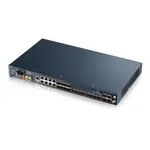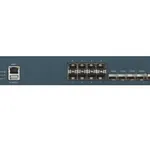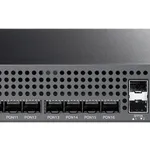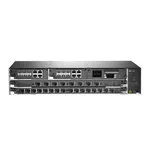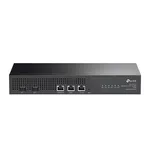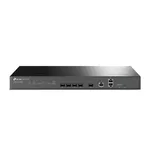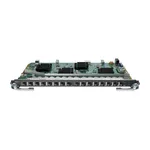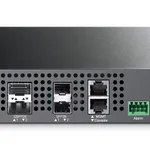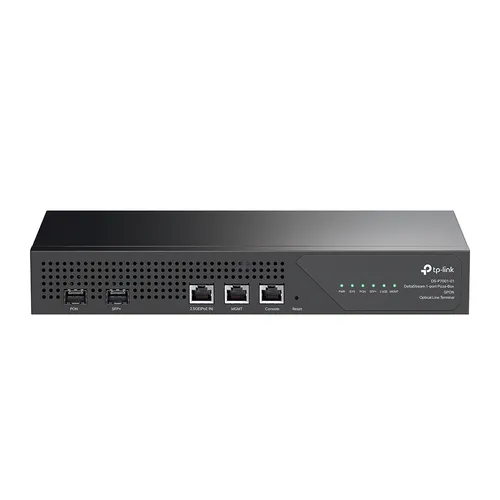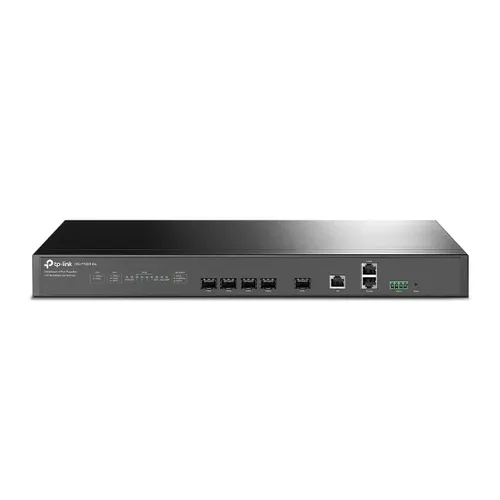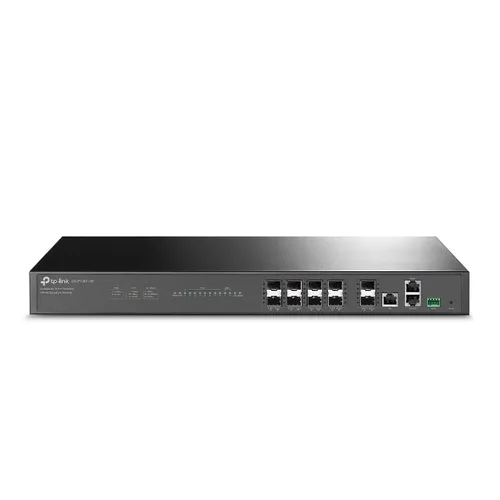


TP-Link DeltaStream 8-Port GPON OLT
Specifications
Features
Features
| Static route |
Yes
63% have it
|
|---|---|
| DHCP server |
Yes
92% have it
|
| DHCP relay |
Yes
84% have it
|
| IGMP snooping |
Yes
89% have it
|
| Multicast Listener Discovery (MLD) snooping |
Y
|
| Quality of Service (QoS) support |
Yes
79% have it
|
| GPON split ratio (max) |
1:128
|
| Maximum operating distance (GPON) |
20000
m
64% better than others
|
| Access Control List (ACL) |
Yes
75% have it
|
Ports & interfaces
Ports & interfaces
| Upstream ports |
Gigabit Ethernet
|
|---|---|
| Ethernet LAN (RJ-45) ports |
2
|
| GPON ports quantity |
8
|
| SFP/SFP+ slots quantity |
2
|
Power
Power
| AC input voltage |
100 - 240 V
|
|---|---|
| AC input frequency |
50 - 60 Hz
|
| DC voltage range |
38.4 - 72 V
|
| Power consumption (max) |
70
W
55% better than others
|
Operational conditions
Operational conditions
| Operating temperature (T-T) |
0 - 50 °C
|
|---|---|
| Storage temperature (T-T) |
-40 - 70 °C
|
| Operating relative humidity (H-H) |
10 - 90%
|
| Storage relative humidity (H-H) |
5 - 90%
|
Weight & dimensions
Weight & dimensions
| Width |
440
mm
78% better than others
|
|---|---|
| Depth |
260
mm
49% better than others
|
| Height |
44
mm
55% better than others
|
Disclaimer: Information on this page may need review. If you notice any discrepancies, please report them

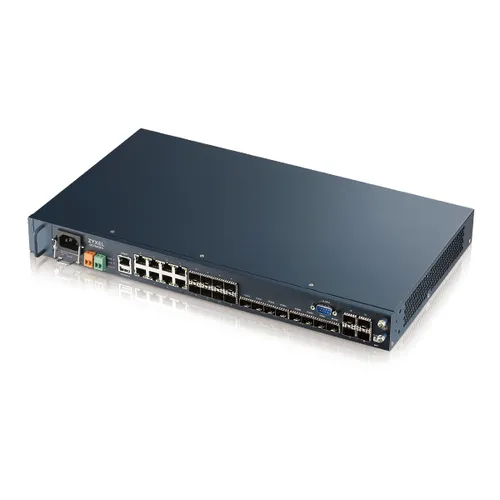
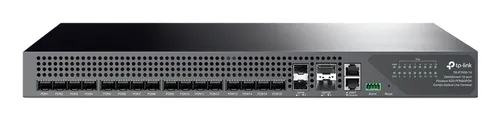
The TP-Link DeltaStream 8-Port GPON OLT is a purpose-built optical line terminal designed for high-density fiber-to-the-home (FTTH) deployments. Its compact, pizza-box form factor makes it suitable for space-constrained environments such as enterprise closets or distributed points of presence, reducing the need for larger, rack-mounted chassis in smaller-scale operations. This unit provides 8 GPON ports, enabling it to serve up to 1024 ONUs (Optical Network Units) assuming an 1:128 split ratio, which is a standard for many FTTx architectures.
Key to its value proposition is the integration of Layer 2 switching capabilities, allowing for efficient traffic management and forwarding within the network. The device supports standard GPON encapsulation methods and adheres to ITU-T G.984 standards, ensuring interoperability with a wide range of ONUs from various manufacturers. The inclusion of uplink ports, typically SFP-based for flexibility and higher bandwidth, facilitates seamless integration into the broader network infrastructure. Its design emphasizes reliability and manageability, crucial for service providers aiming to deliver stable and scalable broadband services. The DeltaStream aims to strike a balance between performance, port density, and cost-effectiveness for medium-sized deployments or as a modular addition to larger networks.
Pros & Cons
Pros
What we love about this product
- High Port Density: Features 8 GPON ports, capable of supporting up to 1024 ONUs, ideal for scalable FTTH deployments.
- Compact Form Factor: The pizza-box design is space-efficient, suitable for limited installation environments.
- Standard Compliance: Adheres to ITU-T G.984 standards, ensuring broad interoperability with compliant ONUs.
- Integrated Layer 2 Switching: Provides essential switching functionalities for efficient data forwarding and network management.
Cons
Points to consider before buying
- Limited Uplink Options: Specific uplink port types (e.g., SFP+, 10GbE) are not detailed in the provided specifications, potentially limiting aggregation bandwidth.
- No Advanced Layer 3 Features: Primarily a Layer 2 device, lacking advanced routing capabilities that might be required in more complex network designs.