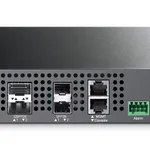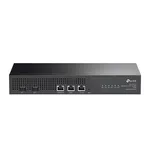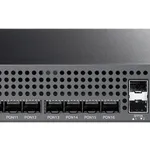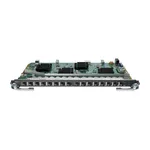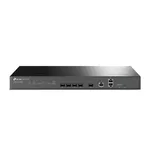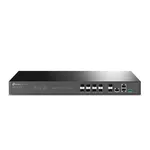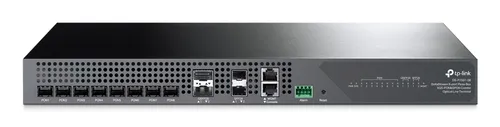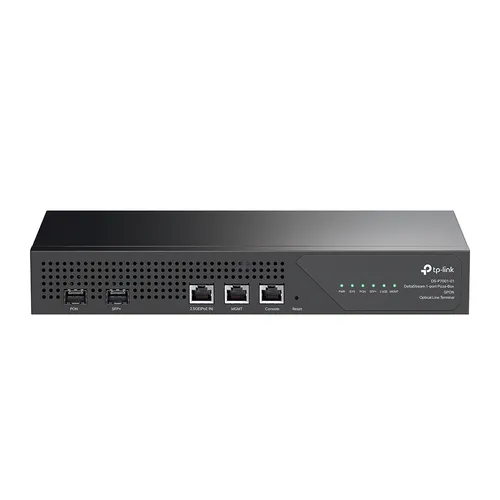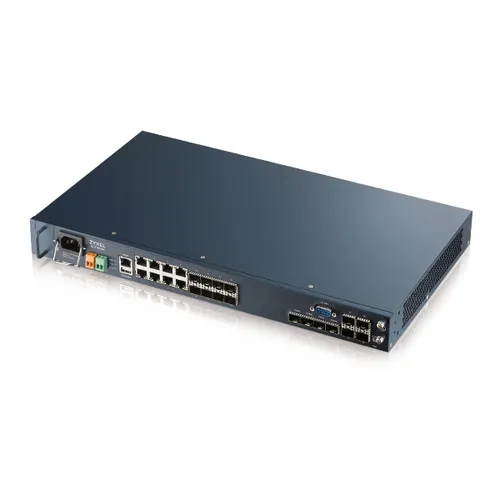


Zyxel OLT1404A Optical Line Terminal
Specifications
Features
Features
| DHCP relay |
Yes
70% have it
|
|---|---|
| Multicast support |
Yes
93% have it
|
| IGMP snooping |
Yes
90% have it
|
| Quality of Service (QoS) support |
Yes
69% have it
|
| Access Control List (ACL) |
Yes
94% have it
|
Ports & interfaces
Ports & interfaces
| Networking standards |
IEEE 802.1D, IEEE 802.1Q, IEEE 802.1ad, IEEE 802.1s, IEEE 802.1w
|
|---|---|
| 10G Ethernet ports quantity |
4
|
Power
Power
| AC input voltage |
100 - 240 V
|
|---|---|
| DC voltage range |
-36 - 70 V
|
Operational conditions
Operational conditions
| Operating temperature (T-T) |
-40 - 65 °C
|
|---|---|
| Storage temperature (T-T) |
-40 - 70 °C
|
| Operating relative humidity (H-H) |
10 - 95%
|
| Storage relative humidity (H-H) |
10 - 95%
|
Weight & dimensions
Weight & dimensions
| Width |
440
mm
27% better than others
|
|---|---|
| Depth |
250
mm
55% better than others
|
| Height |
44
mm
61% better than others
|
| Weight |
4
kg
90% better than others
|
Disclaimer: Information on this page may need review. If you notice any discrepancies, please report them

The Zyxel OLT1404A is an Optical Line Terminal (OLT) designed for deploying high-speed fiber-to-the-home (FTTH) networks. It serves as the central aggregation point in a passive optical network (PON), managing and distributing optical signals to multiple Optical Network Units (ONUs) or Optical Network Terminals (ONTs) at the subscriber end. This OLT is engineered to provide robust and scalable connectivity, crucial for modern telecommunication providers looking to deliver high-bandwidth services such as internet access, voice, and video.
This unit features a compact form factor and is designed for efficient power consumption, making it suitable for various deployment scenarios, including central offices and remote cabinet installations. Its architecture supports high port density and throughput, enabling service providers to expand their network capacity effectively. The OLT1404A integrates essential functionalities required for PON management, including Quality of Service (QoS) controls, traffic shaping, and robust security features to ensure reliable and secure network operations. The focus on operational efficiency and service delivery makes it a competitive option in the FTTx market.
Key Features and Performance
The Zyxel OLT1404A typically supports standard PON technologies, facilitating interoperability with a wide range of ONUs/ONTs. Its uplink ports provide high-speed connectivity to the core network, while its PON ports deliver the optical signal to end-users. The device is equipped with management interfaces that allow for comprehensive network monitoring, configuration, and troubleshooting. This includes support for standard management protocols, enabling seamless integration into existing network management systems (NMS). The emphasis on ease of deployment and management is a significant advantage for service providers aiming to reduce operational expenditures (OpEx) and accelerate service provisioning.
Market Positioning and Value Proposition
In the competitive landscape of FTTx infrastructure, the Zyxel OLT1404A positions itself as a cost-effective yet highly capable solution for building and expanding PON networks. Its reliability, combined with Zyxel's established reputation in networking hardware, makes it an attractive choice for operators of all sizes. The OLT's ability to support advanced service features and its scalability for future network growth underscore its value proposition. For network planners and engineers, the OLT1404A represents a solid foundation for delivering next-generation broadband services with predictable performance and manageable costs.
Pros & Cons
Pros
What we love about this product
- High Port Density: Designed to manage multiple PON connections efficiently, supporting a significant number of subscriber endpoints.
- Scalable Network Architecture: Facilitates network expansion by aggregating traffic from numerous ONUs/ONTs.
- Robust Management Features: Includes essential controls for QoS, traffic shaping, and security, ensuring network reliability and performance.
- Interoperability Support: Built to comply with standard PON technologies, allowing integration with diverse ONU/ONT equipment.
- Operational Efficiency: Compact design and power efficiency contribute to reduced deployment costs and lower operational expenditures.
Cons
Points to consider before buying
- Limited Uplink Options (Potentially): Specific uplink port configurations might restrict direct integration with certain high-speed backbone architectures without additional aggregation layers.
- Requires Companion ONUs/ONTs: Functionality is dependent on compatible end-user devices, necessitating careful selection and management of the PON ecosystem.
- Feature Set Specificity: May lack advanced features found in higher-end OLTs, potentially limiting very complex or niche service offerings.